| Formation of the REME | After WW2 | Recent times | Tasks and training |
| Image gallery |
The Formation of REME
Rearmament and the mechanisation of the Army followed by the outbreak of the Second World War led to further considerable increases in the quantity and complexity of technical equipment. The consequent heavy repair load revealed the weakness of the existing organisation, while the shortage of qualified tradesmen in the Services soon dictated a need for a system which would use the available men more effectively.
In 1941, a Cabinet committee, under the chairmanship of Sir William Beveridge, was set up to investigate the use of manpower in the three services. As a result of one of its recommendations - that the repair services in the army should be rationalised - the Corps Royal Electrical and Mechanical Engineers came into being on the first of October 1942. The Corps had the rare, if not unique, distinction of being honoured with the designation "Royal" from the day of its formation.
Such a major re-organisation was too complex, however, to be carried out quickly and completely in the middle of a world war. It was decided therefore that the changeover should be undertaken in two phases;
In Phase I, which was implemented immediately, REME was formed on the existing framework of the RAOC (Engineering Branch), strengthened by the transfer of certain technical units and tradesmen from the RE and other engineering branches. At the same time a number of individual tradesmen were transferred into REME from other Corps. The new Corps was made responsible for repairing the technical equipment of all arms with certain major exceptions. REME did not yet undertake:
>Those repairs which were carried out by unit tradesmen who were driver/mechanics or fitters in regiments and belonged to the unit rather than being attached to it.
>Repairs of RE specialist equipment, which remained the responsibility of the RE.
In Phase II, which was postponed until conditions were more suitable for a further major change, it was agreed that REME should take over all unit repairs and, in the case of the RASC, field repair as well.
Almost at once the new organisation was tried out and proved successful at the Battle of Alamein, the first major operation after the Corps was formed. The re-organised recovery and repair system was thoroughly tested during the remainder of the war, during which REME grew to be the largest technical corps, extending its activities to include the manufacture of spare parts and special equipments on a large scale. In addition to its uniformed tradesmen the Corps employed thousands of civilian tradesmen of many different nationalities in its static workshops throughout the world.
REME reached its maximum strength in May 1945, approximately 8000 officers and 152,000 other ranks. The Indian EME, East and West African EME Royal Canadian, Australian, New Zealand EME, and South African Technical Service Corps (TSC) totalled another 185,000. Some 130,000 civilians were employed in EME Services in all parts of the world.
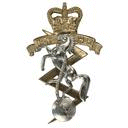
Along with the regiment geing formed a cap badge was created for the soldiers to put on their blue berets :-
|