 Solutions to Reducing
Maritime Piracy
Solutions to Reducing
According to The 1999 Worldwide Maritime Piracy Report, it is necessary
to suppress piracy and violent marine crime through anti-piracy and counter-piracy
operations: “Anti-piracy training and operational security awareness is
mandatory for vessel owners and vessel crew if they truly desire to rid
themselves of their current “perfect victim” stature. Crisis Management
and anti-piracy programs must be established and followed in order to reduce
the vulnerability of the vessel."1
To curb piracy, authorities say the international community must first understand how serious a problem it has become. "John Martin, Manager of the Regional Piracy Centre and a premier authority on piracy, said: "By continuing to develop close cooperation with local law enforcement agencies and giving them intelligence of better and better quality, they'll be able to move aggressively and make arrests. Better policing is the key."2
Martin's message appears to be receiving a positive response from the industry. "More and more indemnity clubs (self-insurance pools to which most responsible shippers subscribe as an insurance of last resort) are helping to provide operating support for RPC's effort. "In the meantime," he says, "hard intelligence about any instance of piracy, no matter how minor, is the best weapon in the fight to make safer the dangerous waters of the modern world." "3

There are numerous ways of solving the problem of maritime piracy and related crimes, or at least decreasing the number of such attacks and their intensity:
Crew Security Awareness and Detection Training
"A Standard Operating Procedure (SOP) supported by the proactive involvement of the crew to DETECT and DETER attackers will dramatically increase the operational security of any vessel. The adversaries rely on three heavy fundamentals when attacking a vessel--Surprise, Speed, and Violence (or implied violence). When you take away the element of surprise, the adversary loses their biggest advantage. The vulnerability of any target is decreased when an active , rather than a passive, security solution is in effect.. This solution must be active and it must be DETECT to be effective. The ability to DETECT and DETER should also be coupled with the ability to RESPOND."4
"An analysis of incident reports over the last five years shows that over 85% of all successful boardings were carried out with the attackers maintaining the element of surprise . . . Crew Security Awareness and Detection Training is an inherent part of the anti-piracy plan, but the RESPONSE is normally a function of a government agency."5 However, in order to decrease the number of piratical attacks and to increase the chances of catching the perpetrators, vessel crews need to be trained to defend themselves, and their vessel, even if this means carrying arms on board in the case of an attack. It is important to keep in mind, however, that:
"the moment a ship decides to offer an armed response, it enters into the realm as a combatant, even if only for self-defense . . . This is not to say that an armed crew doesn't offer a powerful deterrent to an attacker, but this is not a cure all and it will only serve to act as a "band-aid" to the problem."6
Special Security Units: Increased
Port Patrols
Another way of decreasing maritime crime is through special security units. Such units have already been set up in Brazil, India and Thailand to protect vessels and their crews when they are in ports. "To cover the expenses of increased patrol of its seaports Brazilian Congress has approved an anti-piracy inspection fee. Vessels are charged for inspections each time they are made by the Port authorities. This last measure has proved to be highly unpopular by Ship owners and other organizations like the Baltic and International Maritime Council (BIMCO), Centro Nacional de Navegacao Transatlantic and the Brazilian Exporters Association."7
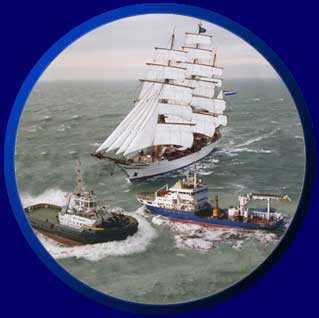
Special Security Units: Increased Port Patrols
Another example is the decision by IMO to send missions of experts to those countries where acts of piracy and armed robbery have most frequently been reported in order to further discuss the implementation in those countries of the IMO Guidelines for Preventing and Suppressing Piracy and Armed Robbery against Ships. The missions are to be followed up by regional seminars intended to assist Governments and officials in the countries concerned in enhancing their capability for preventing and suppressing such unlawful acts in their waters.
"In August of 1998 the IMB announced that it had plans to set up a Rapid Response Investigation Service to secure prompt counter measures when merchant shipping comes under pirate attack. The two main tasks of this service would be:
1. Providing governments with prompt information about attacks so that
they can take action against pirates without unduly delaying voyages
2. To provide counseling for crew members who have been victims of
pirate attacks."8
Anti-Piracy Tracking Devices
"In the February 1999 edition of the online publication Business World of the ICC a new inexpensive anti-piracy tracking device was announced. This system requires only a (hidden) personal computer and internet access on board a vessel. With the SHIPLOC system it can be tracked anywhere using a satellite to track the signal of the transmitter. By using a backup power-system it will keep emitting a signal even when the general power-supply on board is cut. The cost of the system is approximately 150 US dollars per year. The system is expected to be operational later this year."9
~
In conclusion, regardless of the response options available to a vessel's master, playing victim should be the final option, not the primary option. "The first priority should go to spending funds on crew anti-piracy training and for the addition of new technology in the area of detection and deterrence countermeasures."10
Home Introduction Piracy Statistics The 3 Types of Piracy The Problem of Under-Reporting
Legal Aspects & Current Legislation Piracy HotSpots Country Reactions How to Reduce Piracy
Number of Visitors to this page, since May 3, 2000
Page
Created by Cleopatra Delegas: [email protected]