 |
 |
 |
| I'm Thinking about how important silence is as it relates to our perception of music- how all music is simply the manipulation of the pervasive silence that radiates into the eternity of space- about how potent is the human power to use the Great Silence as a canvas to create something alive that dies immediately upon its' birth, for as instantly as music is created it is gone. Part of its nature is pure transience. It's not really there on that CD. You see- it can only really live inside of people as part of what makes us all human. So next time you see a guy on a streetcorner whanging away at a guitar, drop a buck in his case if you can cause what he's doing is real. If he's playing an oboe, drop two- he deserves it. |
| Advanced technology brings changes even to the resistant B*zone. Sometimes these changes can sting the heart of the fiesta yet go seemingly unnoticed, ignored, or percieved as only touch of heartburn.
Back when the Taino were running the show this area was certainly not considered a place of recreation or a resort as it is today- I could be dead wrong. They may have been dancing every weekend in the pre-streets but I'm guessing here. The Ships came and Port Royal, as it was known then, was a major port, a place of commerce, and a haven of pirates. The fishermen played an important role here and eventually Boqueron fell into disuse by the maritime trade, the pirates were hanged, and it came into it's own as a favorite of fisherfolk. For a long time, because of the remote location, the zone was a fishing town trading along the coasts and in the nearby regional capitals of Mayaguez, San German and Cabo Rojo. The beginings of the transformation of Boqueron into a resort probably began shortly after the US took the island as spoils of war and sugar production became the central purpose of the island. A railroad was built to transport the cane to refineries and a station was built here just a couple blocks from the mangrove forest in the center of the village. So there was a way to get here and each weekend the train pulled some passenger cars filled with San Juaneros who departed the capital early on Friday mornings and arrived in the afternoon ready for something different. Dance-halls were built here and a big pavillion on the waterfront for the weekend tourist traffic. Hotels and saloons and cathouses, cockfights and rum shacks and mofongo eateries and what-all got in gear- La Fiesta. Included in this scheduled revelry there were no doubt musicians, quite a few, if you want to dance you need a song. |
| OK- let's get modern and lucky and look at what we've got now from the perspective of a working musician in party-town, finding myself working less as technology makes it so very much easier for venues formerly dependent on presentation of live music to dispence with the pesky problems associated with having to deal with live musicians. Operators of former music rooms converted to giant jukeboxes dont have much to say except 'Hey, we've got CD's- come back at Navidad.' What's going on here is mostly that people dont much care what pummels their ears anymore. When Edison inadvertantly invented the recording industry, he got the ball rolling. From there we can fast foward to last year when producers of Broadway musicals in New York came up with a great cost-effective idea to install push button music in some musicals and began rehearsals without bothering with musicians in attendance- instead employing audio technicians with headphones instead of horns- O the superb cheapness of it- two techs and their boxes of electronica instead of that uncontrolable trombone section. It's not difficult to see the effect technology has had on the proliferation and accessibility of live music to people who'd just like to hear some music being played. Currently in New York, symphonic players on their downtime have taken to visiting area schools many of which have long abandoned any music curricula, in order to demonstrate to children exactly what an oboe is and what incredible things it can do in the hands of a skilled player. If, in a great center of world cultural activity this has become neccesary- imagine where we're at here in the backwater of Boqueron. |
| The island has a long tradition of music that is uniquely Boricua- that belongs to Puerto Rico. And it's still possible to sit someplace with a cool drink on a shaded patio and listen to it- but you are going to need to search it out because what remains of this once everyday commonplace activity of making music has fled like the Taino from the Conquistadors into the mountains. At the present time, even here where folks just love to dance, there are 31 municipalities with varying laws on the books that forbid any musical program to be performed in public areas without prior permission from someone who works in an office in the local mayors' employ. Thumping car stereos, boomboxes, and trucks covered with giant speakers seem to be exempt- it's the guy with the oboe who's the outlaw.
Technology advances, the world becomes more modern & lucky, while primal elements that define our humanity like the ability to make music and the capacity to enjoy it are driven further from the mainstream until they exsist unfettered only up in the woods and down in the swamps. It gets harder all the time to find a place where people are actually playing- and not stacks of machinery making believe. Before our new M&L times if you had the desire to wash yourself in music you had to get dressed and go out to someplace where there were people playing musical instruments featuring such state-of-the-art technology as vibrating strings. Musical evenings were social events attended by all including the kids that joined people in an atmosphere that could not be rendered by any other means. Once the concert or dance was through and you went home satiated by a sonic banquet- the music having stopped sounding in your ears was still kicking around inside your head where it took up residence as musical memory; a rarity in these new times when remembering is easier to burn onto a disc than it is to remember and memory is something you buy at the store. |
| I'm thinking that as technology has brought sonic enhancement to almost every public experience encountered in daily life, that we are becoming incapable of discernment and sensitivity. A general sense of the loss of aural awareness is evident as peoples' abilility to discriminate, to listen actively diminishes. Hidden speakers broadcast in the coin laundry, the coffee shop, the supermarket, the post office and the public crapper- everywhere. To discover anything musical in what people are constatntly hearing becomes near impossible as these sounds form an incessant background noise the mind pushes aside actively ignoring.
The technology has made it possible for me to hear sounds produced by masterful players that vibrated the air around them long before I was born. It has produced a catalog of modern musical history that is of tremendous value but the technology cannot produce music- it is only capable of reproducing sound. Music is produced by various methods but is dependant on one essental element that cannot be replaced by diodes and silica chips- and that lives somewhere in the center of the musician. |
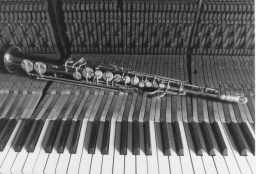
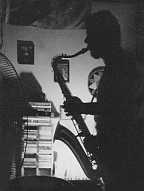
| The oboe guy has his work cut out. The object of his endeavor is to vibrate the space around him by exciting the air enough to form patterns of invisible waves. He gets going by the comingling of his own breath through a pair of matched slivers of hand fashioned cane with enough finesse and articulate care to cause them to set in motion a column of air within the oblate bore of an ebony tube of arcane shape and certain perfect proportion. If he does everything right so far he's got himself a musical tone that he listens to and sculpts with practiced expertise in accordance to exactly what his senses and sentiment tell him is the nuance and timbre and color that he needs in order to perform the next action in the complex sequence that results in music. He hasn't moved a finger yet- he's only a tenth of a second into the tune so far. The instant he changes the frequency of the first tone by changing the length of the interior column of vibrating air, the original is gone forever except as it relates to what follows in his own perceptiom and that of any lucky listeners who might have heard. As music is rendered so it dies- living only in the mind of the witness. His third tone reminds and reinforces the memory of what preceeded. The sequence continues. Music is happening. |
| Lawyers and accountants have families and need to pay the mortgage and eat like everybody else. And lawyers and accountants have done a good job of creating a music industry that has about as much to do with music as cruise ships have to do with fishing.
You might think right off that fishing and cruise ships both need some water to be successful- but no. To go fishing water is vital but there's no reason if the right lawyers and accountants get their heads together they wont come up with a profitable plan to take a great luxury cruise ship and drop it into the heart of the Arizona desert where there's no water for 500 miles. You might ask, Who in the world would pay good money for such a phony cruise? But lawyers and accountants like the ones running the music industry are not stupid and they know that it's only a matter of convincing folks that a cruise ship needn't go anywhere to be one hell of a good time. There are so many advantages to not slopping an expensive ship around in the dangerous ocean it's not funny. And with all those open buffets and the casinos and the complimentary booze and even live music in the lounges and on the promenade deck where a cruiser can see if his car is OK in the vast parking lot- Why pay for all that expensive fuel and docking fees and sailors anyway. Who the hell needs sailors? This will work- write up the contracts. But fishing requires a few things you wont find on a cruise ship to nowhere. You'll need a riverbank or a dock to sit on, preferably with a tree for some shade around and you'll need a cane pole and some string and bait and hooks and little lead weights. And to be sucessful at it you must develop a few skills like tying knots and reading the water and trying to think like the fish you're trying to catch. The more you practice at fishing the better you get at it. Fishing requires some developement of the virtue of patience as well, for the fish aren't just going to jump up on the bank because you want to eat one. You'll have to wait. And while you're waiting and thinking about fishing you can lean up against the tree and read a book or play a tune on your oboe. The lawyers and accountants would have us believe that what they market and distribute and endlessly promote is the best availiable example of what music really is in our modern and lucky world. They have about convinced us that a stack of CD's is as close as we need get to music appreciation and that what is emitted from the stereo speakers is equivalent or better than proximity to a person who has developed the power to fill the space between the great silence with life of his own creation in the form of music. |
 |
 |
| Where goest the Oboist? |
| Modern & Lucky |
| La Musica |
| Sonic Enhancement |
| What's the Oboe Guy doing? |
| BooBBa Boo+++ BooBBa Gee+++ BooBBa Gaa+++ Boobba BBBBusiness |
| The Silence |
|
|