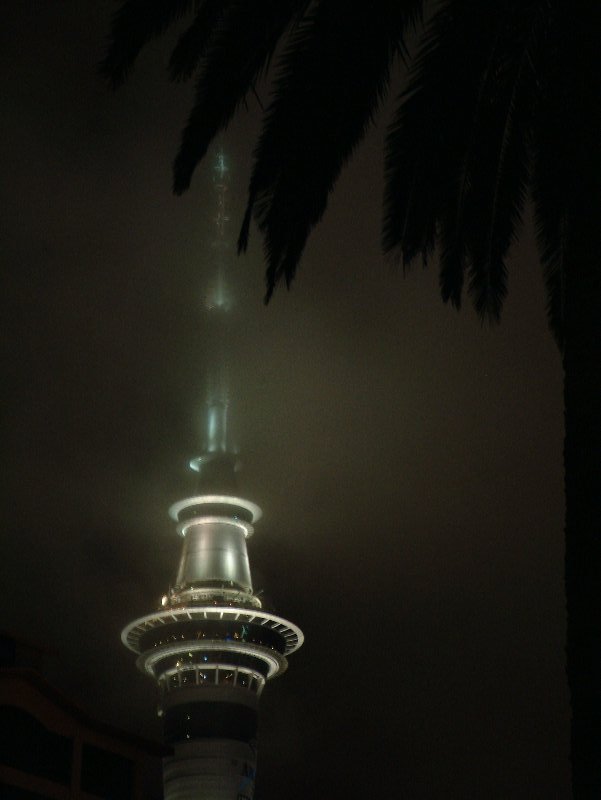
The Auckland Sky Needle has an uncanny resemblence to a giant syringe. (only top of it shown here)
[NB this page best viewed in full screen mode: Press F11 and use up and down keys to view. F11 again will return you to normal screen mode.] If any photos do not appear then try right-clicking on the gap and selecting "Show Picture"
Glad to be finally out of miserable sodden Tahiti we landed in...
... miserable sodden Auckland. Yes, merely by travelling 2,500 miles, crossing the date line and changing countries we were not going to get rid of the rain as easily as that.
Auckland is as close as one gets to a major city in New Zealand and certainly tries hard to impress. We later discovered that almost the entire rest of the nation are highly disparaging about Auckland and the Aucklanders. It is definitely true that the place has a different feeling to the rest of the country, although we were never able to see the place properly owing to driving rain and wind.
The Auckland Sky Needle has an uncanny resemblence to a giant syringe. (only top of it shown here)
The America's Cup was on at that time and there is an entire "village" devoted to the event down by the waterfront. The yachts are certainly impressive when viewed close up, and their masts and sail areas are quite staggeringly large. We wanted to watch some racing but there wasn't any on at the time. Pleasingly, the Kiwis seem to be pretty good at sailing and had despatched the far larger budgets of the Americans in the previous events although this time around there were several American boats looking strong. Needless to say, the mighty "GBR Challenge" was proving to be singularly unchallenging and had already been knocked out.
We had hired a car for the duration of our stay and so had ample opportunity to take whatever route suited us to travel around. Leaving Auckland to drive to Rotorua, we thought we'd take a detour around the "scenic drive" to the west of Auckland. [Later, Kiwis that we met always queried whether there was anything scenic around Auckland when we told them this!]
My own opinion is that the drive was spectacularly unscenic, but it is possible that this is a result of the pounding rain and visibility of about 100m, so maybe I am being a little unfair. Still, the road was enjoyably twisty and New Zealand have an excellent sign system that gives you not only a (very conservative) speed guide but also a diagram of the exact shape of the bend. Very reminiscent of Colin McRae Rally on the computer. Our cheapo Nissan Pulsar that we had hired was small and comically underpowered but in the words of Jon Glass "it corners surprisingly well for a hunk of shite" so we were able to brighten up the drive ourselves ;-)
I think the drive to Rotorua might well have been scenic as well but the rain in New Zealand does not do things by halves so I'll never know. As well as rain, another thing New Zealand is very good at is thrill-sports and to open our account we went luging. This involves piloting a 3-wheeled tray with handlebars that control steering and which can be pulled back for rudimentary braking, down a sloping track. When it is wet this involves piloting a 3-wheeled tray with handlebars that don't control steering and which can be pulled back to effect a powerslide.
As we set off for run number one on the "intermediate" track, I was soon mentally cursing the impending bruise on my left buttock from an unscheduled coming together with the outside of the first bend. However, I was immediately cheered up by a much larger crash and curse coming from behind me as Jon piled into the same crash barrier with somewhat more momentum. Practice makes perfect, they say, and by run 3 we could get down the course in a reasonably controlled manner. Alas, both Jon and I are not perhaps the most uncompetitive of people so control quickly became a poor second to speed in our driving priorities. The advanced course appeared to be shut but Kiwis are a friendly bunch and after a brief conference they decided we could take our chances on the faster course for our final two runs.This course contained a viciously cambered chicane partway down and just prior to the steepest part. By the finish of our two runs each an honourable 2-2 draw had been achieved. The corner scored first with an offline Ingram exiting the corner down the fast downhill bit pointing backwards while the following Glass restored parity (if not a straight face) with a cautious approach. My equally cautious and boringly correct line in the final run took us to a 2-1 lead but the chicane had a spectacular revenge as Glass was spat out of the corner sliding down the wet concrete at high speed on his arse! It transpired that while Jon had successfully got the luge pointing in the correct direction for the corner, he had failed to achieve similar results with the actual direction of travel and a large sideways impact with the inside of the chicane resulted in the luge and Jon going their separate ways and some amusing tear marks in the seat of his jeans.
Whilst this meant that the luge had proved rather expensive for Jon, the rain had manged to permeate a supposedly waterproof pocket and a small amount had got onto my camera. I did my best to save it by removing the battery and letting it dry before trying to coax it back to life. Pleasingly, all the functions except one came back to life. Unpleasingly, the "one" turned out to be the "taking a picture" function so I was left with a rather expensive picture-reviewing device. As a result, many of the pictures on this leg of the trip were taken by Jon so credit/abuse to him please. Sony were of minimal help to someone moving around and so it was not until 4 weeks later in Sydney that a dodgy repair man (no cheques or credit cards and contactable only by mobile!) was able to fix it.
At the time I was not hopeful for any success and so I have to confess to a sudden rise in "carelessness" as the camera was "accidentally" left in full view on the dashboard of the car, or next to the window of the hostel etc. Alas, in addition to being helpful, the Kiwis are an honest bunch and no "success" resulted. Indeed, New Zealand is a wonderfully innocent country and it is typical to see cars parked unlocked and house back doors left open on a reasonably frequent basis.
[NB I have now actually read my insurance document and believe accidental damage is included anyway so it is probably just as well that our evil plans were thwarted.]
After the thrills and spills of luging we booked in to wind down in the afternoon with a little spot of white water rafting down the Kaituna river which includes the highest commercially rafted waterfall in the world. At 7m this is one pretty big waterfall and with the recent weather the water was likely to be flowing pretty healthily over it. Amazingly, when we got there the sun even came out for a brief foray to watch.
The first few rapids were negotiated harmlessly and then we came to the first significant waterfall - a baby at a mere 4m. I was now about to discover why our two guides cheerily referred to my position at the back of the boat as either the Ejector Seat or the Suicide Seat. The front of the boat went over the fall fine, but the boat bent in two in the middle in the process and as the boat flicked out straight again, I was flung back directly under the falling water. Now, water, being a liquid, may not look very solid but I can tell you that several thousand litres raining down from a height of 4m can give you a serious thump in the face. I also made the discovery that it is powerful enough to physically tear the buckle holding one's helmut on and thus remove the said helmut. Fortunately, my neck appeared to be made of stronger stuff, and it merely felt like someone had ripped my head off.
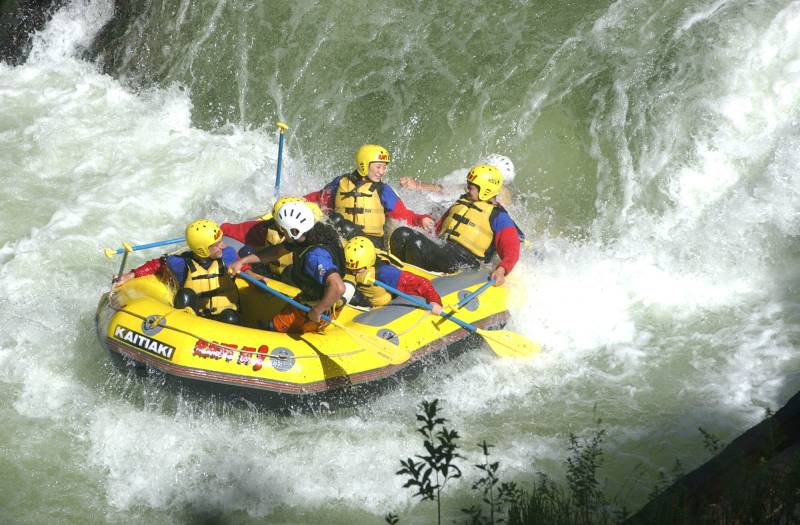
Believe it or not, I think I am on the far right of the boat as we look, next to the guy in the white helmut, but hidden under several tonnes of water
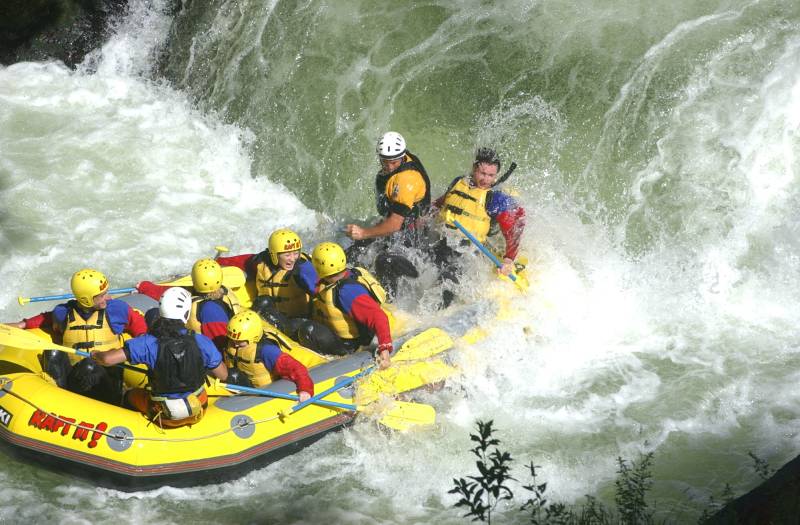
Re-emerging helmutless from the bastard waterfall. Compare this photo to the one above and see if you can work out where I am.
This was all far to much fun for one day and I "rested" my throbbing head with a few beers and an early night.
Amidst all that excitement, I have yet to mention that Rotorua is most famous for a variety of hot springs, bubbling mud pools, geysers and weirdly coloured volcanic pools. Unfortunately, all this natural entertainment comes at a price as the place smells worse than my brother's bedroom after a heavy curry session.
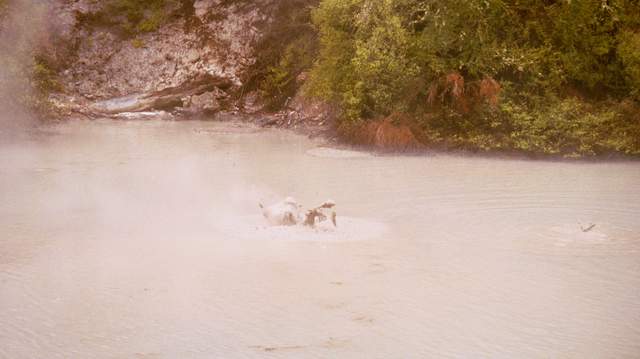
Gloop!
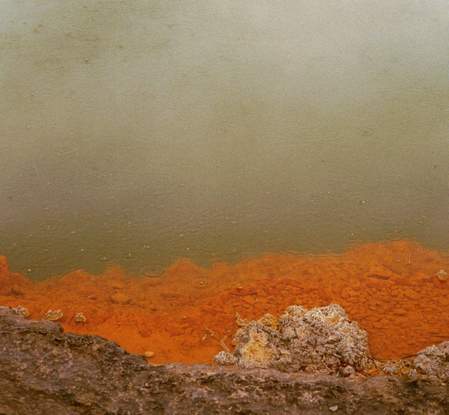
Champagne Pool. The colours are better in real life and on less humid days when the steam is not quite so omnipresent.
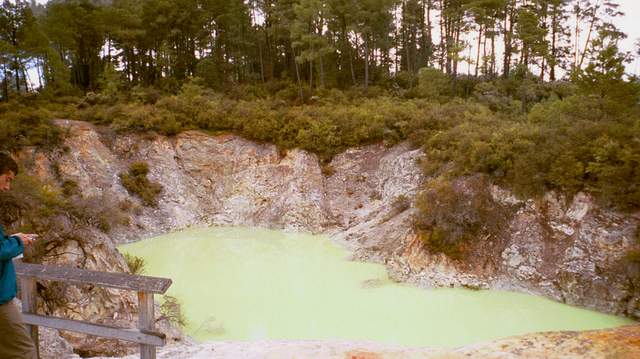
Hmm, am I at Sellafield?
We now drove on down to Taupo, which is an attractive little town next to the giant lake Taupo. On the way we passed a giant geothermal power station that extracts an impressive 180MW of power from the earth. The site is straight out of a Sci-fi movie with miles and miles of shiny pipes and clouds of steam emerging. Unfortunately for the local tourism industry the opening of this power station has "coincided" with a fall in the activity of the local geysers. Now there's a surprise.
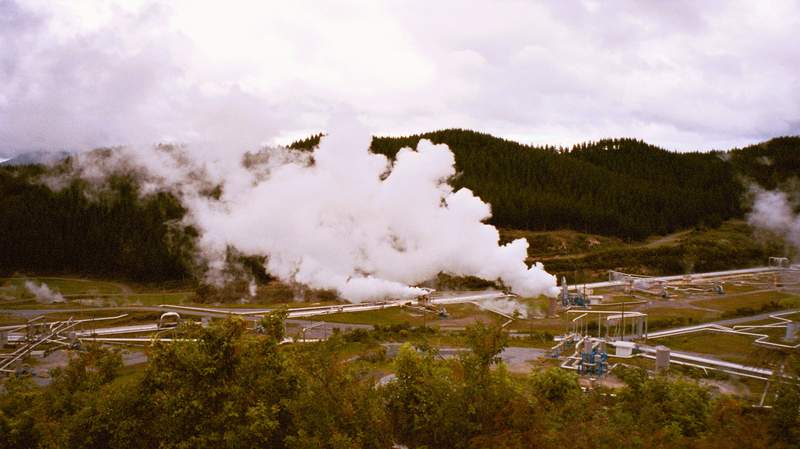
Photo for the engineers among you. Well, I thought it was impressive.
The setting of Taupo town next to the blue lake appears peaceful enough but one learns that lake Taupo was created a mere 2,000 years ago when a giant volcano exploded. The eruption was apparently 10 times the size of Mt St Helens and Krakatoa and the resulting change in world sky colour was noted as far away as the Roman Empire. Gulp!
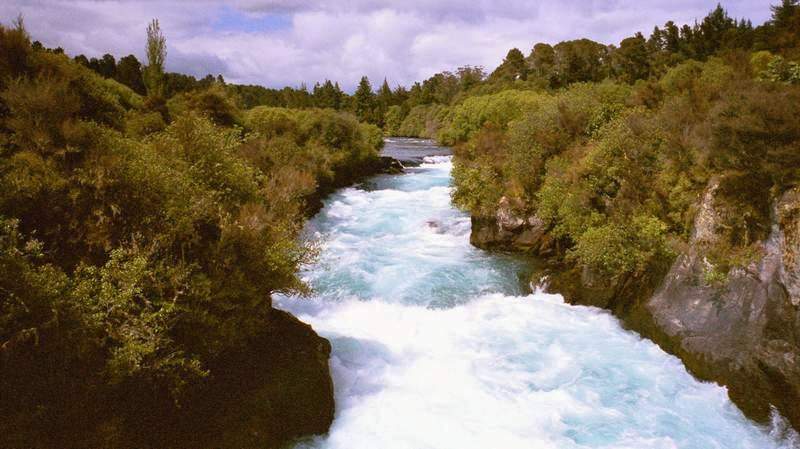
Lake Taupo drains out into the Waikato river through this splendid natural channel/waterfall
I had hoped to do a skydive in Taupo as they are the cheapest in the world there, but I don't need to tell you why they were not skydiving that day. Instead we settled for another scenic drive past the lake and down towards Tongariro national park. There is a hike across the volcanoes which is highly recommended by all but alas the crossing was closed owing to an unlikely (but apparently not that rare, especially when I'm around) summer fall of the damned white stuff. The walk would have been a bit crap anyway as it was all in the cloud but our road took us down the east side of the park which is in a rain shadow and is the closest thing you get to a desert in New Zealand. This enabled us to get some spectacular views of the three volcanoes.
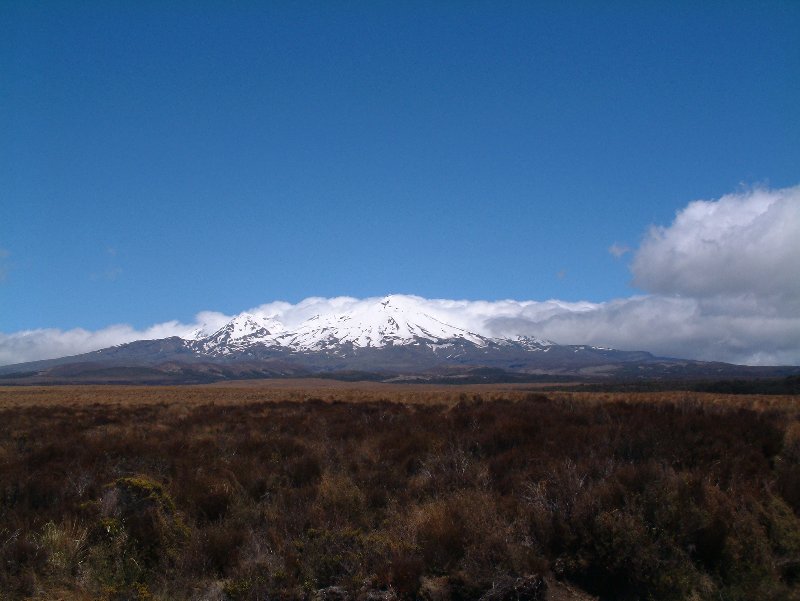
Mount Ruapehu. Tongariro itself is in the cloud to the right. Note the semi-desert vegetation. A rare sight in NZ!
We had to make it to Wellington that evening but we had a whole day to do it and so it was an excellent opportunity to re-practice the auto-tourism skills we had honed in California. After passing through the desert bit we took the 'slow road' over the central hills towards Napier.
This brought us into classic Anchor Butter advert land. Classic rolling bright green hills with English-style fields devoid of anything except lots of sheep. I have no first hand experience but this is how I imagine central Wales to be but devoid of people/villages. The road was twisty but sealed and we passed cars in the other direction approximately every half hour.
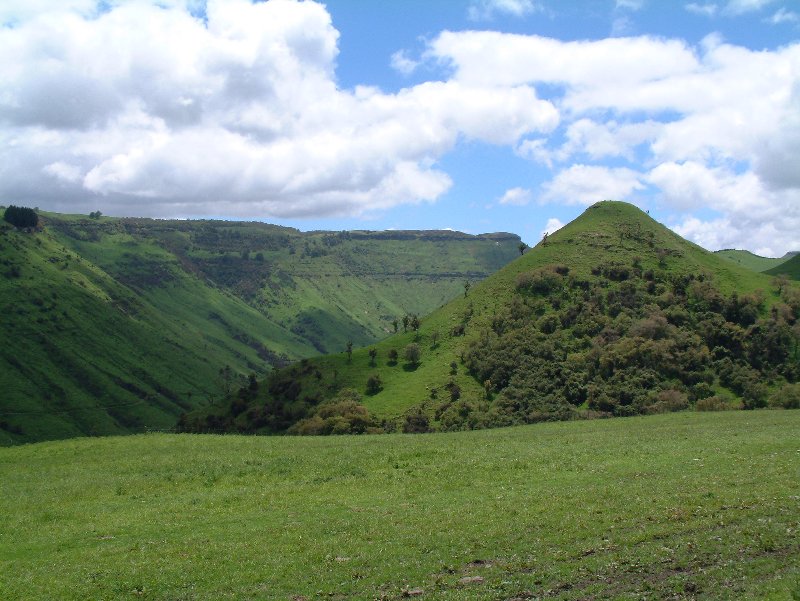
Jon has remarkably managed to find the only viewpoint from which there are no sheep. And where are Tinky Winky, Dipsy, La La and Po?
Coming down out of the hilly bit, the scenery changed abruptly yet again and became distinctly less English/Welsh and more European with pine forest and scrubland. The road also became distinctly less civilised with deep mud / dust depending on whether you were on high or low ground. However, we eventually came out on the east coast into winery country around Hawkes Bay.
The main city here is Napier which was largely rebuilt in the 1930's (after Napier Mark I was flattened in a massive earthquake) and has a strong Art Deco theme. It looks quite cool as a result although it almost seems artificial - even the McDonalds is in the style.
Jon pleasingly lost the coin-toss for next driving stint, so I was able to enjoy sampling a few of the wineries' produce. Very fine it was too and most reasonable. We left with several bottles
The last part of the day's drive down to Wellington was through the least populated part of New Zealand and it was fairly easy to see why, although we did go through a fairly cool canyon at one point.
Wellington city is (yet) another one in a splendid setting on a natural harbour. The central part of the city sits on the harbourfront, partly on reclaimed land and the suburbs rise up onto hills surrounding the harbour. This means that the suburbs are quiet, have excellent views and yet remain a 15 minute drive from the centre. The steepness of the hills also means the roads actually have to have bends in them - rare for cities in the New World.
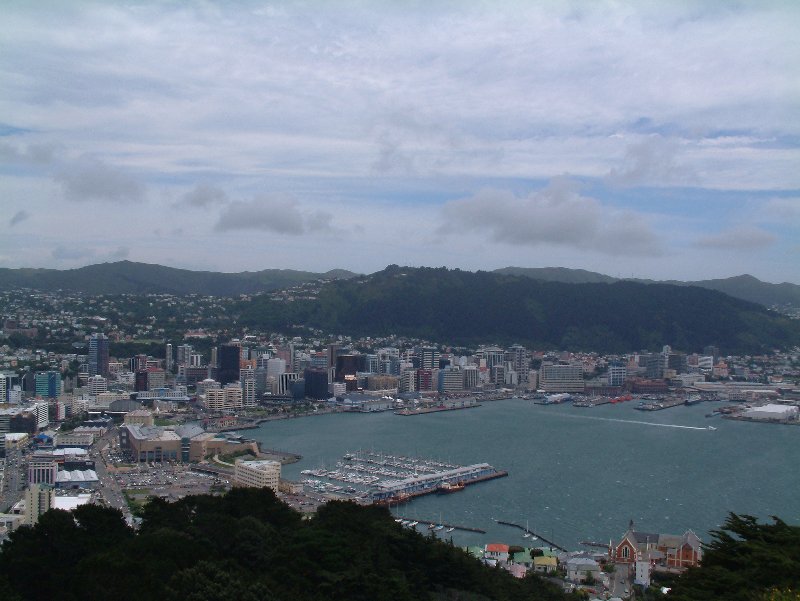
Wellington Harbour as viewed from Mount Victoria.
We did the Wellington sites over a day or two - the highlights being an excellent new museum, the bizarre beehive-shaped Parliament and a funicular railway down from the suburbs into town.
It was now time to take the ferry over to South Island, where we had been told all the good scenery was. This was pleasing as the scenery in North Island was not bad. In the previous evening and overnight it had been particularly windy (i.e gale force since a normal day in Wellington is what most people would still describe as windy) so we were looking forward to an exciting crossing. Alas, it had calmed down a bit when we went out so the only excitement came when through the front window we saw an enormous wave crash over the front of the boat and onto a group of people who had been stupid enough to venture out just before. South island immediately lives up to its reputation as the final hour of the journey is spent cruising down a beautiful Sound into the small town of Picton.
There being little to do in Picton we set forth towards Kaikoura on the east side of the island, a town famous for its whales, dolphins and seals. A mere mile or two off the coast the sea bed drops down to over a mile deep which attracts whales closer to the shore than they'd usually come (except in a river estuary - see Canada Tales!).
The thing everyone wants to do in Kaikoura is go swimming amongst the dolphins, but this was fully booked for weeks so we had to settle for a whale-watching trip. This didn't bother me too much as the (not inexpensive) dolphin thing sounded a bit like touchy-feely mumbo-jumbo to me. I certainly doubt that it would have been a "life-changing and spiritual" experience, but maybe I'm just a cold-hearted philistine.
The whale-watching trips are superbly organised, perhaps overly so, with the boat showing you lots of fancy graphics and videos as you search for the whales. The setting, once you're offshore is also fabulous, with the nearby mountains looking down over the bay. We also experienced our first complete day in the month of December when it didn't rain at some point (in our third different country) which made it even better.
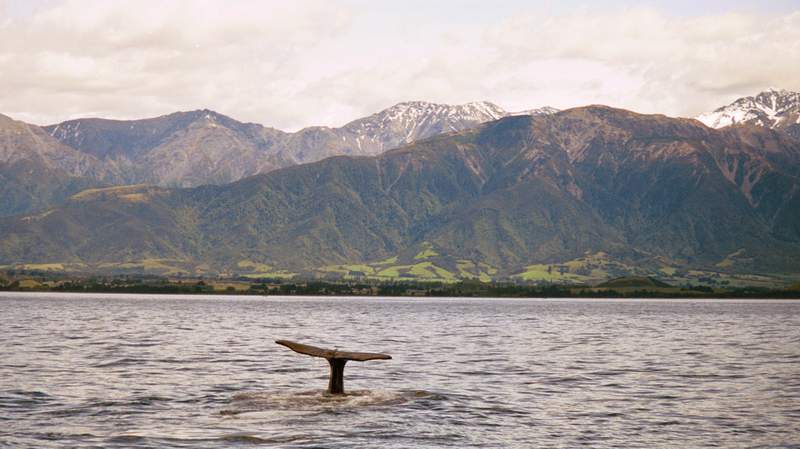
Tail of a sperm whale as it prepares to dive.
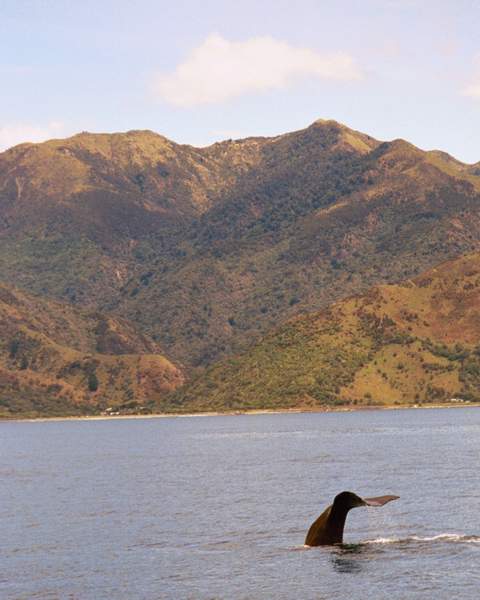
And another one.
Anxious to take advantage of the weather, we thought we'd get some hiking in in the afternoon. As ever, the only walk that appealed in the area had been described as "tiring: 8 hour round trip".
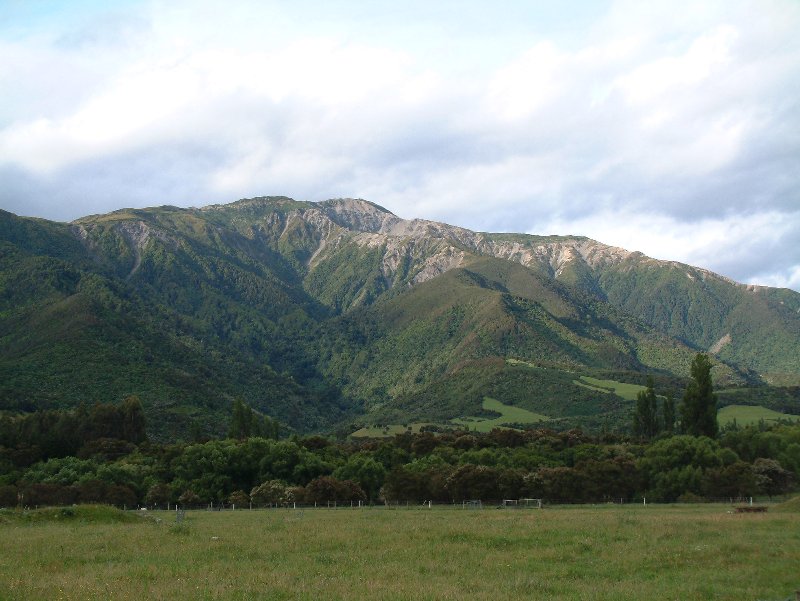
It's only 1,602m high, how can it take 8 hours?
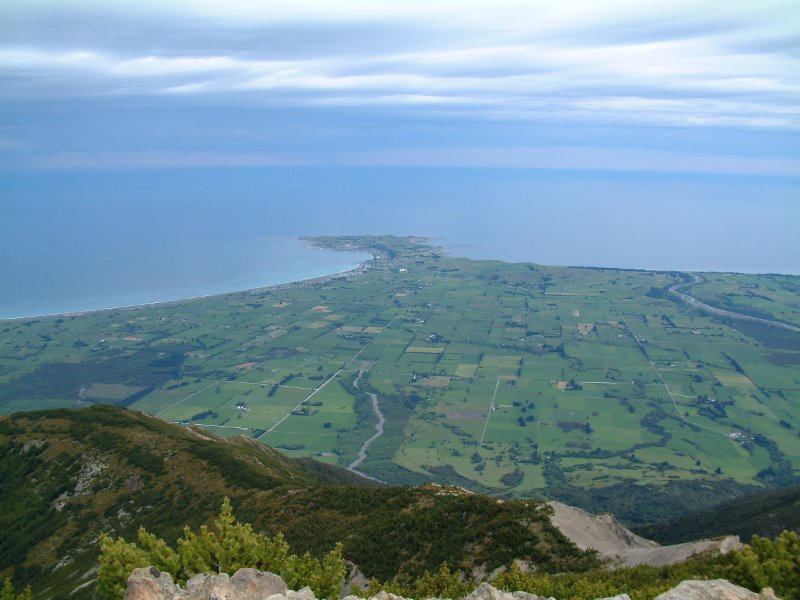
It was hard work but the view from the top was pretty cool. One can see north island 100 miles to the north and the Christchurch peninsular nearly 100 mile to the south!
Just when you may now be expecting me to recount some disaster, our confidence that the 8 hours would prove to be bollocks was actually correct. Pleasingly, we got up to the top in 2hr 10min and despite a 30 min pause at the top, a knee-punishing high-speed descent inspired purely out of pointless point-proving ensured that our round trip had taken just 4 hours. Annoyingly, almost all the guideline times for New Zealand's many tracks appear to be designed for Cambridge-tourist pace meaning that many totally possible trips initially appear too long but as the occasional estimate is accurate, one can never take much for granted.
Continue onto part II.
Back to main page.