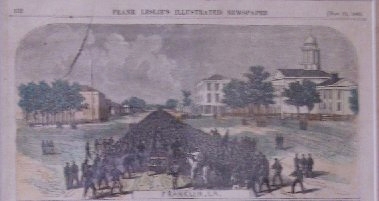
From a Federal Army Report. The Texas Cavalry they were chasing was General Green's, who brilliantly performed "rear guard" duties.
Irish Bend is not mentioned. I wonder why?
To the page from which this is copied. Here
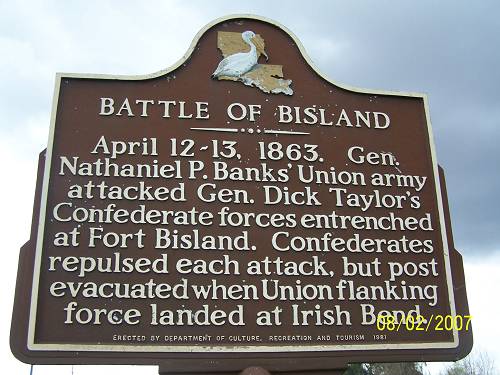
"On the 3d of April, General Paine's brigade left Baton Rouge to take part in the Teche Expedition, proceeding by way of New Orleans, Algiers, and by railroad to Berwick Bay, which they crossed on the 9th, and camped near Berwick City. On the llth, the march commenced and the enemy's fortifications were reached just beyond Pattersonville, at Bisland's plantation, on Bayou Teche. Wetzel's and Paine's brigades were in advance in two lines of battle, the latter forming the second line, when the enemy opened fire with artillery in the afternoon, which was replied to. The Fourth was on the right of Paine's brigade, and companies B and E, were thrown out as skirmishers. The whole force was on the south side of the Teche, a deep narrow bayou, navigable for large steamers. After the artillery duel, the Fourth was posted for the night, at a sugar house, near the Bayou. Colonel Bean posted five companies two hundred yards in advance, and placed forty picked marksmen on the banks of the bayou, to look out for the rebel gunboat Diana, [It was not a Rebel gunboat. It was a Union boat that had been taken in battle on Grand Lake] and to silence her guns [The Yankees would see her later]. During the night the advance line was attacked by the enemy's cavalry [Green's], who were repulsed, Company B, under Captain Carter, keeping a largely superior force at bay, and yielding on no part of his line. In the morning, the cavalry again attacked the skirmishers under Captain Moore, of Company E, but were driven back by the heroic bravery of the Captain and his command. The ground in front of the enemy was crossed by deep plantation ditches, nearly parallel
with the line of works. These ditches formed admirable cover for the infantry supports of the artillery. The Fourth took position two hundred yards in advance of the army in these ditches, the front covered by their skirmishers. The battle opened by an artillery fire from the works, the gunboat Diana, the light artillery, and a battery on the other side of the bayou. This was replied to until about noon, when the enemy's fire ceased. In the afternoon, Gooding's brigade was sent across the bayou, and the contest raged with great vigor. The Fourth Wisconsin in the ditches, were effectually protected, although a tremendous fire had swept over them. Generals Paine and Wetzel, had formed a plan to charge on the works in the afternoon, with their brigades, but it was prevented by orders from General Banks [Banks would show "restraint" again]. At night the regiment threw out pickets, with the expectation of a renewal of the battle in the morning. During the night, however, it was ascertained that the enemy had abandoned the works, which were entered soon after daylight by the Fourth, followed by the rest of Paine's brigade.
The casualties in this battle at Bisland seven killed and six wounded.
The enemy were pursued, and the army reached Opelousas on the 20th, where the Fourth was ordered to forage for horses and equipment, and mount themselves, which was done, and they went in pursuit of a battalion of Texas cavalry. |