 |
 |
 |
 |
 |
 |
 |
 |
 |
 |
 |
 |
 |
 |
 |
 |
 |
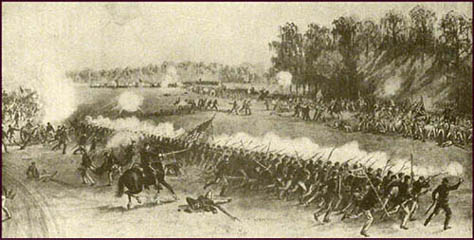 |
| Below is the well used battle report one more time. Irish Bend Nerson's Woods, Franklin April 14, 1863 While the other two Union XIX Army Corps divisions comprising the expedition into West Louisiana moved across Berwick Bay towards Fort Bisland, Brigadier General Cuvier Grover's division went up the Atchafalaya River into Grand Lake, intending to intercept a Confederate retreat from Fort Bisland or turn the enemy's position. On the morning of April 13, the division landed in the vicinity of Franklin and scattered Rebel troops attempting to stop them from disembarking. That night, Grover ordered the division to cross Bayou Teche and prepare for an attack towards Franklin at dawn. In the meantime, Confederate Major General Richard Taylor had sent some men to meet Grover's threat. On the morning of the 14th, Taylor and his men were at Nerson's Woods, around a mile and a half above Franklin. As Grover's lead brigade marched out a few miles, it encountered Rebels on its right and began skirmishing with them. The fighting became intense; the Rebels attacked, forcing the Yankees to fall back. The gunboat Diana arrived and anchored the Confederate right flank. The Confederates were outnumbered, however, and, as Grover began making dispositions for an attack, they retreated leaving the field to the Union. This victory, along with the one at Fort Bisland, two days earlier, assured the success of the expedition into West Louisiana. http://www.americancivilwar.com/statepic/la/la007.html Result(s): Union victory [This I question, Taylor's men accomplished what they entended, preventing Weizel from capturing the army, an army which would deal a severe wound to Banks a year later] Location: St. Mary Parish Campaign: Operations in West Louisiana (1863) Date(s): April 14, 1863 Principal Commanders: Brigadier General Cuvier Grover [US]; Major General Richard Taylor [CS] Forces Engaged: 4th Division, XIX Army Corps [US]; 28th Louisiana Infantry, 2nd Louisiana Cavalry, 12th Louisiana Infantry Battalion, 4th Texas Cavalry, and Cornay's Louisiana Battery [CS] Estimated Casualties: Total unknown (US 353; CS unknown) |
| On the morning of the 14th, Taylor and his men were at Nerson's Woods, around a mile and a half above Franklin. As Grover's lead brigade marched out a few miles, it encountered Rebels on its right and began skirmishing with them. |
| The fighting became intense; the Rebels attacked, forcing the Yankees to fall back. The Gunboat Diana arrived and anchored the Confederate right flank. |
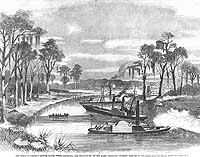 |
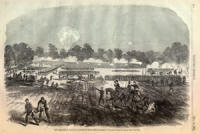
| Copied from a nothern newspaper article: THE BATTLE OF IRISH BEND WE illustrate on page 316 THE BATTLE OF IRISH BEND, fought on 13th April by General Grover's division of General Banks's army, in the recent campaign in the interior of Louisiana. Our picture is from a sketch by Mr. W. M. Hall, of the Twenty-second Maine Regiment. The following account of the battle is from the Herald correspondence: About seven o'clock A.M. the advance reached the edge of a dense line of woods, near what is known as Irish Bend (a sharp bend of the Teche), about eleven miles distant from the rebel earth-works, where General Banks was engaging the enemy. Here our force was met by a strong one of the rebels, in position, from the bank of the Teche, across the front and right flank of General Grover's division. The enemy was strongly posted at this point, their right flank supported by artillery, and their left extending round into another wood, in such a manner as to completely encircle any force which should simply attack their position in the wood first spoken of. Colonel Birge, of the Third Brigade, of General Grover's division, at this time in command of the advance, and supported by two sections of Rogers's battery, now skirmished with the rebels in front for about an hour, our skirmishers and their supports engaging the infantry and dismounted cavalry of the enemy. Colonel Birge then ordered the Twenty-fifth Connecticut and One Hundred and Fifty-ninth New York in front of the first skirt of woods. He had no sooner done this than the enemy commenced a flank attack, endeavoring to take the section of Rogers's battery which was on the right. These two regiments, assailed by a fire on their front and right from an enemy very perfectly concealed, replied ineffectually to the fire, became shaken, and finally commenced to fall back, when General Grover rode up to the front and rallied them, at the same time ordering General Dwight to hasten up with his brigade. The section of Rogers's battery was compelled to limber up and go to the rear, the fire of the enemy being so lively as to pick off nine cannoniers at their guns. At this time General Dwight moved on to the field with his brigade, and placed the Sixth New York on his right, in such a manner as to outflank the enemy's left, in a similar way that the enemy outflanked our right. The Ninety-first New York was ordered in front to advance against the woods, with the First Louisiana supporting the Sixth New York, and the Twenty-second Maine and One Hundred and Thirty-first New York in support of the Ninety-first New York. The order to advance was given, and like veterans they moved forward across the field, through the woods, and over another field, the enemy slowly but surely falling back before them; sweeping on, taking from him all his positions, and finally compelling him to so hasty a retreat that he left over one hundred prisoners in our hands. Then the position which Colonel Birge's brigade failed to take, with a loss of something over three hundred men, was taken by General Dwight, with a loss of only seven killed and twenty-one wounded. General Dwight was now ordered to halt, take a favorable position, and hold it. This was done, the enemy continuing to manoeuvre in front of General Dwight's and Colonel Birge's commands for two or three hours. The Diana did but very little harm during the whole of this time. Our troops, in the mean time, had been ordered by General Grover to rest in their places until further orders, which they did until about three P.M., when an order was given to feel the enemy on the front and flank, with a view to our attacking their position in force. Before any considerable advance further was made the enemy evacuated, retreating to the woods and canes, having previously set fire to the gun-boat Diana and transports Gossamer, Newsboy, and Era No. 2. The retreat was accomplished in such a manner as to prevent effectual pursuit. The rebel prisoners represent that they had upward of five thousand men engaged in this affair, and that they came up with the intention of driving General Grover's division across the Bayou Teche before General Banks's force could arrive; but they were signally repulsed, with a loss of from three to four hundred. On the field of battle one hundred and five prisoners were taken, and thirty wounded. Among the killed is General Riley, and among the wounded Colonel Gray. The prisoners also report that General Dick Taylor advanced in force on the flank, and was in command of the whole. "Sibley was there," they say; "but he was not in the fight, and never is." [ I believe Sibley was the one who ordered the bridge burned prematurely.] About one hundred and fifty prisoners in all were captured by General Grover's command. Immediately on the retreat a reconnoissance was sent out, which met a courier from the advance of General Banks's army, when the news arrived for the first time that the enemy had evacuated his works at Beasland [spelling incorrect] |
 |
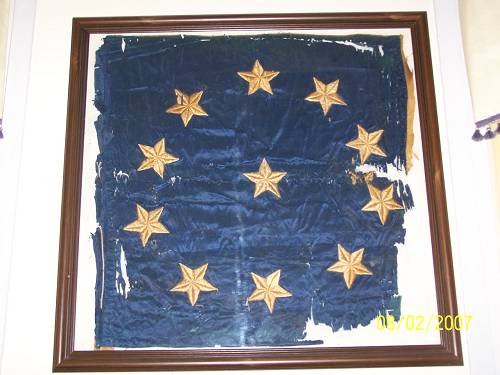
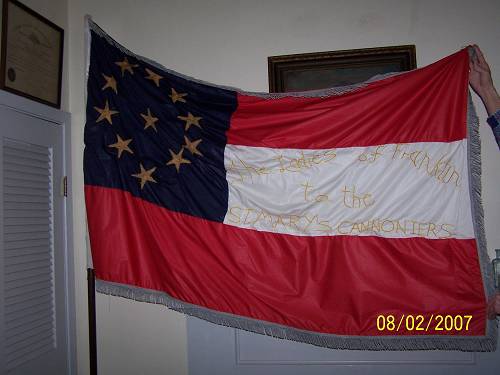
| The afternoon was still young and I had the choice of either taking US 90 back or going through Franklin. US 90 is only an emergency option in my book. I did take it back to 317 (the Burns-Centerville Road) which I used to get on 182 at Centerville (a must see community). I rode Old 90 west back through those great little towns and decided to take the Irish Bend loop at Franklin. There I would continue on a sentimental ride past the battlefield, crossing over the bayou back to 87 at the apex of the loop. The route takes you by Grevemberg House. It is an old home that has been turned into a museum. I felt a pull to stop there. I don't like museums. I get the feeling I'm missing something because there is so much to see in them. I know that's weird. Long story short, I stopped. I gathered my stuff and crammed it all into the tank bag and pulled it off the bike. It and my helmet in hand, I went to the front door. A little sign said to ring the bell, how quaint. I was already getting reservations and figured the place to be closed. No, this young fella opened the door as two tourist types were leaving with all the prolonged goodbyes associated with tourist leaving places, having make newest best friends with the host. The young (45?) fella asked what he could do for me. Bluntly, with a concocted story about being in a hurry, I told him I knew he had what was left of the St. Mary's Cannoneers flag and I just wanted to take a picture OF IT. He said that would be fine and that he would forego the entrace fee of six dollars. Great. He led me into a small room and pointed to a frame hung high on the wall. I almost saluted. It was a moment. If you've been to Washington DC and you have any patriotic blood in you at all, then use that experience to understand how I felt. We talked, me reciting everything I knew about the local Civil War in hopes of getting him to fill in the broad gaps which only a local historian can do. He started pointing around at pictures that reflected the battle out on the bend. I related the story about the missing historical maker for the battle. He said there was one, a new one, and how to find it. I asked him about Nerson's Woods and he went into a full discription of its location. He said it was by the marker. Didn't that make sense. The Confederate name for the battle is "The Battle of Nerson's Woods". |
| He asked me if I had time to see a few more things. He explained that they were being returned to the owners the next day and that my timing was perfect. I agreed to stay, wondering what could top what I'd just seen. |
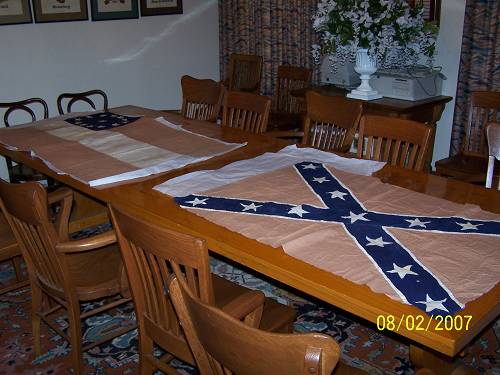
| He asked me to remain in this conference room. In five minutes he returned with two rolled up articles. My mouth dropped as he unrolled the two flags onto the table. He explained that they were Captain Cornay's. Let that simmer a minute.......They are not the flags flown in battle but are either the ones he kept with him as he would his Bible, later given to his widow, or they were the ones given to her in New Orleans after the war, probably secretively since having a Confederate Flag meant trouble. The flags are the Stars and Bars, the first Confederate National flag (left), and the famous flag carried in battle. I still get chills thinking about that moment. Notice they are equally faded. I have their time travel story, also. |
| Above is what is left of the Cannoneers' Flag. Below is a replica with this inscription: "The Ladies of Franklin to the St.Mary's Cannoniers". Noice the Fr.spelling of "cannoneer". |
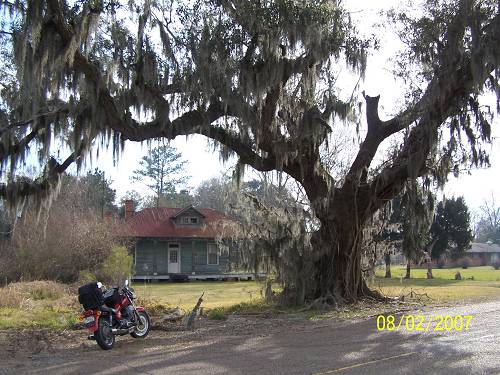
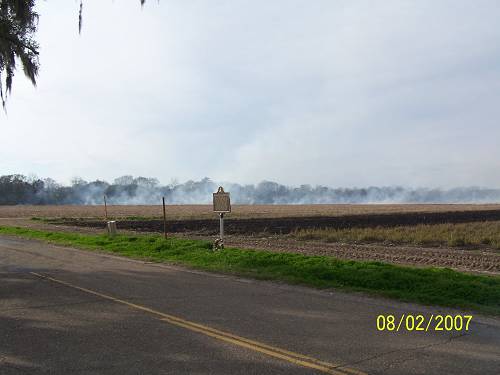
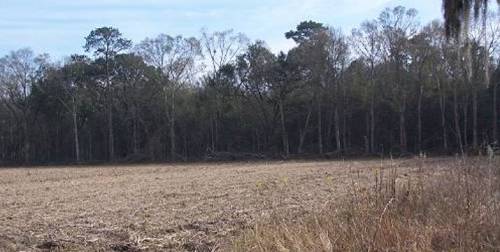
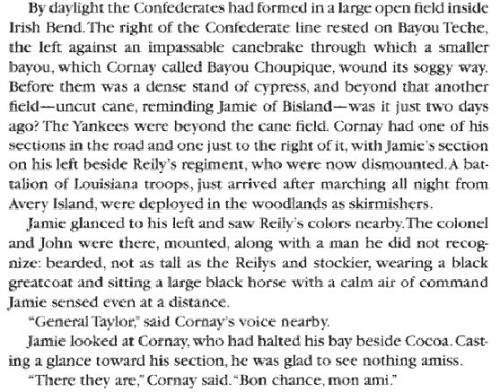
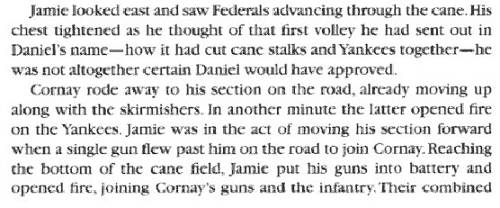
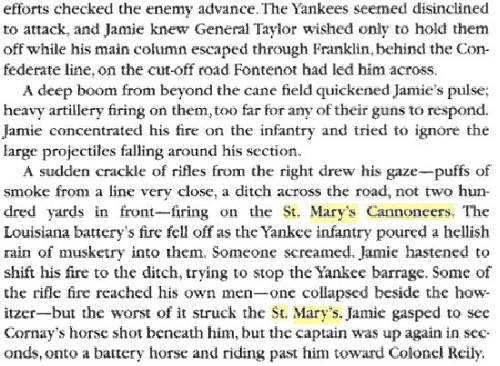
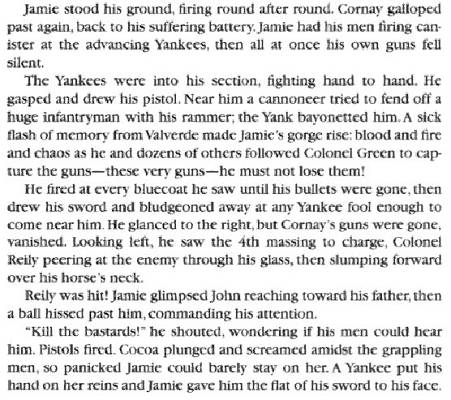
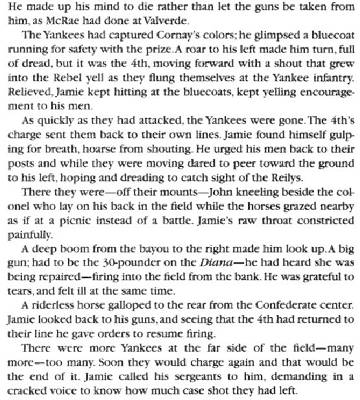
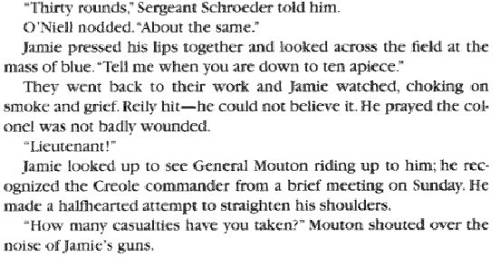
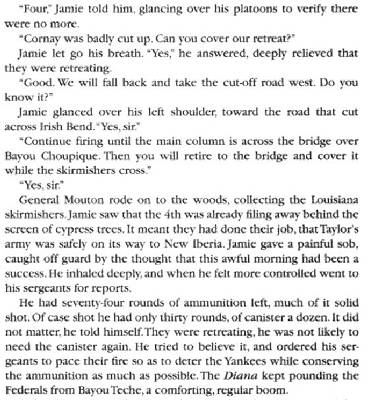
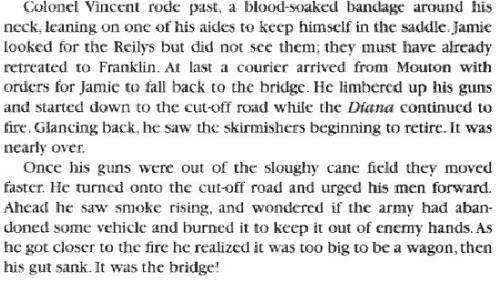
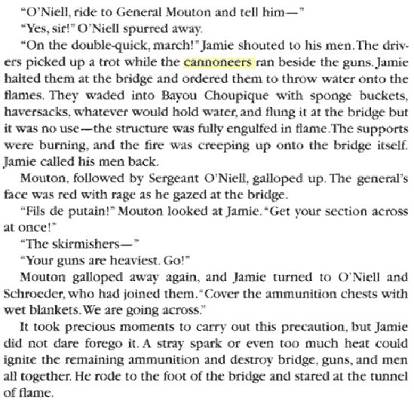
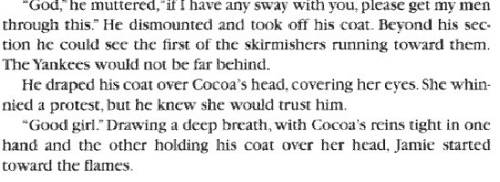
| On leaving I made the previous tourists' goodbyes look cold and harsh with my profuse thanks. I headed for the new sign which is placed sideways with the road so you can't see it when passing. You can't throw anything at it, also. Maybe the folks that put it up were pretty smart knowing that there are thugs that revel in such barbarism It is acorss the road from the first old green house outside of Franklin on Irish Bend Road. In the novel Red River, Nagle stays very close to the historical facts. It looks like a good book and it can be had on Amazon for 4 bucks. The writing, below, with the white background is from the book. It is perfect for what I want you to experience here. Better than pictures Jamie is a Texan Cannoneer that found himself with Cornay when Gen.Green joined Gen.Taylor. |
| Note: Bayou Choupique is not on Irish Bend. It is roughly 6 miles away to the west. It is again mentioned in the novel. |
| Was that smoke or something else? Cannon fire? |
| The Cut-Off Road had to be present day La. 182. There are no other cut roads. Bayou Choupique, as I had said, is further west and would have to be crossed to get to New Iberia. |
| Orders had been incorrectly sent to burn the bridge. Taylor, in his report was furious. |
| Note: Grevemberg House is in the process of developing a website. It will be www.grevemberghouse.com |
| More: |
| Now a personal note. These historical writes take a lot of time and work. I need some feedback to continue writing them. You can express your likes or dislikes HERE. |
| Two pages of text on Captain Florian Cornay: |
| To the HOME PAGE |
 |
|
|
|