 Trip
Reports
Trip
Reports
Trip
Reports

Extremadura: 15th - 19th May 2008 ■ Author: Geoff Dring.
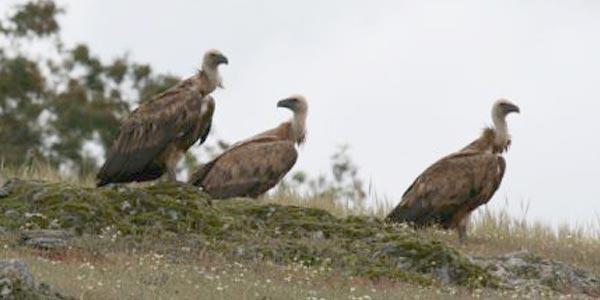
Griffon Vultures - Exremadura May 2008
12 members of the club assembled at Bristol Airport for the start of a new venture for the club – a visit to Extremadura in Spain. The EasyJet flight went well and the first Black Kite of the trip was spotted from the airplane on arrival at Madrid. We soon sorted out the hire vehicles with eight going in a Minibus and four in a car and the adventure began with an unplanned, but welcome, sightseeing trip through Madrid, quickly adding Spotless Starling and House Sparrow to the trip list. Out on the road and all eyes (bar the drivers?) were busily scanning the scenery for birds. We were all very excited by our first views of White Stork and Cattle Egret, not knowing that we were to see literally hundreds of them over the weekend!
 On
the way to our accommodation we first stopped at
Arrocampo Ornithological Park near Saucedilla.
This seemed to be in the middle of nowhere and
the light was fading, but we were amazed when we
heard Great Reed Warbler, Savi’s Warbler and
Crested Lark calling as we stepped from our
vehicles! Black Kites and White Storks were
present and Purple Heron and Zitting Cisticola
were soon added. Arrocampo consists of a series
of waterways, reeds and scrub. Evening was
obviously a good time to visit as not only did
we have the place to ourselves but soon spotted
Night Heron and Little Bittern going to roost. A
Spoonbill and a Great White Egret were on view
but almost ignored as we all got good views of
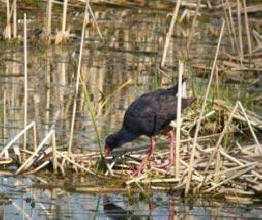
the area’s main claim to fame – a
Purple Swamphen (bottom
left) sat out in the open right in front
of us! There were many other birds normally
associated with such an environment such as Corn
Bunting and Marsh Harrier but we had to get on
to our sleeping quarters despite the obligingly
good views of Black Winged Stilt! Perhaps the
bird of the day, however, was the Black-winged
Kite which flew over us – what a start to our
trip! This was such a good place we vowed to
stop here again on our return journey.
On
the way to our accommodation we first stopped at
Arrocampo Ornithological Park near Saucedilla.
This seemed to be in the middle of nowhere and
the light was fading, but we were amazed when we
heard Great Reed Warbler, Savi’s Warbler and
Crested Lark calling as we stepped from our
vehicles! Black Kites and White Storks were
present and Purple Heron and Zitting Cisticola
were soon added. Arrocampo consists of a series
of waterways, reeds and scrub. Evening was
obviously a good time to visit as not only did
we have the place to ourselves but soon spotted
Night Heron and Little Bittern going to roost. A
Spoonbill and a Great White Egret were on view
but almost ignored as we all got good views of
the area’s main claim to fame – a
Purple Swamphen (bottom
left) sat out in the open right in front
of us! There were many other birds normally
associated with such an environment such as Corn
Bunting and Marsh Harrier but we had to get on
to our sleeping quarters despite the obligingly
good views of Black Winged Stilt! Perhaps the
bird of the day, however, was the Black-winged
Kite which flew over us – what a start to our
trip! This was such a good place we vowed to
stop here again on our return journey.
Despite the darkness Charles must have had good instructions, as he led us successfully to our accommodation in a very quiet and rural retreat near Trujillo. The hosts, Martin and Claudia, are bird tour organisers themselves and made us very welcome. They were very helpful throughout our stay in telling us good places to go see our target species. The accommodation was more than adequate, quite clean and served good local food with wine and after-dinner brandies! Details can be seen on their website www.birdingextremadura.com.
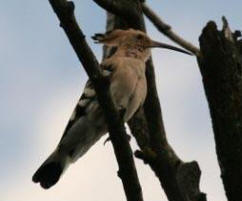
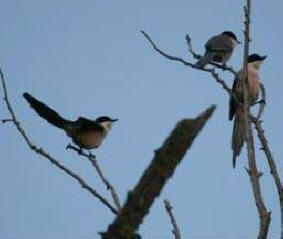 Sunrise was about 7 am so several of us had a
pre-breakfast walk. I’m glad I did as I saw
Hoopoe (above left),
Azure-winged Magpie
(right), Sardinian Warbler, Melodious
Warbler, Woodchat Shrike and Red-rumped Swallow!
Although I needn’t have worried as we saw plenty
of these during our stay! On other mornings we
added Golden Oriole, Nightingale, Stonechat,
Turtle Dove, Short-toed Treecreeper and a
special bird on the last morning. After
breakfast we set off for a tour of the area
around Trujillo. First stop was the Belen Plain
and although the roads seemed to have changed a
bit since our map was printed we were soon
scanning the plains for our target bird – the
Great Bustard. At first we were surprised at the
number of raptors we spotted. We managed to add
Red Kite, Booted Eagle and Montague’s Harrier to
our list as well as being lucky enough to spot a
Black Vulture soaring high. One of the
highlights was a group of about twenty Griffon
Vultures very close to the road which was quite
a special sight. We did manage hazy views of the
Great Bustards and other birds in the area
included White Stork, dozens of Cattle Egrets in
a tree, Calandra Lark, Crested Lark and Thekla
Lark as well as a claim of one Spanish Sparrow
which seemed surprisingly rare! All this was
before lunch when we stopped at a quiet
road-side verge. Even here we were getting good
views of Woodchat Shrike, Cattle Egret,
Woodlark, Hoopoe and White Stork.
Sunrise was about 7 am so several of us had a
pre-breakfast walk. I’m glad I did as I saw
Hoopoe (above left),
Azure-winged Magpie
(right), Sardinian Warbler, Melodious
Warbler, Woodchat Shrike and Red-rumped Swallow!
Although I needn’t have worried as we saw plenty
of these during our stay! On other mornings we
added Golden Oriole, Nightingale, Stonechat,
Turtle Dove, Short-toed Treecreeper and a
special bird on the last morning. After
breakfast we set off for a tour of the area
around Trujillo. First stop was the Belen Plain
and although the roads seemed to have changed a
bit since our map was printed we were soon
scanning the plains for our target bird – the
Great Bustard. At first we were surprised at the
number of raptors we spotted. We managed to add
Red Kite, Booted Eagle and Montague’s Harrier to
our list as well as being lucky enough to spot a
Black Vulture soaring high. One of the
highlights was a group of about twenty Griffon
Vultures very close to the road which was quite
a special sight. We did manage hazy views of the
Great Bustards and other birds in the area
included White Stork, dozens of Cattle Egrets in
a tree, Calandra Lark, Crested Lark and Thekla
Lark as well as a claim of one Spanish Sparrow
which seemed surprisingly rare! All this was
before lunch when we stopped at a quiet
road-side verge. Even here we were getting good
views of Woodchat Shrike, Cattle Egret,
Woodlark, Hoopoe and White Stork.
Our tour continued towards Cáceres with stops along the way. In particular we stopped at a pleasant river crossing where many Crag Martins gave us wonderfully close views as they went about their business. At another stop we saw Montague’s Harrier again and some saw very brief views of possible Pin-tailed Sandgrouse – the only ones of the trip. At another stop and short walk along the tracks crossing the plain we again saw distant views of Great Bustard and eventually caught up with a Little Bustard making its strange “raspberry” calls as well as Common and Great Spotted Cuckoos. It had been a hot and tiring day so we returned to Trujillo to sample a taverna, but not before stopping off to see Rollers on the way. They had been attracted to nest boxes placed on electricity pylons near the road. In Trujillo we enjoyed a beer whilst watching Lesser Kestrel, Common Swift and Pallid Swift around the church. On returning to our cars a Serin was singing from a fence beside the main road.
 The
next day (Saturday) saw us return to a site
visited yesterday. This time we went closer and
obtained excellent views of about a dozen Great
Bustards striding about and flying. A flying
Great Bustard makes an impressive sight.
However, we also managed to tick off
Black-Bellied Sandgrouse and Little Owl although
the views were not so good. In the area we also
clocked two Black-winged Stilts, presumed to be
breeding near a small pool, several displaying
Zitting Cisticola, a Hen Harrier and we also
heard Corncrake calling. We also got our first
real views of Bee-eater – one of the most
colourful birds you are likely to see. This was
only a quick stop, and soon we were off to
Monfragüe National Park. This is a protected
area famous for birds of prey. We weren’t
disappointed and soon had good views of Griffon
Vulture and Black Stork on the nest. A
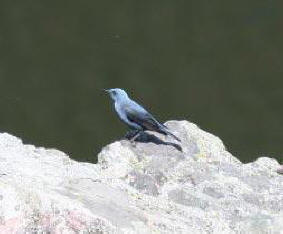
Blue Rock Thrush (left)
gave us excellent views right in front of us
whilst a Black Redstart also hopped around the
rocks quite near us and a probable Bonelli’s
Warbler appeared in the bushes below us. We also
managed our first views of Alpine Swift and a
brief view of Egyptian Vulture whilst Griffon
Vultures and Black Kites constantly circled over
our heads. However, the main bird to see was
Spanish Imperial Eagle and we weren’t
disappointed as one came quite close and had a
tussle with a Griffon Vulture on the way. Could
it get any better than that?
The
next day (Saturday) saw us return to a site
visited yesterday. This time we went closer and
obtained excellent views of about a dozen Great
Bustards striding about and flying. A flying
Great Bustard makes an impressive sight.
However, we also managed to tick off
Black-Bellied Sandgrouse and Little Owl although
the views were not so good. In the area we also
clocked two Black-winged Stilts, presumed to be
breeding near a small pool, several displaying
Zitting Cisticola, a Hen Harrier and we also
heard Corncrake calling. We also got our first
real views of Bee-eater – one of the most
colourful birds you are likely to see. This was
only a quick stop, and soon we were off to
Monfragüe National Park. This is a protected
area famous for birds of prey. We weren’t
disappointed and soon had good views of Griffon
Vulture and Black Stork on the nest. A
Blue Rock Thrush (left)
gave us excellent views right in front of us
whilst a Black Redstart also hopped around the
rocks quite near us and a probable Bonelli’s
Warbler appeared in the bushes below us. We also
managed our first views of Alpine Swift and a
brief view of Egyptian Vulture whilst Griffon
Vultures and Black Kites constantly circled over
our heads. However, the main bird to see was
Spanish Imperial Eagle and we weren’t
disappointed as one came quite close and had a
tussle with a Griffon Vulture on the way. Could
it get any better than that?
We then proceeded to a picnic site for lunch. Martin, our host, had suggested this spot for another bird named after Bonelli - the eagle. These are quite rare and so I was not very hopeful, but within a few minutes one flew right over our heads! We later saw two together further down the valley. This was a very picturesque spot with Crag Martin feeding/drinking from the lake below, when another Eagle flew over us. This one was quite different and was soon identified as a Short-toed Eagle. That was three eagles in about half an hour. Our leader decided we needed some exercise to walk off our lunch and so we made our way up to a “refuge” on top of one of the hills. This gave us fantastic panoramic views and sightings of passing Griffon Vultures and Red-rumped Swallows. Another Blue Rock Thrush was spotted and a nearby Rock Bunting added another bird to our growing list. We were now hot and thirsty so it was back to our usual taverna and on to our accommodation for sustenance. However, the day was not over as we now went on an “owl prowl” which thankfully was only 100 yards from our villa. The unusual calls we could hear turned out to be Red-necked Nightjar but most missed the brief view of one in flight due to the Long-eared Owl that decided to fly right by us! Unfortunately it rained the next night so we never improved our sighting.
 The
next day was Sunday but there was no time to
rest as we now travelled east into a different
range of mountains. At a very remote but very
pretty village, Solana, we stopped and
investigated the local gardens and allotments. I
think every one had very good views of
Nightingale singing its heart out in broad
daylight here. Other birds in this village were
a Melodious Warbler as well as several Spotted
Flycatchers. There was the usual White Stork’s
nest on the church roof with screaming Common
Swifts, Swallows and House Martins everywhere.
One of the things that impressed most of us was
the wild flowers everywhere. We thought the
flowers would attract a lot of butterflies but
there were less of these than we expected.
However, we did manage to identify several
unusual butterflies during the trip especially
several varieties of Fritillary. From here we
proceeded to an even more remote village called
Cabanas del Castillo where our host had promised
us at least one special bird. We did eventually
find and get good views of the target bird high
in the rocks. This was a Black Wheatear which is
very rare outside of this area. Also in this
area various people saw another Blue Rock Thrush
(this time actually displaying), a Sub Alpine
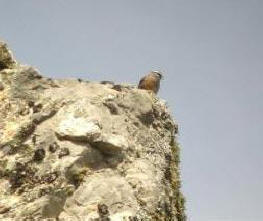
Warbler, another Rock
Bunting (right) and an unusual Stonechat
with all the characteristics of the Siberian
race, a well as Common Redstart. Lunch was at a
peaceful spot by the Almonte River followed by a
trip up a military road that took us higher than
Ben Nevis. Unfortunately the weather at this
altitude turned against us so it was back to
base in time to pack.
The
next day was Sunday but there was no time to
rest as we now travelled east into a different
range of mountains. At a very remote but very
pretty village, Solana, we stopped and
investigated the local gardens and allotments. I
think every one had very good views of
Nightingale singing its heart out in broad
daylight here. Other birds in this village were
a Melodious Warbler as well as several Spotted
Flycatchers. There was the usual White Stork’s
nest on the church roof with screaming Common
Swifts, Swallows and House Martins everywhere.
One of the things that impressed most of us was
the wild flowers everywhere. We thought the
flowers would attract a lot of butterflies but
there were less of these than we expected.
However, we did manage to identify several
unusual butterflies during the trip especially
several varieties of Fritillary. From here we
proceeded to an even more remote village called
Cabanas del Castillo where our host had promised
us at least one special bird. We did eventually
find and get good views of the target bird high
in the rocks. This was a Black Wheatear which is
very rare outside of this area. Also in this
area various people saw another Blue Rock Thrush
(this time actually displaying), a Sub Alpine
Warbler, another Rock
Bunting (right) and an unusual Stonechat
with all the characteristics of the Siberian
race, a well as Common Redstart. Lunch was at a
peaceful spot by the Almonte River followed by a
trip up a military road that took us higher than
Ben Nevis. Unfortunately the weather at this
altitude turned against us so it was back to
base in time to pack.
 Martin had promised us a Scops Owl on our last
morning and we were all taking bets on where it
might be. At seven o’clock Martin led us out of
the grounds as far as twenty yards in order to
set up his telescope on the roosting bird which
most of us managed to see before it popped back
into its hole.
Martin had promised us a Scops Owl on our last
morning and we were all taking bets on where it
might be. At seven o’clock Martin led us out of
the grounds as far as twenty yards in order to
set up his telescope on the roosting bird which
most of us managed to see before it popped back
into its hole.
On the return journey we stopped at Arrocampo again, visiting several of the hides there. We saw most of the species already seen only now in better conditions. Especially good was a Little Bittern that flew past seen by all but me. Additionally we achieved good views of Savi’s Warbler, Great Reed Warbler, Little Tern and displaying Zitting Cisticola and Bee Eater as well as a probable Spotted Crake heard calling. Probably the last bird of the trip seen whilst enjoying our packed lunch was a wonderful Night Heron. This perched up to give good views and then flew slowly past us at close range.
This had been a wonderful trip with everybody getting a lifer or two or twenty! The trip was well organised and itinerary well planned with instructions that pointed to virtually every one of our target birds. Many thanks to Charles and Richard for the organising and to the drivers and to every one else for a really good weekend with enjoyable company. Apologies for anything I missed out. Geoff Dring.
If this report has aroused your interest in visiting Extremadura, a tour dossier has been prepared to assist your planning. It is available from Richard Belson or Charles Stapleton. – ed.

©Bristol Ornithological Club MMVIII
Contact us | How To Join | About The BOC | Programme | Where To Watch | Articles | Gorge Peregrines | Bird Records | Systematic List | Galleries | Links | Message Board | Coming Up | Publications