 Trip
Reports
Trip
Reports
Trip
Reports

Camargue: 23rd February - 2nd March 2007 ■ Authors: Jeff & Celia Holmes ■ Photos: David Wilson
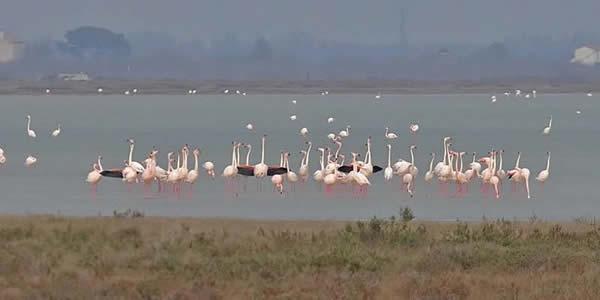
Greater Flamingos - Camargue 2007
 Eighteen members flew from Bristol, on a Friday
afternoon flight, to Nice eager to start
exploring the Camargue area of southern France.
After picking up our two minibuses, a drive of
approximately 3 hours westwards led us to our
base for the week - a small hotel on the
outskirts of Arles. We were fortunate with the
weather during our stay, with variable cloud,
very little rain and a light to moderate wind.
Most of the group went out for a pre-breakfast
stroll each day in the garden and along the
tracks around the fields. A variety of birds
were seen including Black Redstarts,
Goldfinches, Tree Sparrows, and elusive Firecrests, one of which showed brilliantly one
morning. Green Woodpeckers called and small
groups of Cattle Egrets flew over each day
heading for their feeding grounds.
Eighteen members flew from Bristol, on a Friday
afternoon flight, to Nice eager to start
exploring the Camargue area of southern France.
After picking up our two minibuses, a drive of
approximately 3 hours westwards led us to our
base for the week - a small hotel on the
outskirts of Arles. We were fortunate with the
weather during our stay, with variable cloud,
very little rain and a light to moderate wind.
Most of the group went out for a pre-breakfast
stroll each day in the garden and along the
tracks around the fields. A variety of birds
were seen including Black Redstarts,
Goldfinches, Tree Sparrows, and elusive Firecrests, one of which showed brilliantly one
morning. Green Woodpeckers called and small
groups of Cattle Egrets flew over each day
heading for their feeding grounds.
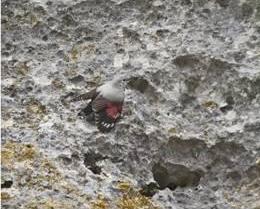
The first morning saw us exploring the limestone hills of the Chaine des Alpilles where we walked up to the ruins of the castle of Les Baux. This was an impressive vantage point where we searched for Alpine Accentor. We were soon rewarded with superb views of up to 15 birds feeding and flying around us at very close quarters. When we could take our eyes off the Alpine Accentors we had good views of Serins, Black Redstarts and Blue Rock Thrush whilst overhead a Peregrine circled, surrounded by about ten Crag Martins. A pair of Ravens and a Buzzard were soaring over the nearby hills. A walk below the castle failed to find the hoped for Wallcreeper (above), but the giant orchids growing alongside the track and throughout a meadow were impressive. The day ended with a short walk in a pine forest, which was quiet bird wise, but we were delighted to watch a Goldcrest which was preening and fluffing itself into a ball as it settled down to roost under a pine cone.
On Sunday we explored the east side of the Camargue stopping at various viewpoints and the Information Centre at La Capelliere. We set off from the hotel in the rain but, nevertheless, as we drove along we managed to see Great White and Little Egrets and four Sacred Ibis from the minibuses. Fortunately when we arrived at our first viewing platform the rain eased and we were treated to our first views of the habitats of the Camargue - wide open vistas with scattered trees, reedbeds, open water and grazing meadows. We were able to glimpse the pink of Greater Flamingos just visible through the trees, the first of many thousand. Suddenly one of the group spotted a Hoopoe perched in a tree which dropped onto the track to feed - our only sighting of the trip. Several Marsh Harriers drifted over the marshes hunting while a Black Kite soared in the distance.
We continued further south to the nature trail of Salin de Badon - a very muddy trail that led to the hides overlooking lagoons and open marshes. Birds seen here included Greylag Geese, Pintail, Spotted Redshanks, Marsh Harriers, a ringtail Hen Harrier and a very distant view of a soaring Spotted Eagle. Much interest centred on a distant perched Buzzard species which could possibly have been a juvenile Long-legged Buzzard, but fortunately a full adult suddenly appeared and perched in the top of a tree close by, stretching out its wings in the wind and providing excellent views to the whole group. We moved on to the information centre where a short circular walk provided views of a variety of duck species, two smart White-headed Cormorants, and a Green Sandpiper. As we headed back to the Centre a White Stork flew low across the trees and a small nesting colony of Grey Herons was spotted in nearby trees. We then drove further down to the end of the tarmac road at Digue a la Mer where we saw more Flamingos, a large flock of Golden Plover, and a male Hen Harrier. As we drove off a small bird attracted our attention on the mud which turned out to be a Water Pipit, the only one of the trip.
Next day we drove down the west side of the Camargue, stopping on route to admire a pair of White Storks perched on their nest on top of a pole before arriving at the Etang dit l'Imperial, where we could view across a large saline lagoon dotted with low islands. Here Greater Flamingos were spread across the area feeding and, amazingly, Robin managed to find the one adult Lesser Flamingo amongst them - a rare visitor from Africa. It was noticeably smaller and pinker with an all-dark bill. Also there were large numbers of Avocets feeding amongst the Flamingos and groups of waders including Dunlin, Little Stint, Bar-tailed Godwit and Golden Plover. In the distance a large number of Red-crested Pochard were sheltering from the wind behind an island whilst around us Sardinian and Cetti's Warblers called but were notoriously difficult to see! Overhead, in the distance, a pale-phase Booted Eagle drifted away and some of the group managed to locate and follow a disappearing bird which was thought to be another Spotted Eagle. As we returned to the buses we were lucky to see 17 Slender-billed Gulls which had just flown in and landed on the shoreline of the lagoon. These were mostly adults with a lovely pink flush on their breasts. As we drove home we spotted a group of Cattle Egrets amongst the bulls and watched one catch a frog which it eventually managed to swallow. The day ended with a large group of Corn Buntings on the roadside wires.
 On
Tuesday morning we headed for the La Crau area -
a flat, stony, dry, open plain which was a
former wide river valley. At our first stop,
whilst we were sheltering from the wind and
steadying our scopes, the odd Little Bustard
head popped up into view amongst the dried grass
and eventually we counted six. A Peregrine was
perched on a bush and two Merlins dashed across
flushing flocks of Skylarks and finches. We
moved off to another part of the plain and in a
nearby field we were really pleased to find
three Richard's Pipits showing very well. We
were also fortunate to see four Little Bustards
in flight after our earlier struggles to see
them on the ground. On a walk along a track
across the plain we had our first sighting of a
Southern Grey Shrike which was perched on a
nearby farm building. Further flocks of Skylarks
rose around us and as the wind dropped many
birds could be heard singing and Crested Lark
were also found along the track. After lunch we
moved off and visited a reserve - the "Petite
Camargue" - on the edge of Etang de Berre which
is a large shallow lake west of Marseille. On
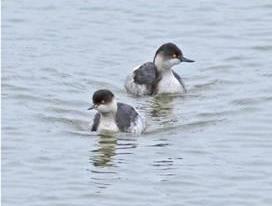
the lake groups of
Black-necked Grebes (right) (1000+) were
an impressive sight and a group of 14 Med Gulls
were seen before they flew off. Along the reed
channels two Water Rails were picked up as we
watched Chiffchaffs feeding. We continued on a
little further to the saltpans opposite
Marseille airport where we hoped to find the
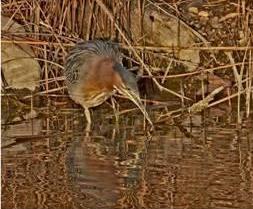
wintering Green Heron
(below left) and just as we were about to
give up Ken took one last look and success - wow
what a bird. The cameras were clicking as the
bird posed at the edge of the reeds in the
perfect evening light. As we gathered on the
shoreline waiting for the photographers to
finish a Red-necked Grebe appeared amongst the
Black-necked in glorious summer plumage - a
brilliant end to a superb day.
On
Tuesday morning we headed for the La Crau area -
a flat, stony, dry, open plain which was a
former wide river valley. At our first stop,
whilst we were sheltering from the wind and
steadying our scopes, the odd Little Bustard
head popped up into view amongst the dried grass
and eventually we counted six. A Peregrine was
perched on a bush and two Merlins dashed across
flushing flocks of Skylarks and finches. We
moved off to another part of the plain and in a
nearby field we were really pleased to find
three Richard's Pipits showing very well. We
were also fortunate to see four Little Bustards
in flight after our earlier struggles to see
them on the ground. On a walk along a track
across the plain we had our first sighting of a
Southern Grey Shrike which was perched on a
nearby farm building. Further flocks of Skylarks
rose around us and as the wind dropped many
birds could be heard singing and Crested Lark
were also found along the track. After lunch we
moved off and visited a reserve - the "Petite
Camargue" - on the edge of Etang de Berre which
is a large shallow lake west of Marseille. On
the lake groups of
Black-necked Grebes (right) (1000+) were
an impressive sight and a group of 14 Med Gulls
were seen before they flew off. Along the reed
channels two Water Rails were picked up as we
watched Chiffchaffs feeding. We continued on a
little further to the saltpans opposite
Marseille airport where we hoped to find the
wintering Green Heron
(below left) and just as we were about to
give up Ken took one last look and success - wow
what a bird. The cameras were clicking as the
bird posed at the edge of the reeds in the
perfect evening light. As we gathered on the
shoreline waiting for the photographers to
finish a Red-necked Grebe appeared amongst the
Black-necked in glorious summer plumage - a
brilliant end to a superb day.
 The
next day we re-visited the cliffs at Les Baux
and after walking around the base of the cliffs
a movement was picked up on the cliff face which
turned out to be a Blue Rock Thrush, but behind
it another movement revealed a Wallcreeper
flitting around the rock formations. We all had
good views of the bird (thanks to Ken who
sprinted up the path to gather the rest of the
group) both in flight and on the rocks. We drove
off to explore the eastern end of the Chaine les
Alpilles - a lovely area of limestone hills. We
ate our lunch overlooking a large cliff and
valley where Red-legged Partridges, Sardinian
Warblers and Serins called around us but
unfortunately we failed to see any of the hoped
for Bonelli's Eagles. We visited another part of
the La Crau plain where a flock of Lapwing and
Golden Plover were sitting inside an airfield
perimeter fence. Further scanning revealed two
Merlins and Southern Grey Shrikes. On the other
side of the airfield a group of buntings which
landed in nearby bushes turned out to be Rock
Buntings - a good find although the six birds
were elusive to locate as they dropped down
amongst the low vegetation. As evening
approached we visited a low limestone ridge
hoping to locate Eagle Owls. As the light faded
Robin suddenly signalled to the group as he had
found a pair perched, in full view, on top of
the rocks and we could hear faint calling from
the birds - fantastic!
The
next day we re-visited the cliffs at Les Baux
and after walking around the base of the cliffs
a movement was picked up on the cliff face which
turned out to be a Blue Rock Thrush, but behind
it another movement revealed a Wallcreeper
flitting around the rock formations. We all had
good views of the bird (thanks to Ken who
sprinted up the path to gather the rest of the
group) both in flight and on the rocks. We drove
off to explore the eastern end of the Chaine les
Alpilles - a lovely area of limestone hills. We
ate our lunch overlooking a large cliff and
valley where Red-legged Partridges, Sardinian
Warblers and Serins called around us but
unfortunately we failed to see any of the hoped
for Bonelli's Eagles. We visited another part of
the La Crau plain where a flock of Lapwing and
Golden Plover were sitting inside an airfield
perimeter fence. Further scanning revealed two
Merlins and Southern Grey Shrikes. On the other
side of the airfield a group of buntings which
landed in nearby bushes turned out to be Rock
Buntings - a good find although the six birds
were elusive to locate as they dropped down
amongst the low vegetation. As evening
approached we visited a low limestone ridge
hoping to locate Eagle Owls. As the light faded
Robin suddenly signalled to the group as he had
found a pair perched, in full view, on top of
the rocks and we could hear faint calling from
the birds - fantastic!
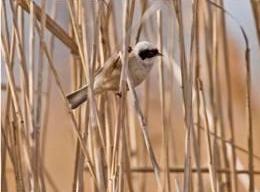 Our
last day was spent back in the Camargue where we
explored the east side again, stopping to scan
at various points before reaching the
Information Centre at La Capelliere. While we
were waiting for the group to assemble a
Penduline Tit suddenly appeared in the reeds at
the edge of the car park showing well to some of
the group before flying off. We wandered down
the road hoping to relocate the bird but despite
hearing the calls the bird remained elusive. So
we moved on to a new reserve (Le Verdier) which
was a reed-filled series of lagoons and to our
delight three Penduline
Tits (right) showed very well to everyone
as did two Coypu swimming in the pools, showing
their red teeth. Overhead two White Storks
soared and a Peregrine flew over. At another
roadside stop four Common Cranes were picked up
in the distance but dropped down behind the
treelike and were not relocated. We drove on to
the car park at the end of the rough track
(brilliantly negotiated by our two drivers)
towards the Gacholle lighthouse for a scan of
the shallow lagoons not far from the sea. The
atmosphere here was great - wide open views, big
skies and large numbers of Greater Flamingos
spread out across the lagoons looking a
beautiful colour in the dramatic light. We were
treated to the sight of groups of Flamingos
displaying, with wing flicking and head shaking
- a spectacular sight. Many could not take their
eyes off the Flamingos to spot good numbers of
waders including Avocet, Curlew, Golden Plover,
Kentish Plover and a group of Red-breasted
Mergansers. Watching the displaying Flamingos
was the most wonderful finale we could have
wished for.
Our
last day was spent back in the Camargue where we
explored the east side again, stopping to scan
at various points before reaching the
Information Centre at La Capelliere. While we
were waiting for the group to assemble a
Penduline Tit suddenly appeared in the reeds at
the edge of the car park showing well to some of
the group before flying off. We wandered down
the road hoping to relocate the bird but despite
hearing the calls the bird remained elusive. So
we moved on to a new reserve (Le Verdier) which
was a reed-filled series of lagoons and to our
delight three Penduline
Tits (right) showed very well to everyone
as did two Coypu swimming in the pools, showing
their red teeth. Overhead two White Storks
soared and a Peregrine flew over. At another
roadside stop four Common Cranes were picked up
in the distance but dropped down behind the
treelike and were not relocated. We drove on to
the car park at the end of the rough track
(brilliantly negotiated by our two drivers)
towards the Gacholle lighthouse for a scan of
the shallow lagoons not far from the sea. The
atmosphere here was great - wide open views, big
skies and large numbers of Greater Flamingos
spread out across the lagoons looking a
beautiful colour in the dramatic light. We were
treated to the sight of groups of Flamingos
displaying, with wing flicking and head shaking
- a spectacular sight. Many could not take their
eyes off the Flamingos to spot good numbers of
waders including Avocet, Curlew, Golden Plover,
Kentish Plover and a group of Red-breasted
Mergansers. Watching the displaying Flamingos
was the most wonderful finale we could have
wished for.
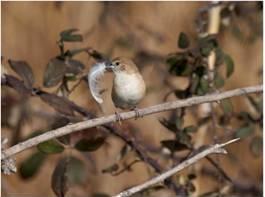
We left the hotel promptly on Friday morning hoping to reach Nice with enough time to visit the mouth of the river Var near to the airport. Despite passing an accident on the motorway near our turn-off we arrived in time to walk by the riverside scanning the reeds and brambles - much to the entertainment of shoppers in the car park! Our target here was the Indian Silverbill (left), a small finch which were originally escapees but are now established as a feral species. We all had excellent views of courting behaviour with one male ceremoniously offering a feather to a female, who did not look at all impressed - another brilliant ending. The bird list came to 127 species which far exceeded our expectations. Everyone thoroughly enjoyed the week with good company, good food and wine (thanks to Lys for her expertise) and most excellent birding. Many thanks to Ken and Lys for all the organisation which ensured the success of the trip and also thanks to Ken and Robin for driving and finding so many species. We had fun communicating between the minibuses via walkie talkies which were loaned to us from the Chew Valley Ringing Station – again, many thanks.
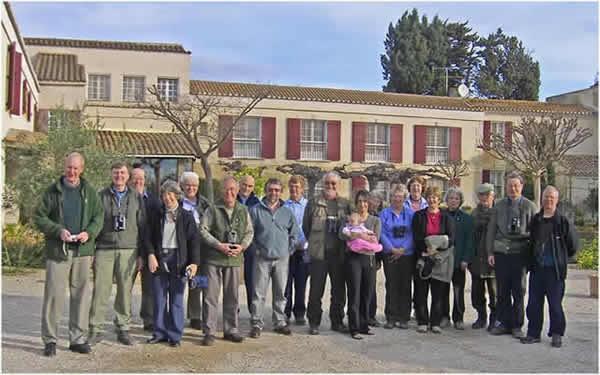
Members of the BOC trip to the Camargue 2007

©Bristol Ornithological Club MMVIII
Contact us | How To Join | About The BOC | Programme | Where To Watch | Articles | Gorge Peregrines | Bird Records | Systematic List | Galleries | Links | Message Board | Coming Up | Publications