

Biotechnology and Medical Technology

Famous Innovators and Inventers in Biotechnology and Medical Technology history |
|
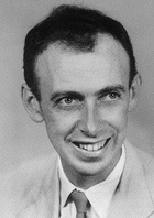 James Dewey Watson was the co-discoverer of DNA structure, along with Francis Crick, and one of the fathers of biotechnology. |
James Dewey Watson was born in Chicago, Ill., on April 6th, 1928, as the only son of businessman James D. Watson and Jean Mitchell. His father's ancestors were originally of English descent and had lived in the midwest for several generations. His mother's father was a Scottish-born tailor, married to a daughter of Irish immigrants who arrived in the United States about 1840. During the spring of 1951, he went with Herman Kalckar to the Zoological Station at Naples. There at a Symposium, late in May, he met Maurice Wilkins and saw for the first time the X-ray diffraction pattern of crystalline DNA. This greatly stimulated him to change the direction of his research toward the structural chemistry of nucleic acids end proteins. He soon met Francis Crick and discovered their common interest in solving the DNA structure. They thought it should be possible to correctly guess its structure, given both the experimental evidence at King's College plus careful examination of the possible stereochemical configurations of polynucleotide chains. Their first serious effort, in the late fall of 1951, was unsatisfactory. Their second effort, based upon more experimental evidence and better appreciation of the nucleic acid literature, resulted, early in March 1953, in the proposal of the complementary double-helical configuration. At the same time, he was experimentally investigating the structure of TMV, using X-ray diffraction techniques. His object was to see if its chemical sub-units, earlier revealed by the elegant experiments of Schramm, were helically arranged. This objective was achieved in late June 1952, when use of the Cavendish's newly constructed rotating anode X-ray tubes allowed an unambiguous demonstration of the helical construction of the virus. From 1953 to 1955, Watson was at the California Institute of Technology as Senior Research Fellow in Biology. There he collaborated with Alexander Rich in X-ray diffraction studies of RNA. In 1955-1956 he was back in the Cavendish, again working with Crick. During this visit they published several papers on the general principles of virus construction. Since the fall of 1956, he has been a member of the Harvard Biology Department, first as Assistant Professor, then in 1958 as an Associate Professor, and as Professor since 1961. During this interval, his major research interest has been the role of RNA in protein synthesis. Among his collaborators during this period were the Swiss biochemist Alfred Tissi�res and the French biochemist Fran�ois Gros. Much experimental evidence supporting the messenger RNA concept was accumulated. His present principal collaborator is the theoretical physicist Walter Gilbert who, as Watson expressed it, "has recently learned the excitement of experimental molecular biology". The honors that have to come to Watson include: the John Collins Warren Prize of the Massachusetts General Hospital, with Crick in 1959; the Eli Lilly Award in Biochemistry in the same year; the Lasker Award, with Crick and Wilkins in 1960; the Research Corporation Prize, with Crick in 1962; membership of the American Academy of Arts and Sciences and the National Academy of Sciences, and Foreign membership of the Danish Academy of Arts and Sciences. He is also a consultant to the President's Scientific Advisory Committee. Top |
As researchers for the New York Department of Health, Elizabeth Lee Hazen and Rachel Fuller Brown combined their efforts to develop the anti-fungal antibiotic drug nystatin. To Hazen's single-minded pursuit of an antifungal antibiotic, Brown added the skills needed to identify, characterize, and purify the various substances produced by culturing bacteria found in hundreds of soil samples. The drug, patented in 1957 was used to cure many disfiguring and disabling fungal infections, as well as to balance the effect of many antibacterial drugs. In addition to human ailments, the drug has been used to treat such problems as Dutch Elm's disease and to restore water-damaged artwork from the effects of mold. It was named nystatin after the New York State Department of Health. The two scientists donated the royalties from their invention, over $13 million dollars, to the nonprofit Research Corporation for the advancement of academic scientific study. Elizabeth Lee Hazen and Rachel Fuller Brown were inducted into the National Inventors Hall of Fame in 1994. Top |
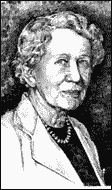 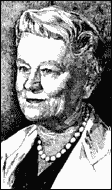 The long distance cooperation between Elizabeth Lee Hazen and Rachel Fuller Brown culminated in the creation of Nystatin |
No image available George Nicolas Papanicolaou created the Pap smear, a technique used to detect cancer of the uterine cervix |
George Nicolas Papanicolaou was born on May 13, 1883 in Kymi, Greece. His father, Nicolas, was a well-respected physician and his mother, Maria, was a very cultured lady who had a great love for Greek classical music and literature. George had three siblings, Athanase, Maria and Helen. Dr. George Papanicolaou began his medical career taking care of patients at a leper colony north of his hometown of Kymi. Papanicolaou was very sympathetic to the lepers, who received little care from the surrounding community, and spent a lot of time tending to their medical and other personal needs. In 1907, Papanicolaou went to Jena, Germany for postgraduate study at the Zoological Institute in Munich, the greatest zoological research center in the world at that time. His first teacher at the Institute in Munich was Professor Ernst Haeckel, one of Europe's greatest early proponents of Darwinism. In 1910, Papanicolaou obtained his Ph.D., becoming George Nicolas Papanicolaou, M.D., Ph.D. After receiving his Ph.D., he married Mary Mavroyeni, the daughter of a wealthy merchant from his hometown of Kymi. In 1920, Dr. Papanicolaou began his study of the vaginal cytology of the human. After becoming familiar with normal cytology changes, he found some cases of malignancy. About this discovery, he remarked, "The first observation of cancer cells in a smear of the uterine cervix was one of the most thrilling experiences of my scientific career." In 1928 he published a paper about the results of his work, entitled, "New Cancer Diagnosis." A newspaper article in the "New York World" stated, "Although Dr. Papanicoloau is not willing to predict how useful the new diagnostic method will be in the actual treatment of malignancy itself, it seems probable that it will prove valuable in determining cancer in the early stages of its growth when it can be more easily fought and treated. There is even hope that pre-cancerous conditions may be detected and checked." In 1928, Dr. Papanicolaou became a citizen of the United States and was promoted to Assistant Professor of Anatomy at Cornell. In 1939, the reevaluation of the vaginal smear for cancer detection began. At the New York Hospital all women patients were required to take a routine vaginal smear. Dr. Herbert Traut, a gynecological pathologist, collaborated with Dr. Papanicolaou to validate the diagnostic potential of the vaginal smear. In 1943, they published their findings and conclusions in the famous monograph, "Diagnosis of Uterine Cancer by the Vaginal Smear." The diagnostic procedure was named the Pap test. In 1954, Dr. Papanicolaou's comprehensive scientific treatise was published. It was entitled, "Atlas of Exfoliative Cytology," which contained a compendium of cytological findings in health and disease involving multiple organ systems of the human body. Some of the many awards and honors he received were the First Award of the Order of AHDPA, as the Most Outstanding American Scientist of Greek Descent; The Honor Medal of the American Cancer Society; The Modern Medicine Award for Distinguished Achievement; Honorary Member of the Obstetrical and Gynecological Society of Athens; Honorary Member of the New York Academy of Sciences; Permanent Honorary Consultant to the Society of Pelvic Surgeons; and Honorary Degrees from the University of Athens, University of Turin and the Hahnemann Medical College. Dr. Papanicolaou died on February 18, 1962 of heart failure and pulmonary edema and is buried in New Jersey. Millions of women have received the Pap test and deaths from cancer of the uterus have been greatly reduced, thanks to the Pap smear. On May 13, 1962, the Papanicolaou Cancer Research Institute in Miami, Florida was dedicated. The dedication address was given by Dr. Papanicolou's friend, Dr. Charles Cameron, who said: "He was a giver of life; he is in the company of the great; he is one of the elect of the men of earth who stand for all eternity like solitary towers along the way to human betterment. We are deeply in his debt." Top |
Wilhelm Conrad R�ntgen was born on March 27, 1845, at Lennep in the Lower Rhine Province of Germany, as the only child of a merchant in, and manufacturer of, cloth. His mother was Charlotte Constanze Frowein of Amsterdam, a member of an old Lennep family which had settled in Amsterdam. R�ntgen married Anna Bertha Ludwig of Z�rich, whom he had met in the caf� run by her father. She was a niece of the poet Otto Ludwig. They married in 1872 in Apeldoorn, The Netherlands. They had no children, but in 1887 adopted Josephine Bertha Ludwig, then aged 6, daughter of Mrs. R�ntgen's only brother. R�ntgen's name, however, is chiefly associated with his discovery of the rays that he called X-rays. In 1895 he was studying the phenomena accompanying the passage of an electric current through a gas of extremely low pressure. Previous work in this field had already been carried out by J. Plucker (1801-1868), J. W. Hittorf (1824-1914), C. F. Varley (1828-1883), E. Goldstein (1850-1931), Sir William Crookes (1832-1919) and H. Hertz (1857-1894) and by the work of these scientists the properties of cathode rays - the name given by Goldstein to the electric current established in highly rarefied gases by the very high tension electricity generated by Ruhmkorff's induction coil-had become well known. R�ntgen's work on cathode rays led him, however, to the discovery of a new and different kind of rays. On the evening of November 8, 1895, he found that, if the discharge tube is enclosed in a sealed, thick black carton to exclude all light, and if he worked in a dark room, a paper plate covered on one side with barium platinocyanide placed in the path of the rays became fluorescent even when it was as far as two metres from the discharge tube. During subsequent experiments he found that objects of different thicknesses interposed in the path of the rays showed variable transparency to them when recorded on a photographic plate. When he immobilised for some moments the hand of his wife in the path of the rays over a photographic plate, he observed after development of the plate an image of his wife's hand which showed the shadows thrown by the bones of her hand and that of a ring she was wearing, surrounded by the penumbra of the flesh, which was more permeable to the rays and therefore threw a fainter shadow. This was the first "r�ntgenogram" ever taken. In further experiments, R�ntgen showed that the new rays are produced by the impact of cathode rays on a material object. Because their nature was then unknown, he gave them the name of X-rays. Later, Max von Laue and his pupils showed that they are of the same electromagnetic nature as light, but differ from it only in the higher frequency of their vibration. Numerous honours were showered upon him. In several cities, streets were named after him, and a complete list of Prizes, Medals, honorary doctorates, honorary and corresponding memberships of learned societies in Germany as well as abroad, and other honours would fill a whole page of this book. In spite of all this, R�ntgen retained the characteristic of a strikingly modest and reticent man. Throughout his life he retained his love of nature and outdoor occupations. Many vacations were spent at his summer home at Weilheim, at the foot of the Bavarian Alps, where he entertained his friends and went on many expeditions into the mountains. He was a great mountaineer and more than once got into dangerous situations. Amiable and courteous by nature, he was always understanding the views and difficulties of others. He was always shy of having an assistant, and preferred to work alone. Much of the apparatus he used was built by himself with great ingenuity and experimental skill. Four years after his wife, R�ntgen died at Munich on February 10, 1923, from carcinoma of the intestine. Top |
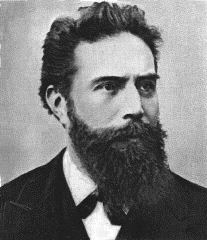 Wilhelm Conrad R�ntgen devoloped one of the most famous medical technologies of all time, the X-ray. |
Sources
| |