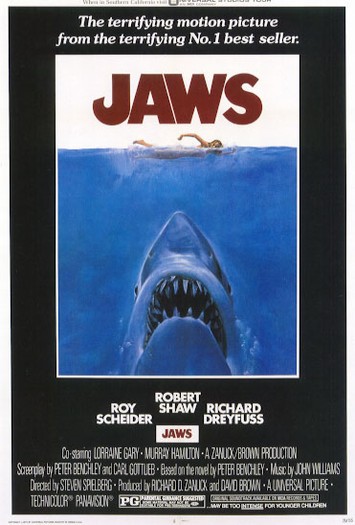
|
Jaws
|
Movie
| Book
| Author
| Director
& cast
|
Book: A Stillness in the Water/ Jaws (1974)
Movie: Jaws (1975)
Premise
movie:
"The box-office smash that created the event-movie
mentality in Hollywood and to which all theme-park-ride movies get
compared--and it still makes you think twice before a trip to the
beach. A seaside community (it was filmed on Martha's Vineyard,
Massachusetts) succumbs to terror, and writes off a tourist season,
when a great white shark seems to target the town's beaches for a
hunting ground. Local sheriff Scheider joins with a bespectacled
academic (Dreyfuss) and a salty-dog fisherman (Shaw) in an Ahab-like
hunt for the monster. A young Spielberg (all of 27) stage-manages
the bounding main action, and a recalcitrant mechanical shark named
Bruce, to produce a modern classic of archetypal terror. Williams's
score can still evoke shivers. Based on the best-selling book by
Benchley. Followed by three sequels. Academy Award Nominations: 4,
including Best Picture."
from:
http://www.amctv.com/show/detail?CID=1727-1-EST
back
to top
Premise
book:
"More than twenty years ago, I set out to write a story
about a town menaced by a marine predator. Intrigued by a newspaper
item about a fisherman who had caught a 4,550-pound Great White
Shark off the coast of Long Island, I wondered what would happen if
such a creature were to visit a resort community . . . and wouldn't
go away. After considering more than a hundred titles--some
pretentious (Leviathan Rising), some portentous (A Stillness In The
Water)--I decided, for lack of anything better, to call it Jaws. My
ambitions for the story were modest, my expectations for its
commercial prospects were nil. For one thing, it would be a first
novel, and conventional wisdom held that nobody read first novels.
For another, it was a first novel about an unlikely subject, a fish.
I knew the story couldn't be filmed; no one could catch and train a
shark to perform for the cameras, and movie technology wasn't
sophisticated enough to create a credible animal. So much for what I
knew. I've often been asked why Jaws became the weird cultural phenomenon
it did, and to this day I have no satisfactory answer. Luck played a
part, certainly; so did timing; so did my inadvertent tapping of a
profound, subconscious, atavistic fear in the public, fear not only
of sharks but of the sea itself, of deep water and of the unknown. I
do know one thing, however: if I were to try to write Jaws today, I
couldn't do it. Or, at least, the book I would write would be vastly
different and, I surmise, much less successful. I see the sea today
from a new perspective, not as an antagonist but as an ally, rife
less with menace than with mystery and wonder. And I know I am not
alone. Scientists, swimmers, scuba divers, snorkelers, and sailors
all are learning that the sea is worthy more of respect and
protection than of fear and exploitation.
Twenty years may be but a wink in the long span of humanity's
relationship with the sea, but since the early l970s our knowledge
of and attitude toward the oceans and the animals that live in them
have grown and changed more than at any time in history. Today I
could not, for instance, portray the shark as a villain, especially
not as a mindless omnivore that attacks boats and humans with
reckless abandon. We know now, as we didn't then, that the majority
of shark attacks on human beings are accidents (often cases of
mistaken identity), that a person has a much greater chance of being
killed by lightning, bee stings, or feral pigs than by sharks, and
that even the most formidable great white shark does not attack
boats: rather, responding to complex and confusing electromagnetic
signals in the water, it tests a boat, exploring it with its mouth
to determine if it is edible. (Of course, if a 3,000-pound shark
chooses to sample a scuba diver, believing it to be a sea lion,
apologies may be a bit late to mean much.)
No, the shark in an updated Jaws could not be the villain; it would
have to be written as the victim, for, worldwide, sharks are much
more the oppressed than the oppressors. Every year, more than a
hundred million sharks are slaughtered by man. It has been estimated
that for every human life taken by a shark, 4.5 million sharks are
killed by humans. And rarely for a useful purpose. "
Peter Benchley
from:
http://seawifs.gsfc.nasa.gov/OCEAN_PLANET/HTML/
ocean_planet_book_peril_intro.html
back
to top
Author:
"After graduating from Harvard, Peter Benchley worked as a
reporter for The Washington Post, then as an editor at Newsweek and
a speechwriter in the White House. His novel Jaws was published in
1974, followed by The Deep, The Island, The Girl of the Sea of
Cortez, Q Clearance, Rummies, and Beast, among others. He has
written screenplays for three of his novels, and his articles and
essays have appeared in such publications as National Geographic and
The New York Times. He has written, narrated, and appeared in dozens
of television documentaries. He is a member of the national council
of Environmental Defense and is a spokesman for its Oceans Program."
from:
http://www.fantasticfiction.co.uk/authors/Peter_
Benchley.htm
back
to top
Director:
Steven Spielberg
Cast:
Roy Scheider (Martin Brody), Robert Shaw
(Quint), Richard Dreyfuss (Hooper), Lorraine Gary (Ellen Brody), Murray Hamilton
(Larry Vaughn), Carl Gottlieb (Ben Meadows) and others.
back
to top
|