


| |
 |
| STARTING YOUR POSTER PRESENTATION: |
| The poster presentation is meant to provide practice for presentation of an orginal research question (a research poster is a common way for professional entomologists to communicate their research with the public and with other entomologists). Therefore, your poster should focus on hypothetical research question (posed by you) that focuses on a particular family of insect that interests you in some way. On the day that the posters are due, each student will display their poster in the lab and will give a brief oral presentation (4 minutes maximum) about the family of insect they have choosen. Each presentor will be given a couple of minutes to answer questions from other students, instructors, and TA's. NOTE: YOUR RESEARCH QUESTION IS ONLY HYPOTHETICAL. YOU WILL NOT HAVE TO ACTUALLY PERFORM THIS EXPERIMENT. |
| HOW TO GET A GOOD MARK ON YOUR POSTER PRESENTATION: |
|
Your poster will emulate a professional research publication and as such, it should be composed of 3 parts: (1) BIOLOGICAL/ECOLOGICAL FACTS (ie. information regarding the habitat, ecology, physiology, and/or environmental/economic/medical impact of your chosen insect family) - Are there any unique or interesting physiological characteristics or behaviors demonstrated by this insect family? - What is the family's or insect's habitat/geographical location? - Describe the insect's mode of nutrition (is it a herbivore, carnivore, predator, prey?) - Is anything known about the communication or mating system of this insect? (2) RESEARCH QUESTION (a hypothetical question that could be tested by using your chosen insect in a hypothetical experiment(s)) - State your hypothesis (What is your question? What are you trying to prove?) - Give a rationale for your hypothesis (Why is your question important? Are there any potential ecological or economic benefits to answering your question?) - Originality of your hypothesis (Has this question or a similar question been asked before?) - Feasibility of hypothesis (can the question be answered with limited time & resources?) (3) EXPERIMENTAL DESIGN (a description of the hypothetical experiment you could perform to answer your research question) - Materials (What materials and funding would you expect to need for this experiment(s)?) - Methods (How will your experiments be performed? Will yu use a laboratory or run experiments in the field? How long will each experiment last? How many replicates will you run?) - Interpretation/Discussion (What will your results tell you? are alternative or unexpected outcomes possible? What would these alternative outcomes tell you?) (4) VISUAL & ORAL PRESENTATION (In addition to the information you have included in your poster, you will be given marks based on the poster's visual layout as well as your oral presentation of the poster's contents.) POSTER TIPS: You are not allowed to choose the same family as another student so reserve your insect family as soon as possible. Your choice of family is subject ot first come - first served to eliminate duplication. Those who have not chosen their family by the beginning of week 4 lab will be assigned an unrepresented family. - The poster should be no larger than 1m x 1m in size - Keep the poster as pictorial as possible while still providing the information listed above - Before you choose your research question, you are encouraged to contact one of the TA's to discuss your hypothesis and experimental design. - Your oral presentation of the poster should be no more than 4 minutes long. There will also be a couple of minutes for questions from the class. Your poster should be no more than 1m X 1m in size. Keep the poster as pictorial as possible but making sure there is adequate information for the reader to know what is going on. To keep written information organized and concise, use sub-headings whenever possible. Before choosing a research question (or if you are having any difficulties with your poster), please pay a visit to one of the TA's for general feedback and advice. |
| MARKING SCHEME FOR THE POSTER PRESENTATION: |
| Individual Marks | Totals | ||
| 20% | BIOLOGICAL/ECOLOGICAL FACTS: (ANSWER THE FOLLOWING QUESTIONS or any others you can think of): - Are there any unique/interesting physiological or behavioral characteristics of this insect? - What is the insect's habitat/geographical location? - Give a very brief description of the insect's life history - what is known about hte inset's communication/mating system? |
5 Marks 5 Marks 5 Marks 5 Marks | Up To 20 Marks |
| 25% | RESEARCH QUESTION: (PROVIDE ALL OF THE FOLLOWING): - Statement of hypothesis - Rationale for hypothesis (why is your hypothesis important?) - Originality of hypothesis (is it an original question?) - Feasibility of hypothesis (is this question feasibly answerable?) |
5 Marks 10 Marks 5 Marks 5 Marks |
up to 25 Marks |
| 30% | EXPERIMENTAL DESIGN: (PROVIDE ALL OF THE FOLLOWING): - Materials (what materials/funding are required?) - Methods (how will your experiments be performed?) - Interpretation/Discussion (what will your results tell you? |
10 Marks 10 Marks 10 Marks |
up to 30 Marks |
| 25% | ORAL & VISUAL PRESENTATION: (COMPLETE THE FOLLOWING): - Oral Presentation - Questions answered - Poster Appearance (is it concise, clear & organized?) |
10 Marks 5 Marks 10 Marks |
up to 25 Marks |
| 100% | TOTAL | 100 |
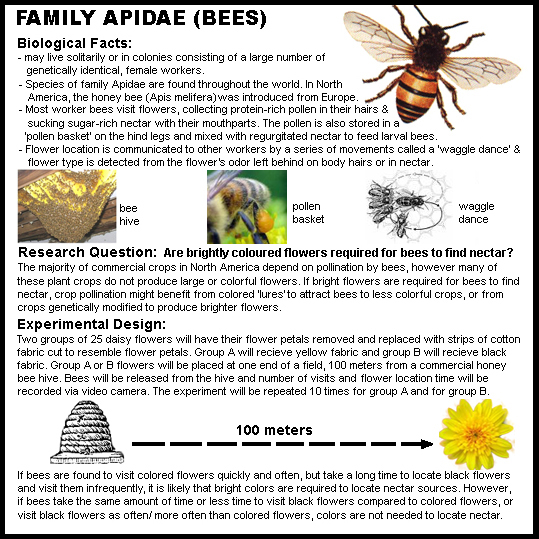
| EXAMPLE POSTER: |
 |
 |
| ___________________________________________________________ All images and information appearing on this website are intended for educational purposes only, and are the exclusive property of their respective owners. |