






February 1, 2002 is the day I will leave this rich country of the United States of America and enter the somewhat poorer country of Mexico. I had mixed emotions about leaving the USA but I had made it that far so there was no turning back.
There was no lineup at the border crossing, but progress was slow. First, I stood in the wrong line for ten minutes. Then I found the person who would give me a travel card to fill out. After that, I had to go across the street to pay a fee, about $40 Canadian, and then I returned to the first building to have the card stamped to indicate I had paid. With all that done, I finally entered Mexico and found the highway south.
Before you are really free to go, however, you must pass another checkpoint further along to insure that you paid the fee. If not, you are sent back to the border. When I finally reached this last checkpoint, they were very impressed that I had rode my bike all the way from Canada and was planning on crossing all of Mexico. They let me by without any problems.
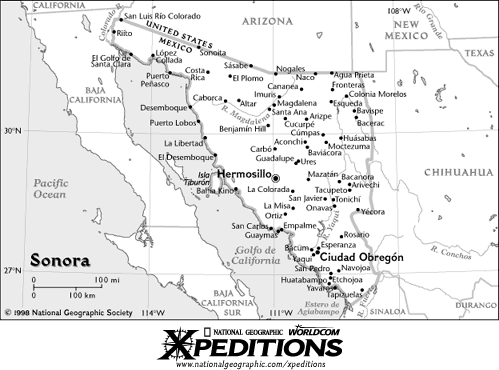
The first night in Mexico, I camped at the side of the road under a train bridge. Only one train went by until the morning when another train flew by waking me up. I packed up and left and as I approached the town of Esqueda, I was pulled over by a police officer driving a pickup truck. He inquired as to where I was going. After I told him, in my broken Spanish that I was going to the Yucatan I think he was trying to tell me that the route I was going to take was not good. I inquired where there was a grocery store and he threw his hands up in frustration and drove away. I found the grocery store and when I came out it had started to rain. Someone was looking at my bike and he gave me the name of someone I could stay with in Moctezuma but no address or phone number.
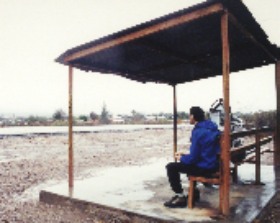
The rain continued and the road became worse. I was constantly reminded of how bad the roads were by the number of monuments at the side of the road for people who had died in accidents. By the time I finally made it to Nacozari de Garcia, I was shivering uncontrollably from the cold. I took the first motel I could find, only to discover that it had no hot water; but at least there was heat in the room. When I started out again the next day, it was still raining but the road conditions had improved somewhat and I was going downhill. I stopped for lunch at a bus shelter overlooking Los Hoyos.
The terrain had become flatter and by late afternoon I arrived at Moctezuma in the middle of a bike regatta. I started to look for a motel but I was told that everything was booked because of the regatta! After much searching, I finally found a hotel but this time there was hot water but no heat! I went downtown to look for a restaurant and Laundromat but everything was closed because it was Sunday. On returning to the hotel, the owner inquired if I had eaten and, when he realized I had not found a restaurant, his wife cooked me a delicious Mexican meal. I had coffee with the family and then retired for the night.
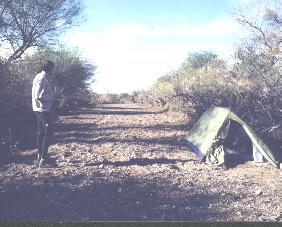
On February 4, I started down the road that I thought would take me south. After about an hour of holes, rocks and washboard gravel, I met a farmer in an old 1950 Ford pickup truck. He told me that I was on the wrong road, loaded my bike in the back of his truck and drove me back to the hotel where I had started. I started out again and it began to rain. I stopped in another bus shelter in Merquillo for lunch. I continued on until I arrived at a fork in the road that was not on the map, so I checked with the State map and decided to take the road toward Divisadero. The sun was setting as I approached the town so I set up my camp in a dried-up riverbed.
In the morning, I rode into town to get some groceries and the owner told me that I would have to go back to the intersection to get to my destination. I rode on through Tepache but soon after the road came to an end with fallen trees blocking the way. A dirt road branched to the left and, as I was sitting there deciding what to do, a truck came towards me down the dirt road. I asked him if that was the way to Sahuaripa and he gave me what seemed like very complicated directions as to how to get there. I then set off down the dirt road that was full of mud puddles from many days of rain. As I rode through the puddles, the mud collected between the tires and the fenders, both on the front and back, and acted like a sudden brake. I was frequently forced to stop and clean out the mud. I then arrived at another branch in the road that pointed to San Pedro. There I found a flat area with a couple of trees so I decided to set up camp.
The next day I set out again, but now I had run out of water! As a farmer went by, I asked him if this was the road to Sahuaripa - he mumbled something that sounded like it was. Two horses wandered down the road. I frequently saw loose horses, cows and donkeys. The sky had become very clear, it was very hot and I had no water. The road became hillier making the bike hard to control on the gravel. In addition, cattle guards across the road added more obstacles. By the early afternoon, I was exhausted and dying of thirst. I found some water in a riverbed, boiled it and added some purification pills for good measure. With my map and GPS, I realized that I had missed the road that branched to Sahuaripa so I would head to San Pedro. When I arrived at La Rancheria, I was unable to find water, so I decided to continue down the road towards San Pedro. The road was now going through some mountains and it continued to be impossible to make any progress, so I set up camp at the side of the road. By this time, I had developed a severe pain in my abdomen. I had a great deal of difficulty sleeping with the pain.
On February 7, I set out again through some incredibly rugged mountains on a dirt road that made the last few days seem like a picnic. The sun was beating down and there were no trees to get some shade. I desperately needed water but I kept passing dried-up riverbeds. One arduous climb and scary descent was followed by another when I finally found a trickle of water in a riverbed and desperately took a drink. A pick up truck driving in the other direction stopped to see if I was all right. They offered me a 3-liter coke bottle filled with water. Further down the road, I found a larger stream and stopped for lunch and then took a bath in the cold water. Soon after, a cowboy riding a horse stopped and asked me about my trip. As we were talking, another pickup truck stopped and the cowboy convinced them to give me a ride down the mountain. I no longer had the strength to fight the road, so we loaded my bike into the back and I jumped in with it.
This proved to be a very wise decision as the road down out of these mountains was an incredibly dangerous drive that zigzagged back and forth with hundred foot drops off the side and no guardrails. It was a very scary ride in a truck but on a bike that was unstable on gravel, it would have been suicide! We finally made it to the bottom in one piece and stopped at the Moctezuma River. The map clearly showed that there was no bridge crossing this river, but they plowed through with the truck. It would have been impossible for me to do this with a recumbent bike!
We arrived in San Pedro de la Cueva and they took me to a house where I inquired about a hotel. The owner told me that he could rent me an old house that he had inherited from his mother. The driver took me there and we arrived at a house that should have been condemned. There were cows, horses and four ostriches running around in the back yard. After we unloaded the bike, they then took me to a restaurant for a meal. I thanked them for the ride and they headed back to the road, either very brave or very crazy.
On arrival, I had asked Ruben, the owner of the house, if there was anywhere to do my laundry. In the morning, he came to the house wondering if I wanted to use the laundry facilities at their home. I gathered up my laundry and jumped into his 1979 Ford pickup truck, which looked like it had been through a battle. The windshield was completely smashed, he "hot wired" it to get it started and, on the rough roads, it felt like it was going to fall apart. First we drove to the edge of town where he had a corral full of cows. He buys cows from local ranchers, fattens them up and then resells them at a profit. He then took me on a tour of the town before going to his place where his wife offered me some food and coffee. I then did my laundry and hung the clothes out to dry, as they did not have a dryer.
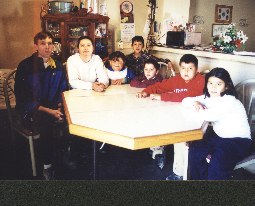
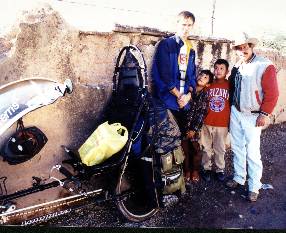
After doing my laundry, I spent some time wandering around town shooting some video. Back at the house in the late afternoon, Ruben showed up and told me to bring my camera as he was going to take me to the 'Big Lake" where all the gringos go fishing. We passed "Big Lake" but the years of drought had caused it to dry up to next to nothing. We continued on to San Jose de Batuc and here I realized that Ruben was actually out to collect money from people that had borrowed from him. He went into a house and I stood around waiting, but after about 1/2 hour he returned empty handed. We carried on to the next town, Tepupa, where he talked to a family that was in his debt, but no money. He then stopped at another place on the edge of town but this family was not home. We returned to his house where they offered me a meal of salty, dried beef and a tamale, which was stuffed, wrapped and cooked in a dried cornhusk. The men ate before the women and young girls ate last. In the evening we watched some television, then I returned to the run-down house for the night.
The next day, February 9, I packed up to leave and Ruben assured me it was a short ride over the mountains then a long "whoosh" downhill to Hermosillo. In reality, it was an incredibly steep climb that took me three hours to go 20 km. and the roller coaster ride continued all day but at least, the road was paved.
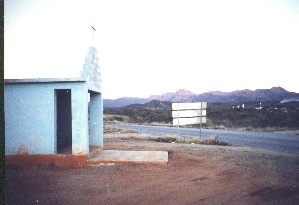
That evening, I stopped at a baseball field near Villa Pesquera and set up camp in the outfield. After supper I saw a steady stream of traffic heading towards town and I could hear loud music on a PA system. I rode into town to investigate and found a wedding ceremony taking place in the Town Square. The bride, who was dressed very elaborately, would dance with a guest, then wander up onto a gazebo and swing on a swing. It was a big production with a Master of Ceremonies, a live band and wedding videographers, as well as bride's maids and ushers all dressed to the hilt and all dancing around the large gazebo. After a while, I returned to the baseball field and settled in for the night.
The next day I had a small mountain range to cross but it proved relatively easy. After that, it was a 10-km downhill ride into Hermosillo and, with the bonus of having the wind at my back, I flew into town. As I approached the town, however, I struck a hole in the road, lost control of my bike and went crashing to the ground. After I assessed the damage, I continued down the road and found a motel. I made dinner and took a shower and then the abdominal pain that I had experienced on and off, became very severe. I went to the motel owner to ask if he would call a taxi so I could go to the hospital. After a few minutes, an ambulance with lights flashing arrived. I was reluctant to take an ambulance, thinking it would cost a fortune, but I relented and we sped off to the hospital with lights flashing. In the emergency room, they found a nurse that could speak some English. After running some tests, they concluded that it was just the change of food and water and gave me some medication to relieve the problem. They did not charge me anything and so I called a taxi and returned to the motel.
I had planned on staying in Hermosillo for two days and rest, but the motel had a policy that stated you could only stay twelve hours. You would have to pack up and leave and then check in again later in the day, so I decided to carry on. The wind was now blowing at my side as I headed south on a flat, four-lane divided highway with a lot of traffic and no shoulders. Towns were shown on the map but I never saw any sign of civilization. That night I found a tree with some bush to shelter me from the road and set up camp.
On February 12, the wind had died down and it was very hot. The landscape was like a desert with no trees, just cactus. I stopped for lunch under the one tree I could find. As I started out again, I realized I had a flat tire. Since it was the rear tire, I had to unload everything to do the repair. Back on the road, I stopped at a truck stop to get some air in the tire and met some Americans driving a motor home. They suggested I stop at San Carlos to camp as that spot offered the best views of the Gulf of California. As I turned off the highway toward San Carlos, I noticed all the billboards were in English. I stopped at the first campground I came to and found that everything was in English and the campground was full of Americans and Canadians. I set up camp by a couple of motorcycles from Washington State.
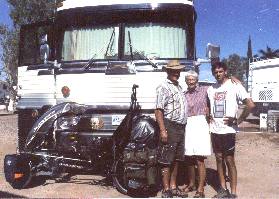
I decided to stay in San Carlos for a few days to relax, do the laundry and clean up the bike. The first day I met Ray and Shirley from Kamloops B.C. and they became my adopted grandparents for the duration of my stay at the camp. They had converted a 1967 Greyhound Bus into a very nice motor home complete with a bedroom, washroom, dining room, washer and dryer. Shirley offered me the use of her washer and while I was waiting for the laundry to finish, she gave me lunch. On February 14, Ray caught some fish in the Gulf of California and they invited me over for a Valentine's Day supper.
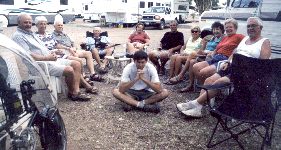
The next day I awoke with excruciating pain in my back. The B.C. group drove me into town and recommended a doctor that they said would speak English. I saw the doctor, had the recommended lab tests and returned to his office after lunch to get the results. He concluded I had a kidney infection and recommended antibiotics, lots of fluids and rest. The people in the campground were very concerned for my welfare and gave me a lounge chair to use for the duration of my stay. I resigned myself to staying here longer than I had planned but with the warm weather, a beautiful location and a whole camp ground of people looking after me, it was not too difficult to handle.
Mexico - Sinaloa State


Last updated 2002-05-05