






After doing a great deal of research on
long distance biking,
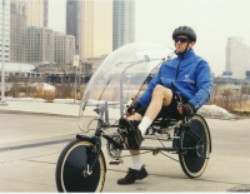 Gordon decided that a recumbent bike would be the most comfortable way to undertake such a trip.
He looked at all the different styles of recumbent bicycles on the market as well
as testing a few in Toronto where he was living.
His research led him to travel to Boston to test drive a Ryan Recumbent. Reviews in biking
magazines showed this recumbent bike as one of the best for long distant bicycle touring. After
considering all the possibilities, Gordon settled on the Ryan.
Gordon decided that a recumbent bike would be the most comfortable way to undertake such a trip.
He looked at all the different styles of recumbent bicycles on the market as well
as testing a few in Toronto where he was living.
His research led him to travel to Boston to test drive a Ryan Recumbent. Reviews in biking
magazines showed this recumbent bike as one of the best for long distant bicycle touring. After
considering all the possibilities, Gordon settled on the Ryan.
 usual modifications of wheel discs, lights and carbon fiber fenders for lightness were added. He
used heavy-duty rear racks to accommodate the largest available panniers. The front racks had
to be adapted to fit the small front wheels. The back of the seat was extended higher so that
there would be a more comfortable headrest. A small neck pillow was also attached with Velcro
for added comfort.
usual modifications of wheel discs, lights and carbon fiber fenders for lightness were added. He
used heavy-duty rear racks to accommodate the largest available panniers. The front racks had
to be adapted to fit the small front wheels. The back of the seat was extended higher so that
there would be a more comfortable headrest. A small neck pillow was also attached with Velcro
for added comfort.
However, the most challenging modification was designing and constructing a cover or body stocking. The enclosure was made up of an outside skin of waterproof sailbag cloth laid over a skeletal structure of fiberglass poles and an aluminum frame. Access ports were added to reach the rear panniers. A windshield, made of Lexan, was attached with Velcro to be used in rainy weather.
A solar panel was attached to the fairing in order to charge batteries for the lights and his video camera as well as any AAA or AA batteries used for the sound system. With help from an engineering friend, Gordon assembled a small 6-volt converter needed to change the 12-volt solar panel to the 6-volt needed for the batteries to run the sound system. The sound system consists of a small AM/FM short wave radio and a mini disc player.
Camera equipment included two camera bodies, three lens, a tripod and a video camera.

Last updated 2001-10-09