





When arriving in Managua on October 1, I tried to find the downtown area. I asked different people where the city centre was and they all gave me a different answer. After riding around in circles, I decided to ride to the waterfront and figure out what to do.
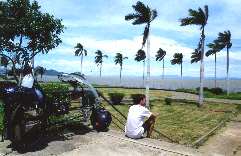
I remembered that the map showed a tourist information centre and also gave the names of all the major streets. However, there was not one single street sign anywhere. I used a landmark on the map and, luckily, found the tourist office. They gave me a brochure with the usual expensive hotels. I asked a taxi driver for suggestions and he gave me the name of a cheap place. I finally found a hotel for $10 American and paid for three nights. They had internet service and I had my own bathroom. For supper, I went to a food court in a mall that was beside the Intercontinental Hotel - an island of decadence in the middle of the slums.
The next day, I looked in the telephone book for banks that would have Interact Service. It was in another mall that was a long walk away and, in the heat, proved to be a real strain. I finally found a banking machine that would work. On the way back, I stopped at an internet place and sent a letter home to arrange for the bike ownership to be faxed there. As well, Claudia whom I had met in Belize, e-mailed me with the name of someone I could interview in Managua. Mr. Alejandro Bendana had been a Minister in the Sandinista Government and was now a teacher who had written a number of books on how the rich countries of the north exploited the poor countries of the south.
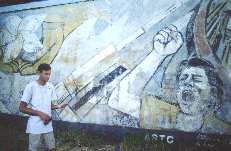
The next day, I e-mailed Mr. Bendana and then telephoned the El Salvador Embassy to see if they had a telephone book of San Salvador where I could look up Rubidia's address. I understood most of what they said but finding the Embassy without street signs was going to be a challenge.
The next day, I rode about 9 kilometers south of the city to an area called Los Colina. It was a rich neighborhood with big houses and Embassies but no street signs. After asking a number of people for directions and riding around for about a half hour, I finally fell upon the El Salvador Embassy. I went in and checked the phone book for the address of Rubidia's parents but found nothing that resembled the address she had given me. I rode back to the mall, had lunch and went to a early movie.
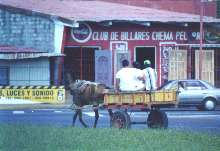
I decided to make a list of hardware stores to visit as I needed fuel for the stove and plastic to line the panniers since it was raining all the time. On the way, I stopped at a shop where they did iron work and had my seat fixed again. When I reached the area where the hardware stores were located, I only found one open and they did not have a clue what I wanted and suggested I use kerosene for my stove. I reluctantly picked up some kerosene and headed back to the hotel for supper then another movie. This one had been shot in Costa Rica on video and transferred to film. I recognized one of the actresses from a play I had seen in San Salvador.
When I returned to the hotel, I could smell something electrical burning. I awoke an hour later to a loud explosion and people yelling and dogs barking outside. I looked out the window and saw that a power line pole was on fire. The transformer had overheated and exploded and people had gathered to watch what looked like a cross on fire. The fire department arrived and put the fire out.
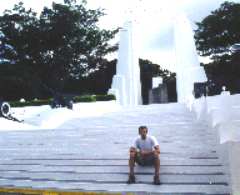
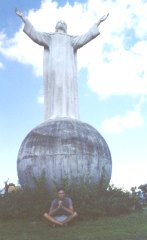
On October 6, I decided to shoot some video of the city. Along the way, I shot a picture of myself in front of a military monument, and then I climbed a hill to an overview of the city when I was approached by a soldier. He told me that I couldn't take pictures of the city from there because of a military base at the bottom of the hill. I wandered downhill a way, out of sight of the soldier, and got my footage of the city. I then headed back to the mall and took some film of the Intercontinental Hotel where the rich stay.
Back at the hotel, I discovered that a big rat was going through my food bags and, as soon as I entered the room, it scurried under the bed. I assumed that it had come in through the window. I poked under the bed with my bike pump and, after two tries, it climbed up an electric cord for the air conditioner and made its way out the window.
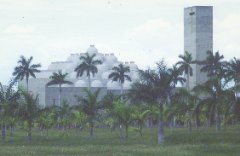
The next day, I still had not received an e-mail from Mr. Bendana so I decided to phone the University. The receptionist there told me that he was teaching in the Philippines and was not sure when he was going to return but she gave me his personal e-mail address. I e-mailed him and then tried again to phone Rubidia in San Salvador but with no luck. I then took some more video pictures when a fairly new battery, that I had only recharged a few times, died. I plugged it in to recharge and headed over to the mall and, by some miracle, found a battery that would fit my camera.
The next day, I found that my video battery had not recharged. I concluded that it was either a defective battery, the charger was not working, or the electrical outlet was defective. I started the process all over again in a new outlet and found that the battery was taking a charge. I then went back out with the video camera to finish what I had started the day before. I went to a poorer neighborhood that surrounded the government buildings and offices. Many buildings were in ruins from an earthquake in 1972 and squatters had taken them over. That night, I went to see the movie, "The Sweet Thing" with Cameron Diaz.
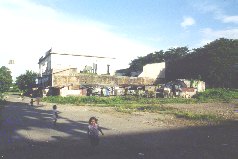
On October 9, I still had not heard from Mr. Bendana and I didn't think I would want to stay in Managua another week as there was very little to do. When I was out stocking up on food and water, I saw a sign to the Canadian Embassy and went looking for it. I found it nestled away in a fairly well-to-do neighborhood. It was not an impressive place but it was comforting to see the Canadian flag. In the afternoon, I went to another movie. Movies were cheap at about three dollars and they were air conditioned, so I was able to get a break from the heat. I returned to the hotel to cook dinner but the kerosene fuel would not get hot enough making it very difficult to cook a meal. It also coated the pots with black soot that I had to clean up every night. I later found out that there was a special nozzle for the stove if using kerosene but I had lost that somewhere along the way.
The next day, I rode over to the area where all the hardware stores were located but had been closed on my last attempt. I asked for white gas but none of them knew what I was talking about. Along the way, I went by a sign that said it was 35 degrees Celsius! I returned to the mall, had a Chinese stir fry for supper and went to see "Signs" with Mel Gibson. The next day, I took an inventory of all the repairs and improvements I needed to make to my bike and panniers and then I took the bus to search for the materials I needed. Back at the hotel, I worked on the various projects I had wanted to get done.
On October 12, I decided to move to cheaper accommodation and, since I had my bike all loaded up for the move, I shot some video of myself riding by various locations on the bike. I then went down to the waterfront and, as I was setting up, a uniformed guard approached and asked what I was doing. Apparently, I was in a high security area near the President's home. The guard wanted to see my camera. I was reluctant to give it to him. I rolled the tape back to show him what I had just shot. He wasn't interested in that either so I switched to camera mode so he could see it working. He then asked for my passport and wanted to see what was under the plastic on the bike. Apparently, he was only interested to see if I had anything like a gun or a bomb that would injure the President. When he was satisfied, he told me to go on shooting and wished me luck on my trip.
As I was heading back to the mall, my front brake cable broke. I found a bike kiosk in the Oriental Market area. I had a great deal of trouble finding the right cable and then, while I was installing it, my tool kit disappeared. The heat, the noise, the crowds and the constant questions and then having my tool kit stolen just about drove me to the breaking point. On the way back to my new accommodation, it started to pour and I arrived dripping wet. I checked in, had supper at a restaurant across the street and watched a movie at the hostel.
The next day at the hostel, I found there were travelers there from around the world. I met residents, one from California and one from England, who had been travelling together in a jeep for about a month looking for good places to surf. The English traveler worked on set construction in the film industry in England. I hung out with them for a few days until, on October 15, they loaded up the jeep and started out for Costa Rica to wrap up their trip.
I called the University again to try to find Mr. Bendana and the receptionist informed me that he was back in the city. I left my phone number and asked to have him call me. I then hung around the hostel for a day waiting for his call. The next day, I called the University again and this time, I got his home phone number. I called and got an answering machine with his voice; one step closer. I then went out for dinner with a traveler from France who had spent the day touring the city. I was surprised to find he really liked Managua considering he came from Paris. The next day, he left on a bus for Costa Rica.
I kept trying to phone Mr. Bendana but with no luck so I went in search of some books that he had written. I finally ended up at The Center for International Studies where I found a number of his publications. I chose one that was in English and went back to the hotel to read it. After that I went to the mall for supper and to a movie to see Insomnia.
On October 18, I finally got through to Mr. Bendana but he said he would not to able to do the interview as he was leaving town again. He suggested someone else who worked at the International Studies Center. I called the Center and Carlos was expecting my call as Mr. Bendana had spoken to him already. He wanted to do the interview right away so I hurriedly packed up my equipment and jumped on a bus. He took me to a conference room to set up when I realized that I had forgotten the headphones. He suggested that I return in the afternoon when he would be free again. I returned at 4pm and did the interview. The interview went well and Carlos talked as if he was using the opportunity to vent his frustration about the obvious problems in his country.
On October 19, after eighteen days in Managua, I packed up and hit the road, satisfied that I had gotten my interview
Leaving Nicaragua


Last updated 2002-11-29