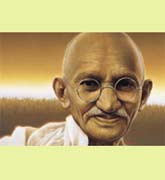
His words changed the thoughts of millions...
Navigation:
How has he effected our world today?
Gandhi's Philosophy
|
Gandhi's Philosophy The two main principles of Gandhi's belief are truth and nonviolence. The English word "truth" is not a perfect translation of the Sanskrit or "satya"; He felt that the ultimate truth is God (as God is also Truth) and morality - the moral laws and code are its basis. "Nonviolence", is an even more imperfect translation of "ahimsa"; nonviolence or love is regarded as the highest law of humankind. Gandhi's philosophy is also compatible with the view that humankind is undergoing gradual moral changes. While conflict is seen as unavoidable, in fact not always unwanted, violence as the result of conflict is not looked upon as certain. Simply put, human beings are good at heart; therefore have the potential to resolve conflicts nonviolently. This might be difficult, but it is not impossible. The ultimate responsibility of an honest person is to resist bias and being untruthful, either with others or alone. Resistance should be nonviolent if at all possible. But Gandhi forgave the use of violent means in certain circumstances, in preference to being viewed as coward. In relation to the use of violence he stated firmly: "Where there is only a choice between cowardice and violence I would advise violence..." As surprising as it sounds, Gandhi disliked violence, but he disliked cowardice and laziness even more. The eminent peace researcher Johan Galtung said that Gandhi preferred first, nonviolent resistance, second, violence in a just cause, and third, (least of all) disliked idleness. The central concept in Gandhi's philosophy is Satyagraha. As Gandhi defined it, Satyagraha is a way of nonviolence. It is a technique or tool of nonviolent action. As a technique, Satyagraha was developed by Gandhi in South Africa to give the Indian population there a weapon to resist the injustices being committed upon it by the colonial government. But Satyagraha can be practiced anywhere. A Satyagraha campaign is started only after all other peaceful means have proven ineffective. At its heart is nonviolence. An attempt is made to change, convince, or win over the rival. It involves applying reasoning and conscience simultaneously, while announcing the truth of his or her position. Any violence inflicted by the opponent is accepted without retaliation. But just because there is no retaliation (which can make the opponent feel his violence is reasonable), the opponent can only become morally bankrupt if violence continues to be inflicted constantly. Two points that need to be understood is that there can be no Satyagraha for a cause, which is not just and truthful. Nor can there be any violence or hostility in a Satyagraha movement - it must be carried out with genuine nonviolence. Any campaign that is dishonest, or is not started with a just cause, is not Satyagraha as Gandhi meant it. To sum up, Gandhi's philosophy is not only political, moral and religious, it is also traditional and modern, yet it is simple although it sounds very complex. It represents numerous Western influences to which Gandhi was exposed, but being rooted in ancient Indian culture. This is why Gandhi could say: "I have nothing new to teach the world. Truth and nonviolence are as old as the hills." Perhaps the philosophy is best seen as a pleasant blend of the traditional and modern. The difficult nature of Gandhi's thought can also lead one to believe that it is extremely complex. Perhaps in one sense it is. One could easily write volumes in describing it! Yet Gandhi described much of his thought as mere commonsense. Dr. Diwakar sums up Gandhi's thought in a few words: "The four words, truth, nonviolence, Sarvodaya and Satyagraha and their importance makes up Gandhi and his teaching." |