
Of all Napoleon's foes, the British
alone remained undefeated and implacable in their opposition. Unlike his other
enemies, who he was able to meet in open battle, the English were protected by
the English Channel and the Royal Navy. As a naval victory alone would not subdue
them, he needed to defeat the British on land and on their own soil as he had
done the Austrians and Prussians. To do this, the British navy had to be distracted
or defeated to allow his army to cross the channel.
With the establishment of the third alliance, between Britain, Austria and Russia,
Napoleon's priority shifted from defeating the British to avoiding defeat by her
new allies. Instead of covering his invasion force, his navy was required in the
Mediterranean to protect his forces in Italy by preventing the British and Russian
armies joining and attacking from his rear. On 14th September, he ordered Admiral
Villeneuve to pass through the Straights of Gibraltar, link with the Spanish squadron
in Cartagen, and head for Naples to block any attempt by the British to land their
army currently in Malta.

The British had kept the French
and Spanish fleets separated and locked in port. Of the ships of the line available
to Napoleon, 35 French and 25 Spanish; about one third were in the Mediterranean.
In 1803, the British had 111 ships, of which 60 could be used in home waters and
the Mediterranean. The rest were spread throughout the West Indies, North America,
India and the East Indies to protect British interests. Of the remainder, many
were dispersed on blockade duty. In 1805, 12 were stationed off Brest, six at
Ferrol, 11 at Toulon and five at Texel to keep an eye on the Dutch. There was
an additional reserve, six in Kent and five at Plymouth. As a generalization,
the French and Spanish ships could be viewed as more strongly built and more heavily
gunned than those of the British but they were blockaded in port and in various
states of disrepair, many unseaworthy.
The French revolution had decimated the officer corps of the French navy. Most
officers were revolutionary appointees, inexperienced in command and lacking in
ability while the rank and file was no better. In 1793, the Corps of seaman had
been disbanded and army soldiers had to be used to fight on board ships rather
than sailors and marines. The Spanish were in even worse shape, the French admiral
Villeneuve describing them as "herdsmen and beggars." The allied navies were,
therefore, inexperienced at naval warfare and unskilled at ship handling.
On the other hand, most English officers had been in battle. Sailors were mostly
either volunteers or had been pressed into service from the maritime community.
As a merchant ship sails the same way as a warship, they were experienced at ship
handling and gave the British a distinct advantage in maneuverability. More importantly,
most had seen action and experienced success. This resulted in confidence and
an expectation of victory that the French lacked.

British commanders tended to favor
placing their ships to the windward of their enemy whereas the French tended to
prefer the leeward. This gave the more aggressive British commander greater maneuverability
and the ability to choose the moment of attack whereas his French opponent was
forced to wait for the move and react accordingly. While the leeward ship had
the ability to slip away more easily if the battle became too hot, it was a tactic
aimed more at survival than victory.
French tactical thinking felt that the best way to defeat a ship was to destroy
its means of maneuvering. As such, the French tended to concentrate their fire
on the masts and rigging of their opponents. The British, on the other hand, saw
killing the enemy ship's crew as the preferred tactic and therefore concentrated
fire into the hull. Due to the strength in design of warships of the day, they
were rarely sunk by enemy fire but casualties could be very high. This, and the
British ability to fire at a faster rate, helps to understand why French and Spanish
losses tended to be so much higher than those of the British.
Fleet actions of the period had tended to be inconclusive. As a fleet closed on
another to attack, a ship in line only knew when to turn into attack when its
predecessor did. This resulted in a sequential attack where the battle developed
piecemeal. This, together with the French tactic of sailing to the leeward, allowed
them to easily escape. The only way to overcome this would be to approach line
abreast and attempt to rake the enemy. This was, however, a risky tactic as it
exposed the weaker bows to the enemy and masked the broadside. As a man-of-wars
armament was placed in its sides, when approaching head on, it was unable to return
fire. The attacking ship or fleet could be crippled before it was even able to
make contact. If the fleet broke through the others line, it would then be forced
to reform to the enemy's leeward side.1. Only
a brave and confident commander would use such a tactic and it was a modification
of this that Nelson intended to use against Villeneuve.


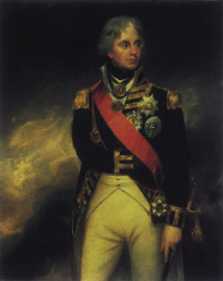
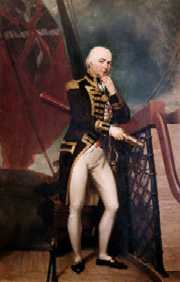
On 9th October, Nelson called his
captains aboard to explain his plan of battle. The British were to approach
the French/Spanish in two independent lines, the weather column led by himself
in Victory and Admiral Collingwood in the Royal Sovereign commanding
the lee column. His own column was to break the French line just ahead of the
enemies commander in chief, presumed to be at the center of the line while Collingwood's
division was to attack 12 ships from the end of the line. This would isolate
up to 20 of the enemies ships in the van giving the British a local superiority
of numbers to the rear, allowing them to envelop and defeat the rear of the
enemy before the van could turn and render assistance. The British could then
reform to meet this new threat or give chase if the van decided to run. As the
leading ships in each of his columns would be surrounded by enemies and isolated
from help as they broke the enemy's line, Nelson placed his most powerful three
deckers in the van to concentrate his firepower. Such a plan of close fighting
favored the British emphasis of firing into the hull and their higher rates
of fire.
Interestingly, Nelson's opposite number, Villeneuve, predicted that Nelson would
take such a course of action:
"The enemy will not confine himself to forming into a line of battle parallel
with our own and engaging us in an artillery duel... he will endeavor to envelope
our rear, to break through our line and to direct his ships in groups such that
ours such as he shall have cut off, so as to surround and defeat them."

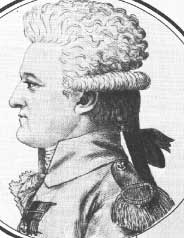
To overcome this tactic, there were a number of possible counters that could
be employed. The French/ Spanish could wear together and reverse their direction
as the British approached so that the rear of the line became the van. This
would cause the British columns to hit the front of the line. Instead of concentrating
on the rear and isolating the van as it sailed away in the wrong direction,
the rear ships would sail up to the action and be able to quickly join the battle.
Alternatively, the French could fire their broadsides into the approaching British
and then bear up and run to leeward to avoid being raked as the British reached
their line. The tactic decided on was of "equalizing the line." Believing that
Nelson had only 20 ships of the line at his disposal, Villeneuve intended to
form a "Corps de bataille" of that number and the rest into an "Escadre
d'observation" as a reserve to meet the enemy where he chose to concentrate.
In reality, however, this formation couldn't be effectively implemented due
to the poor sailing ability of his crews. On sighting the British on the 21st,
he saw that the British had more than 20 ships and that his "Corp de bataille"
was outnumbered. He was forced to place his reserve in the van forming one long
unwieldy line - the worst formation in which to meet the British.2.
A
List of the Fleets
1.Keegan I. Battle
at Sea: From Man of War to Submarine, Pilmico, London, 1988, p.49
2.Corbett J.S. The Campaign of Trafalgar,
Longman, Green & co., London, 1910, p.338

