

In a council of war, Villeneuve's
Spanish commanders refused to set sail knowing that Nelson and the British
fleet were waiting for them. Napoleon, expecting Villeneuve to avoid carrying
out his orders, dispatched Vice Admiral Francois Rosily to relieve him of
command. On hearing of this and that on the 18th, the British had sent a fleet
of four ships of the line to escort a convoy to Malta, Villeneuve convinced
his commanders to set sail.
At 7am on 19th October 1805, the British frigate Sirius raised signal
no. 370, "The enemy's ships are coming out of port or getting under sail."
This was in turn passed to the frigates Euryalus, to Phoebe,
to Niad and onto the ships of the line Defense, Colossus and
Mars. By 9.30, Nelson has the message and ordered a "general chase
southeast" towards the Straights of Gibraltar. Due to a drop in the wind and
poor seamanship, only eight of Villeneuve's ships managed to clear harbor
and it wasn't until noon the next day that all 33 had cleared port. This,
and Nelson's quick response, resulted in his fleet arriving at the Straights
well before the allies and forcing him to backtrack towards Cadiz. Villeneuve,
in the meantime, sailed into the Atlantic towards the out of sight Nelson
who kept watch with his frigates.
Dawn on the 21st saw the allied fleet approach the Straights to find it blocked
by the British. At 6.00 Nelson hoisted signal no. 13, "Prepare for battle".
Those ships which had not already done so, set about the task. On a 19th century
man-of-war, this was a major undertaking. Wherever possible, rigging was duplicated
and strengthened to prevent yards from being shot away and falling to deck
and the tiller was strengthened to preserve the ability to maneuver. Damage
control equipment was prepared to plug holes below the waterline and buckets
were filled with water for firefighting. Anything loose such as tables, furniture
and even livestock was either stowed below or thrown overboard and hand weapons
were placed around deck where they could easily be reached. Magazines were
prepared and the deck was doused in water and covered with sand to provide
better grip and soak up blood. Finally the galley fire was doused. Grog was
issued with the cold meals eaten before the battle to help fight nerves.
At 7.30, Villeneuve ordered a retreat to the north. He ordered the easier
option of turning down wind rather than tacking into it but it still proved
too much for his fleet who milled about for 1 1/2 hours trying to reform while
the British, using all possible sail, closed to attack. Instead of using fighting
sail, they utilized every bit of canvas in order to maximize their speed and
minimize the amount of time that the enemy was able to fire on them while
they were unable to reply. The British were aided by a heavy swell which had
caused the Allied line to lose its formation, opening gaps through which they
could break. The allied crews, for many of whom this was their first time
out of port, proved unable to keep close formation in the conditions. The
British, on the other hand, with years of experience, were better able to
keep station.

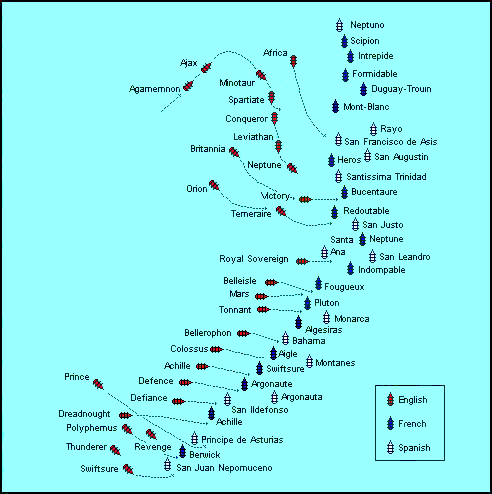
Source: Maine R. Trafalgar: Napoleon's Naval
Waterloo, Thames & Hudson, London, 1957, p.211


