
A deeply disappointed Edward ordered his weary troops to make camp for the
night. Making camp on the waterlogged bog of the Carse, they spent an uncomfortable
night, sleeping fitfully on the marshy ground, expecting a night attack at
any moment. During the night, the English cavalry crossed the burn, using
barn doors taken from a nearby village which was completed shortly before
dawn. The bulk of the infantry, however, remained on the far side of the burn,
splitting the force.
Edward assumed the Scots would stay on the defensive when faced by his superior
numbers. He planned to move his army onto the level and solid ground of the
plain where he could deplete the Scots with his archers before outflanking
and crushing them with his cavalry.
Robert, on the other hand, was under no illusions at to what he would face
the following day. Despite the high spirits flowing from the day's victories,
the English army was still intact and greatly outnumbered him. His victories
that day would allow him to withdraw with honor which is what he planned to
do until an English knight, Sir Alexander de Seton, made his way to the Scottish
camp. Brought before Robert, he told of the weak and dispirited condition
of their army and pledged on his own life that if Robert was to fight the
following day, he would win. Robert, therefore, has two choices if he chose
to fight. He could remain with his back to the wood in a defensive position
and risk being outflanked or to attack before the English could properly deploy,
forcing them to fight on unfavorable ground - he chose the latter.
The Scot army rose at dawn on the 24th and by 3:45am it was light enough to
see clearly. As they celebrated mass, those who had shown great courage were
knighted, including Randolph and Douglas. Full of confidence from the previous
day, they formed their divisions and received the order to advance.
Advancing in echelon, Douglas to the left, Randolph at the centre and Edward
Bruce to the right, they poured from the wood with a cry. Robert remained
with the cavalry and his own division to the flank of Edward Bruce out of
sight of the English.
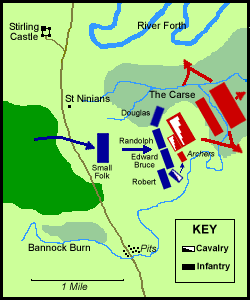

The English, with their split force, were temporarily stunned at the Scottish
advance believing they would fight defensively and allowed them to within
100 yards before the order for them to form was given. Suddenly, the Scots
halted and dropped to their knees in prayer. Seeing this, Edward sneered,
"They kneel to ask for mercy." Sir Ingram de Umfraille, a Scot in English
employ replied, "You say sooth now, they ask for mercy, but not of you. Those
men will win or die." The king simply replied, "Be it so" and ordered the
English advance.
The potent English archers scattered the few Scottish archers before being
jostled out of the way and to the rear where they were unable to fire for
fear of hitting their own advancing cavalry. The van, formed in good order
on the English left, was closest to Edward Bruce's division while the other
nine cavalry divisions jostled together into one large mass, lumbering over
the boggy churned up ground.
Glouchester, stung by accusations of disloyalty for suggesting they rest a
day before battle after their long march, spurred ahead and unsupported at
the Scots. His glorious charge ended as he was unhorsed by a spear and killed.
The other cavalry followed in a piecemeal fashion without any real cohesion.
As they attacked over the boggy ground, the English were able to make no headway
on the Scots. The two divisions of Randolph and Douglas moved up to strengthen
the line and present a single continuous line.
A body of several hundred archers was formed on the English left flank by
a quick thinking English commander and began to pour their deadly fire onto
the tightly packed Scots. Seeing this, and that the archers had been left
unsupported by cavalry, Sir Robert Keith, the commander of the Scottish cavalry,
ordered the charge. As the cavalry charged the unprotected flank, the archers
routed and scattered. As they were slashed down without mercy, the remaining
Scot archers once again began to fire on the English.
As the three Scott divisions steadily pushed back the English onto ever more
constricted ground, Robert ordered his division onto the English flank. With
the entire Scottish army now engaged in the brutal and bloody melee, the English
found themselves on unsteady ground without room to maneuver or fight. As
the routed archers, and then the shattered van were driven back into the main
body, the situation was made worse. Edward ordered countercharges which were
ineffective and continued to be pushed relentlessly back. Seeing this, the
Scots pressed forward with cries of "On them, on them, they fail!"
As Edward was about to order yet another counterattack, another even larger
Scottish division burst from the woods and streamed down the slope to join
the fight. Seeing another army approach, banners flying, the English broke.
This new army was in fact the Small Folk who had been ordered by Robert to
remain in the forest. Robert, always a clever commander, may have ordered
them to advance at that moment in an effort to break the English morale. With
this, the Bruce also flung himself into the din.
Edward, wile having exerted little effective command and having failed to
delegate it to one of his veteran commanders, had, nonetheless fought with
unusual bravery. Unwilling to leave the battle, he was forced to do so by
others. Led by the Earl of Pembroke and Sir Giles d'Argentau, they escaped
through the gaps between the Scottish divisions. As the Scots attempted to
grab the reigns of his horse to unseat him, Edward smashed down on them with
his mace.
Once Edward was clear of the battle, Sir Giles, seen as the third greatest knight
in all of Christendom, declared his honor prevented him from fleeing. With that,
he lowered his visor and plunged headlong into the thicket of Scottish spears
and was killed. Pembroke, feeling responsible for "his men," the1000s of levies
he had brought with him, returned to where they were stationed. He led them
from the field and managed to bring most of them safely to Carlisle which was
still in English hands. Edward's flight signaled the end for the English who
scattered and fled in panic.



