


Knowing the route the English must take to reach Stirling, Robert chose his
ground carefully. Two miles from Stirling, he found the ideal position. There
were two possible approaches from the south east. The most direct way was along
the old Roman road that ran directly to the castle. As it neared Stirling, the
ground narrowed through closely enclosed woodlands that would be difficult for
cavalry to traverse before opening up to clear ground beyond. The second was
to circle around the wood to a level plain to the east. The Bruce positioned
the four battails of his army to be able to cover either route.
The vanguard, commanded by Randolph de Moray, was placed in woodland near St
Ninians Kirk to the north. Closer to Stirling Castle, it was their job to cover
the clear ground to the east and prevent any forays from the castle itself.
Bruce, in command of the rearguard, placed himself blocking the Roman road.
He strengthened this position by digging numerous knee deep pits to trip cavalry
and break up any charge. The battails of Douglas and Edward Bruce were positioned
in between to be able to render assistance to whoever required it. The "small
folk" lightly armed and less disciplined, could be more of a hindrance than
a help in battle, and were moved out of sight to the rear.
To the front of the Scot position was the Bannock Burn, an overgrown stream with
steep sides that was difficult to cross except at the ford where it was bisected
by the road. To the left, the ground sloped down to a boggy area known as "The
Carse," a flood plain difficult for cavalry to operate. To the right was dense
woodland into which the Sots could retreat if the need arose. This was a defensible
position from which they could meet the English.
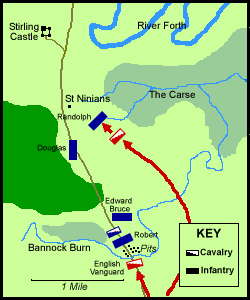


The English army began marching early on the 23rd, covering over 20 miles by
the time they were spotted by the Scottish scouts. Douglas and Keith, sent by
Robert to locate the English army, returned with the alarming news of its size.
Robert ordered them to keep this news to themselves so as to not dishearten
his men but the English could soon be clearly seen as they neared, their banners
fluttering in the wind, all the way to the horizon. Robert declared that any
Scotsman of faint heart could leave to which he was answered with cheers of
support that they would all fight to the death.
The English vanguard, under the joint command of the rival Earls of Glouchester
and Hereford, approached the Scot position along the old Roman road. On sighting
the Scots, they pressed forward recklessly without waiting for the main body
of the army to arrive, scattered many miles behind.
Sir Henry de Bohun, Hereford's nephew, riding some distance ahead of the main
group, crossed the ford and spotted the Scots retiring into the woods. In front
of their positions, he sighted a lone horseman astride a small horse and easily
distinguishable as Robert the Bruce by his gold crown. Without pausing, de Bohun
lowered his visor and spurred his heavy Flemish charger up the slight incline
towards the self proclaimed king of Scotland, thoughts of glory in his mind.
For Robert, it was unthinkable to run from such a challenge, even one as unequal
as this. To do so would break the already shaky morale of his army, disconcerted
by the size of the English force.
At first, he did nothing, watching as the Englishman thundered up the hill towards
him, lance lowered and clods of earth arching up behind by his chargers hooves.
As de Bohun neared, Robert gripped his small battle axe and urged his horse
into a gentle trot down the hill. At the last moment, he swung his smaller,
more nimble horse to the side, allowing the deadly lance of the astonished de
Bohun to pass harmlessly by, rose in his stirrups and with a mighty swing, brought
his axe crashing down onto the back of the Englishman's helmet. Such was the
force of the blow, the handle shattered as the blade cleaved through the helmet
and into the skull of the Englishman.
The English advance guard halted in stunned silence as de Bohun toppled from
his horse and crashed to the ground. Amid Scottish cheers, Robert returned to
the safety of his lines complaining of the loss of a perfectly good axe. While
being admonished by his advisors for placing himself at such a risk, it provided
the morale boost his army needed.
Before the English vanguard could recover, the Scots advanced, the combined
divisions of Robert and Edward Bruce rushing down the hill. The shaken English
retreated in disarray. Their retreat was reduced to a chaotic route as many
of the fleeing knights stumbled into the potholes that had been laid for that
very purpose. Glouchester was unhorsed as his mount tripped but managed to gain
a new mount and make good his escape. A number of knights were not so lucky
and were slain as the wave of Scotsman swept over them. Only the force of Robert's
personality prevented them from pursuing the English over the Burn.

After this setback, Edward sent a strong reconnaissance detachment of 600 cavalry
under the command of Sir Robert Clifford and Sir Henry Beaumont to discover
more about the Scottish position and numbers. As they moved to the east under
the cover of trees, bickering over who should lead, they came out into the open
where they were spotted by the Scots. Robert was initially annoyed with Randolph,
whose job it was to cover that route, for allowing them to get so far, rebuked
him with the comment "a rose has fallen from your chaplet." Stung by this criticism,
Randolph left Robert's side and returned to his men. Other accounts suggest,
however, that Randolph did know of their approach and was allowing them to outstrip
the support of the main English army before challenging them. The English, for
their part, were oblivious to the Scots presence until Randolph's 500 spearmen
marched out of the woods to block their path.
The Scots quickly formed a schiltrom, similar to the later British infantry
square but oval in shape, bristling with outturned spears. An approach from
any direction would be met by a thicket of spears.
Beaumont suggested they simply ride around the Scots and continue towards the
castle but Sir Thomas Grey observed that whatever they did, the Scots would
be in a superior position. When told that if he was afraid, he was free to leave,
with his bravery questioned, he and Sir William Dreycourt lowered their and
lances and charged headlong into the forest of Scottish spears. Sir Thomas was
dismounted and captured but Sir William was killed. With a cry, the English
knights charged. The Scots buckled but managed to hold. The English reformed
and smashed into the Scots again and again, unable to cause a breach while their
own losses mounted. Unable to break the schiltrom, they resorted to throwing
swords, maces and any other objects into the mass of spearmen with little effect.
The objects were piled at the center but still the schiltrom held firm. The
English by this time, no doubt regretted not bringing a contingent of archers
with them who would have quickly shot such a densely packed group of infantry
to pieces.
The battle lasted over an hour in the afternoon heat as the dust swirled around,
thrown up by the horses. Twice, the Black Douglas asked to assist Randolph's
tiring men but was refused. It was Randolph's battle and the glory should go
to him. Finally, Douglas was given permission. His body of 1,000 spearmen marched
out of the woods on the Englishmen's flank, halting 100 yards or so away.
Faced by a seemingly immovable wall of spearman in front and 1,000 fresh Scotsmen
watching attentively on their flank, seemingly ready to charge, the English
faltered. Seeing this, Randolph ordered his men to break their protective formation
and charge the cavalry! This was too much for the tired and frustrated English
knights who broke and fled some to Stirling Castle and others back to the main
body. This victory proved to the Scots (and the world) that disciplined infantry
could defeat cavalry in the open. Unable to catch the cavalry, they returned
tired but triumphant to the main body of their army.


