|
nection to the U.S. It was decided that while Michael stayed behind with the boat, I would make a brief visit to Conrad in California to see how his convalescence was coming along after his burn accident. On my return journey I would detour to Maui to visit our daughter and her family as well.
So rather than kick back and relax now we plunged into a whirl arranging plane tickets and finishing off my book so that I could have copies printed in the States for distribution to possible publishers. Between chores we bumped into one or the other of the local cruising community, some of whom had part time jobs on the island. One of these was Glynn. After I mentioned that I thought I would have to take my laptop to the States to get it fixed, he came over and dismantled it and then put it back together and it worked (for awhile). The kindness of cruisers to each other is certainly one of the bonuses of the lifestyle.
The over-layering of foreign influences has nearly obliterated native culture on heavily overbuilt Majuro. Today Majuro is the capital atoll of the Marshall Islands group made up of 29 coral atolls and 5 single islands spread out over an exclusive economic zone of nearly 1 million square miles. The country has been an independent country since 1986 but operates within a Compact of Free Association with the U.S. What this means essentially, is that the U.S. pours many millions of dollars a year into the Marshall Islands, in return for the use of some of its territories as military tracking stations. They also pay compensation for damage to Bikini Atoll, made almost permanently uninhabitable after Atomic Testing in the 1950's. The money which flows in we are told tends to stick to a few families or used to fund expensive fripperies rather than helping raise the general standards of health and hygiene.
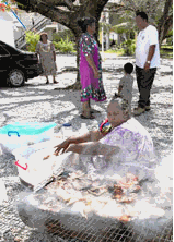
The Marshallese people are short and squat and burnt very dark by the sun as they make no attempt to cover themselves or wear hat. The women have oval faces and soft lustrous black hair, always worn long. When they are young their faces reflect some of the Malay blood that flows in them, but as they age they grow stout, though seldom obese.
No one walks in Majuro. Taxis pick up people anywhere along the way and deposit them where ever they like along the single slow road that meanders several miles over bridges linking three islands out to the airport and then back again. As many as will fit climb into the air-conditioned cars, as cold inside as an arctic strorm. Local taped music swings to a melodious slow beat, like the unhurried Marshallese heartbeat. It is a languorous sound reflecting a languorous people, who are never interested in exerting themselves, but always quick with a smile.
Our 50 cent ride took us to the immigration department housed in a pretentious coral-colored, mirror glass five-story building. It was easy to get a 30 day Visitor's visa, followed up by customs entry. Departure turned out to be a little more complicated, requiring us to go first to the Port Authority to pay a $30 light fee as well as $60 harbor departure dues (minimum charge), before we could be cleared from Customs and Immigration.
We never got a chance to know the Marshallese well as our social life was taken us with the cruisers who befriended us. We did learn that society was and for the most part, still is, stratified into three general classes: chiefs, clan heads, and workers. Chiefs have ultimate control of such things as land tenure, resource use and distribution, and dispute settlement. The duties of clan heads include maintenance of lands and supervision of daily activities. The workers are responsible for the daily work involved in subsistence living, such as construction of
|
|