|
homes, agriculture, canoe building and so on. Inheritance of land is matrilineal.
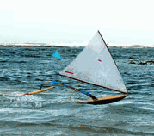
Like other places in Micronesia the sailing canoes legacy is important. We saw small ones we took to be pleasure craft, sailing in the lagoon. However on a windward beach one late afternoon when the shadows were already long, we chanced on a group of children racing their meter long hand-built model canoes with greatly extended outriggers. The model boats were extremely fleet and resistant to capsizing --- impressing us greatly.
The Marshall Islands were named after two British Captains who sailed into the islands in 1788, two centuries after the Spanish explored the region and set up trading contacts with the Marshallese islanders.
Germans also set up trading in the 1850's, building the first trading posts. The Marshalls were eventually declared a German protectorate with headquarters on Jabor, Jaluit.
The local guide book tells us that "When the First World War broke out 29 years into official German rule, Japan, which had joined the allies quickly after the beginning of war, sent naval squadrons into the Marshalls and took military possession of the islands in October of 1914.
"After heavy fighting in the Pacific and especially in the Marshall Islands, the Japanese were defeated in the Second Wold War and the United States was the next major power to occupy the Marshalls. After the U.S. takeover in 1945, the U.S. Navy governed the Marshalls (in addition to the Northern Marianas, Palau, Yap, Chuuk and Pohnpei) and in 1947 the Marshalls were given by the United Nations to the U.S. as a Strategic Trust. In 1951, the administration of the Marshalls switched from the U.S. Navy to the Department of the Interior."
Today the main industry for the Marshall Islands is the fishery. With almost a million square mile "Economic Zone" that straddles an ocean of wild fish, the government has been able to license fishing consortiums from many countries. Large factory ships anchor in the harbor. Smaller trawlers regularly return from sea to unload onto the larger ships which process and freeze their catch before themselves setting off for Japan, Taiwan or Korea to unload in turn. Some days we counted up to 50 fishing boats, large and small. There is also a cannery ashore.
I lugged my laundry ashore to the local Laundromat. Like so many of the small islands where the local's own traditions make going into business almost impossible, the Chinese merchants have moved in to fill the gap. The Laundromat, an extension of the next door Chinese Store, was immaculate, with not a single machine out of order. I crossed the street for lunch at an equally immaculate Chinese restaurant.
Natives of the Marshall Islands, like so many in the Pacific, have communal customs that make it impossible to run a business profitably. There are too many obligations to clan and family members that must be honored. Truly private property is almost unknown. Any family member can lay "borrow" what belongs to another --- and then not return it. Poorer family members are fed by those with
|
|