|
We entered Avapehi Pass, turned and headed southeast, back the way we had come about four miles, to Baie du Bourayne, where the two islands were separated.
The bay, besides being beautiful, was also very deep. We had to anchor in 90 feet of water. By dinghy we set off to explore, threading our way through the channels and under the bridge to emerge in Baei Maroe, a large bay on the eastern side of the island, also very deep and difficult to find anchorage in. Natives we saw fished from a canoe in the channel, but did not come near.
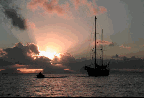
The next afternoon we proceeded further south along the coast, under power with our main awning still rigged to give us some protection from the scorching sun. Even in the shade we sweltered. Tiny white sand beaches over-hung with palms pocked the gentle landscape with a scattering of yachts, some of them chartered bare boats, anchored near them. At the extreme southwest, just inside Pt. Tiva where we had caught the mahi-mahi, lies Baie d'Avea, reputedly the prettiest white sand beach in French Polynesia. The turn of the land gave moderate protection against the southeast trades but was breezy enough to keep the boat cool.
We were a little community of foreign yachts, Norwegian, Swedish and New Zealand, joined by a succession of local charter catamarans. Small, unsophisticated beach resorts dotted the beach, and a smattering of local homes. It was Michael's 60th birthday. H was living his dream, which was the birthday present he wanted, on this day that was a special milestone in his life
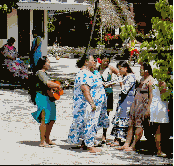
On the eastern side behind its own bay sheltered by an offshore motu, lay the village of Parea, in full voice because it was Sunday. On our tandem we passed church after church as we peddled along, from which issued harmonious hymns. When the services were finished and most of the people had gone home, groups of ladies still lingered behind outside in the shade to sing some more.
At swampy Baie Mauhiti, children who tossed mangoes down from a tree and broke out in gales of laughter when they saw the bike. They danced and laughed around us and begged for rides on the bike, but jumped around so much on the seat hat it snapped off! Five miles from home Michael ingeniously lashed the remains of the seat back together with string he found so I could ride rather than walk home!
Back on the boat we swam in the perfect water, lounged on the decks, and ate the huge chocolate cake I had made for Michael's birthday. That evening, at the little resort ashore, we met the Scandinavian cruisers, with whom we immediately struck a rapport.
Lighting was flashing in the west and cloud blanketed the sky by the time we returned to the boat. The mara'amu blew strongly. We dropped the awnings and wind scoops and made everything on deck secure.
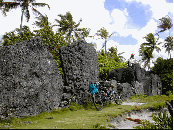
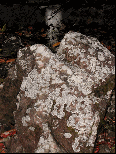
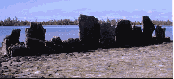
After wishing our new Scandinavian friends a good trip we left Baie d'Avea to head northwest to the opposite end of the island where we anchored in the old port of Fare. Just eight kilometer beyond were some ancient 16th century marae sites that had been restored in the 1970's by a team of archeologists from Honolulu's Bishop Museum. Artifacts dating back to 850 AD were also discovered when the adjacent lagoon
|
|