|
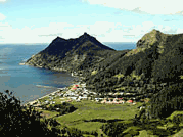
Afternoons we strolled ashore. One day we climbed Te Vai Tau, the nearest of the 12 fortified Pas that encircled the island at the tops of its high peaks. In olden times when the natives almost continually warred with one another, and each clan jealously guarded his land with lookouts, archeologists have estimated that the largest of these, Morongotoa Pa, was once inhabited by approximately 400 people.
Tough and wiry dwarf fern scratched our legs and tore at our clothes as we climbed to a remnant grove of aromatic sandalwood, one of the commodities that first brought the European and his depopulating diseases to these shores. The Pua-rata, with its red pom-pom flowers reminded us of home, and New Zealand's own Rata vine and Pohutakawa trees. Some scientists, by studying the similarities of flora and fauna among other things, have concluded that in past geological ages, a great continent spanned what is now the almost empty Pacific, linking Australia, New Zealand, Southeast Asia, Hawaii, perhaps even including parts of Peru or Chile. (D.S. Allan and J..B. Dulair, Cataclisym! Compelling Evidence of a cosmic Atastrophe in 9500 B.C. (Santa Fe: Bear & Company, 1997).
A dwarf tree fern sprouted "branches" of new growth, unlike the New Zealand variety, which grew straight. Louis told us the new shoots had been used in times of starvation as food. We turned to survey the harbor spread below, the coral patches clearly visible from this height. Behind us the peaks of what was once a great crater fanned out like an amphitheater for giants --- or Gods!
In the 1960's the Norwegian Thor Heyerdahl, of Kon Tiki fame arrived with a theory that exiles from Easter Island found refuge here. Perhaps a remnant did, and mingled with the older population. It is difficult to be sure. Archeology has shown Rapa-Iti to have been inhabited since (at least) 1300 AD. However, the mountain fortresses were constructed later, almost at the time of European contact. Nowhere else in Polynesia, except in New Zealand, where Pas are common, do such structures exist. And in both places the same word is used to describe them. Does this suggest then, that the N.Z. Maori is also linked to Rapa-Iti?
Capt. Goege Vancouver discovered Rapa for Europe in 1791. In the 19th century English missionaries converted the islanders to the protestant religion. The population, estimated to be between 1500 and 2,000 befoe European contact began to fall, decimated in the usual way --- by contact with sailors abourd whalers and sandalwood ships who intorduced disease and firearms. By 1867 there were a mere 120 people left.
A front galloped past on our last night in Rapa, funneling into the bay from the mountains. The anchor held fast and we felt grateful for the shelter of the bay. In the morning, which dawned bright and clear, we set sail for a nice breeze for Ile Gambier, 550 miles to the east.
Two days out we were over taken by another cold front that blew for awhile at 40-50 knots. But by mid morning of the next day we were underway again in large confused seas. The strong winds continued to push us eastward until we realized that up ahead was an almost continuos display of lightening. Hurriedly we cleared the cockpit, set the trisail and hove to while the northwest edge of a newly formed low howled past.
Iles Gambier
Six days after setting out the jagged mountain peaks of the main islands of the Gambier Group began to pop up above the horizon. In the south there is no distinct barrier reef. The coral appeared in clumps here and there, more numerous as we closed the land. Mangareva is the largest island of the group. Rikitea the main village.
|
|