|
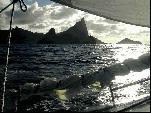
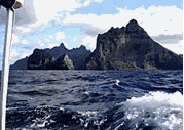
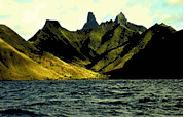
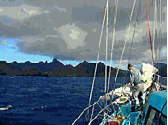
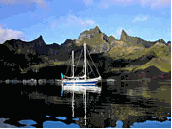
The day dawned bright as though last night's squalls had been just an illusion. Rapa's high volcanic peaks on western side, still in shadow, were all claws and teeth. Ridges plunged, without relief, hundreds of feet to the sea. There were deep, beachless bays that looked to be deathtraps for unwary mariners. However, as we rounded the southern coast the strong lines softened a little, and appeared more inviting. Rapa's glorious harbor, huge for an island only 5 miles in diameter, was formed from a breached crater. Little swell enters but we were warned to beware of the buffeting of strong winds funneling down from the peaks. We found a place to anchor far from shore in line between the innermost leading mark and a large protestant church on the southern side of the bay where we made sure it was dug in deep. Should one drag here, especially in the night, it could be difficult to find another suitable place between areas too shallow or profoundly deep!
Ashore, we were very surprised to find the local gendarme in Haurei village surprisingly relaxed about our unscheduled appearance. Since the cessation of the French Nuclear Testing at Muraroa and the removal of a military radar station on Rapa, the policy has significantly changed. He was interested mainly in seeing our clearance papers from New Zealand, not the passports and visas.
We met Louis, a strange character who spoke very good English. He did not fit into the local community, although he was born here, and had we not become involved with him, others may have better received us. He was an evangelistic Mormon in an overwhelmingly Protestant village. Louis insisted it was his God-given right not to labor, which may not have endeared him to the villagers who he leaned upon to give him their hard-won fish, goat or beef, as well as vegetables and fruit. Of course we did not know all this when we met and Louis generously offered the use of his washing machine.
We were told that Rapa-Iti (Easter Island is Rapa-Nui, Big Rapa) is in all of French Polynesia the only one that remains owned by the community as a whole. The local administration has resisted the efforts of the French to officially survey the land so that it could be bought and sold in individual names. It has also spurned the offer of the government to build an airport, preferring their cultural purity and isolation. Once every month or two a supply boat arrives for the 500 strong community, although during our visit the co-op shelves were as bare as bones. The supply boat had run on a reef.
Our visit coincided with the return for the holidays of the school children aboard a government ship provided for the purpose. In preparation for the reunion ladies baked dozens of sponge cakes and gallons of freshly squeezed orange juice mixed with heady passion fruit. Others wove flower leis and crowns with which to greet their relatives. When the gleaming white Tahiti-Nui arrived in mid-afternoon, we wandered down to take a look. Heavy bags of oranges were off-loaded from mud-caked trucks, bound for the Tahiti marketplace. The cool-store was opened from which carcasses of beef were dispatched. A local group of young women, on their way to Tahiti for the month-long dancing competitions, hauled tin trunks of stage props, clothes bags, and stiff rolled cow hides to sell or barter to pay their way.
Dignified large ladies dressed in flowered, lace-edged muumuus hugged babies or greeted their children and grandchildren, kissing both sides of the cheeks, French fashion. Men with tattooed mahogany skin and muscular solid backs stood looking on self-consciously.
The harbor has a village on each side, each presided over by its own large Protestant church. After dark the practicing drummer from these two villages vied with each other, the beat becoming stronger, more insistent as the night wore on! Our days were mostly spent washing away the salt from the interior and bilges.
|
|