   |
Wunala Dreaming
The story of 'Wunala' started thousands of years ago with the ancient Dreamtime stories of Aboriginal people
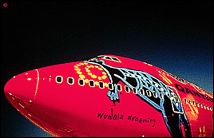 and they continue
with the most advanced technology thats available for your own experience.
To celebrate our great country, so rich with diverse
cultural heritage and its natural beauty, in 1994 Qantas commissioned
a painting from an internationally known design form, "Balarinji"
Designs, in Adelaide, and South Australia. A team of Aboriginal and
non-aboriginal arists developed distinctive images using a
contemporary graphic style featuring motifs which come from Northern and
Central Australia to create one of the world's largest pieces of modern art - a unique Boeing 747-400.
and they continue
with the most advanced technology thats available for your own experience.
To celebrate our great country, so rich with diverse
cultural heritage and its natural beauty, in 1994 Qantas commissioned
a painting from an internationally known design form, "Balarinji"
Designs, in Adelaide, and South Australia. A team of Aboriginal and
non-aboriginal arists developed distinctive images using a
contemporary graphic style featuring motifs which come from Northern and
Central Australia to create one of the world's largest pieces of modern art - a unique Boeing 747-400.The natural colours of the country inspired the artists' colour selection, from, the bright reds of Uluru (Ayers Rock) at sunset to the blue-lavenders that bring out the Flinders Ranges lining the Center's desert horizon. And if you've visited the wetlands of Kakadu, you'll recognise the lush apple-green.
The Dreamtime Legend
The Aborigines boast the world's oldest continuous culture which dates back to some 40,000 years. It is passed on though dreamtime legends from one generation to the next. John and Ross Moriarty, principals of Balarinji Design, explained the 'Wunala Dreaming' of the Yanyuwa tribe from the Gulf of Carpenteria:
"In dreamtime journeys, spirit ancestors in the form of kangaroos (Wunala) make tracks from camps to waterholes, leading the people to water and food. Today, as they have for centuries, Aboriginal people re-enact such journeys through song and dance 'corroborees'. These ensure the procreation of all living things in the continuing harmony of natures seasons."
Modern Mythology
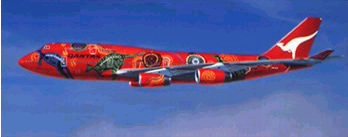
As the plane is fitted with much modern art, the painting of this plane is a blending of old and new. Wunala Dreaming was digitalised on a computer and then magnified 100 times to make 2 kilometres of blotting paper. This allowed the 67 patterns - including 1324 irregular dots - to be traced onto this Boeing 747-400 aircraft, the most advanced aviation technology available for commercial travel was used.
"Nalanji" means "place".
Internationally-renowned Australian Design studio. 'Balarinji', created the "Nalanji Dreaming"
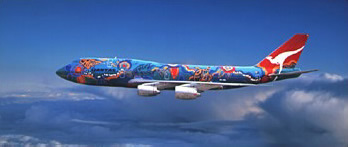 design for Qantas to celebrate
the balance and harmony of nature in 'our place', here in Oz.
In late 1995, this aircraft became the second designed and painted
Aboriginal contemporary style for Qantas.
"Nalanji Dreaming" shows its uniquely Australian cultural
theme in lush, tropical colours. The Yellow sun rays dot
intense blue sky. Flowers and vines shows the rainforest and
symbolizes, too, tracks between ceremonial places of the 'Great spirit ancestors'
when they created the Australian landscape in the Dreamtime.
Emerald green shows the colours of the forest. Vivid blues are
the tropical reef waters that splash on our golden shores along the
entire perimeter of the Australian continent. A flash of
watermelon catches the eye like a native parot flying through
the canopy or a flower in sudden bloom.
design for Qantas to celebrate
the balance and harmony of nature in 'our place', here in Oz.
In late 1995, this aircraft became the second designed and painted
Aboriginal contemporary style for Qantas.
"Nalanji Dreaming" shows its uniquely Australian cultural
theme in lush, tropical colours. The Yellow sun rays dot
intense blue sky. Flowers and vines shows the rainforest and
symbolizes, too, tracks between ceremonial places of the 'Great spirit ancestors'
when they created the Australian landscape in the Dreamtime.
Emerald green shows the colours of the forest. Vivid blues are
the tropical reef waters that splash on our golden shores along the
entire perimeter of the Australian continent. A flash of
watermelon catches the eye like a native parot flying through
the canopy or a flower in sudden bloom.
By helping celebrate one of the world's oldest cultures and the latest in aviation technology, Qantas came up with "Yananyi Dreaming", a painted Boeing 737-800 aircraft.
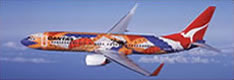 The fuselage layout was designed by 'Balarinji' using individual
motifs which was painted by "Rene Kulitja" whose vibrant colours where inspired
by the dramatic landscape surrounding Uluru
The fuselage layout was designed by 'Balarinji' using individual
motifs which was painted by "Rene Kulitja" whose vibrant colours where inspired
by the dramatic landscape surrounding UluruUluru has dominated the Western part of Australia for millions of years. The 'Anangu' people have lived in that region for more than 40,000 years, maintaining their special sites and unique culture. Through song, dance and art, they tell their Tjukurpa - Anangu stories of the land and journeys that hold their knowledge and their Law. The Dances from the 'Tjukurpa' teaching Anangu way of life and a great history of their land are passed on from generation to the next, keeping their culture strong.
"Yananyi" means going or travelling.
"Yananyi Dreaming" radiates pathways lead to the symbol of Uluru, though both are a physical form surrounded by Kurkara (desert oak trees), and as a representation of concentric circles. Blue hills (Tali) come up from the desert landscape, and mala (Rufous Hair - Wallaby) tracks are imprinted on the sand. Lungkata (Blue tongued Lizard) sunbakes in the hot sun in this fragile and ancient place.
"Yananyi Dreaming" is the strong Uluru story.
Rene Kulitja tells of her artistic work for "Yananyi Dreaming." "This is my traditional place. I am a Pitjantjatjara woman. My pictures tell about the landscape, the animals and the plants of Uluru. We go hunting in the desert for tjala (honey ant) and lungkata (Blue-tongued Lizard). I am a traditional owner at Uluru. My husband, my kids and I - we love this country."
"Yananyi Dreaming" was introduced to Australia with a special 'Inma ceremony' which was performed by singers and dancers from Rene's 'Mutitjulu' community in Uluru.
"Yananyi Dreaming" is Qantas' third aircraft to be painted with an Aboriginal design and will be used in the Australian domestic market.
About the Aircraft The 737-800 is a 'Boeing Next Generation' Aircraft. It has a number of new features,
 every one of them was designed to enhance your flying experience.
They use the latest in-flight entertainment with drop down LCD monitors.
There is more storage space for your personal belongings.
There engines have been updated. It puts out more power, burns less fuel,
generates fewer emissions and makes less noise.
every one of them was designed to enhance your flying experience.
They use the latest in-flight entertainment with drop down LCD monitors.
There is more storage space for your personal belongings.
There engines have been updated. It puts out more power, burns less fuel,
generates fewer emissions and makes less noise.Revolutionary new wings improved its efficiency, making the plane fly higher for a smoother ride. The new winglets (rear wings) allow the plane to fly further and climb faster in order to get you where you want to go even faster.
Technical Specifications
39.5m long from nose to tail
35.8m from wingtip to wingtip 2.5m winglets
12.5m high from the ground to the top of the tail
Seats up to 189 passengers
Range of 5,508 kilometres
Capacity to carry 26,035 litres of fuel
Painting Specifications
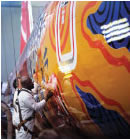 Painted at Boeing's Seattle headquarters.
It used484.5 litres of paint.
Took 2,000 man hours over six days to complete.
It used 200 large plastic stencils, 7mm thick measuring 1.27m x 3m defined the overall design.
63 pieces of nylon stencil ranging in size from 0.5m x 1.5m to 1.25m x 5.6m created the more intricate designs.


© Ray Webb - GiraMCAL
Information used with permission
