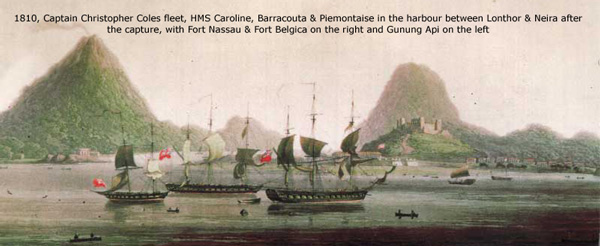
During the Napoleonic wars in the early 19th century the French occupied the Netherlands
and as a consequence the Netherlands East Indies were a threat to British
interests in the east. It was decided to eliminate this threat and plans were
made to occupy the islands of Ambon, Banda Neira and Java
CAPTURE
OF BANDA-NEIRA 1810
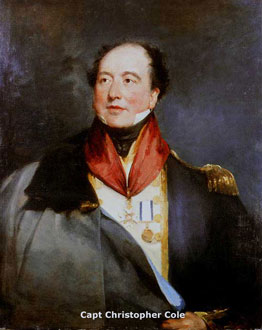
On
10 May 1810, Captain Christopher Cole of the Royal Navy in his ship HMS
Caroline with Piedmontaise, Barracouta and the Mandarin
transport under his orders, he left Madras to support the garrison at Amboyna
which had been captured in February by Capt. Tucker in Dover. The
squadron carried 100 European troops, money and provisions. They arrived at Penang on the 30th and embarked a lieutenant and 20 men from the artillery
with two field-pieces and 20 scaling ladders to attempt an assault on the Banda
(or Spice) Islands on their way to Amboyna.
The passage through the Straits of Malacca against the S.E. monsoon took six
weeks and they entered the Java Sea on 23 July. As they approached Banda Neira
on the evening of 8 August the boats were hoisted out. It was intended that the
ships would run undetected into the harbour before daylight but they were fired
at by a battery on Rosensgen Island during the night. The weather, which had
been calm and clear, now turned squally with rain and thunder, and when the
boats assembled off Great Banda, Capt. COLE found that instead of nearly 1000
officers and men, less than 200 had reached the rendezvous. The few boats there
held seamen and marines and 40 of the Madras European regiment, all the rest
having been driven to leeward.
In order that something should be accomplished before daybreak this small force
pulled across the harbour to attack two batteries which would hinder the ships
entering in the morning. They landed in the rain and, led by Capt. Kenah of Barracouta,
attacked the first battery of ten 18-pounders from the rear, killing a sentinel
and and taking an officer and 60 men prisoners without firing a shot. Twenty
minutes later they attempted an assault on the citadel, Fort Belgica, a pentagon
shaped fortification with inner and outer works surrounded by a ditch. Their
approach and placing of the scaling ladders was covered by the bad weather and
they were soon over and poised for an attack on the inner work. The priming in
the enemy's guns was wet and they were only able to fire three rounds but they
kept up a discharge of musketry during the assault. When the scaling ladders
were found to be too short for the inner wall the attackers rushed the main
gateway which had been opened to admit Dutch officers who lived outside. The
commandant died there, sword in hand, with ten of the guard, but the majority of
the garrison jumped over the walls and escaped. Four officers and 40 men
surrendered and the British flag was hoisted over the fort which had 52 pieces
of ordnance mounted on the walls.
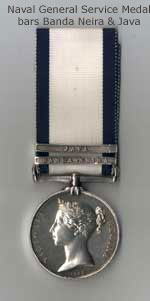
Capt. Kenah, with Lieuts. Carew, Allen, Pratt, Walker and Lyons of the navy, and
Lieut. Yates and Ensign Allen of the Madras regiment led the assault over the
ramparts.
The following morning the ships entered the harbour, Caroline under her
first lieutenant, Mr John Gilmour, and were fired on from the remaining Dutch
batteries but a threat to the governor to storm the town of Nassau and a
well-placed shot from Fort Belgica soon silenced them. In all they captured 120
guns and 1500 troops and militia, this without loss to the attackers.
Capt. Charles Foote of Piedmontaise was appointed Lieut. Governor of
Banda Neira and on 15 August Caroline sailed for Madras. To commemorate
the action the captains of Piedmontaise and Barracouta offered
Capt. Cole a silver cup to be made in England and the officers of the three
ships presented him with sword worth 100 guineas as did the officers of the
Madras regiment and the artillery.

Click here to read about the
capture of Banda Neira in 1810 by Capt. Christopher Cole in William James'
"Naval History of Great Britain" or download the Word document.