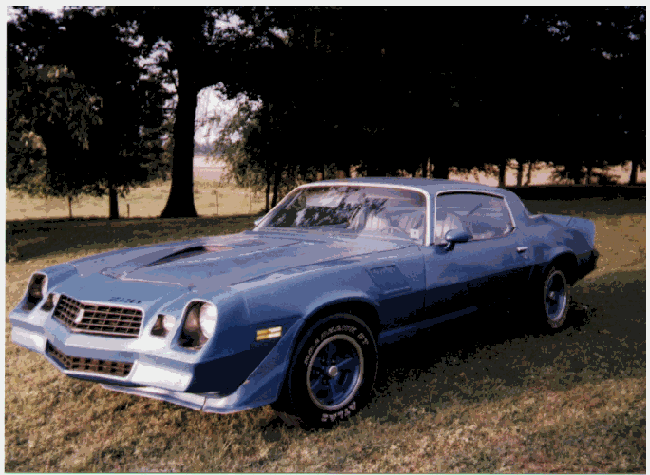
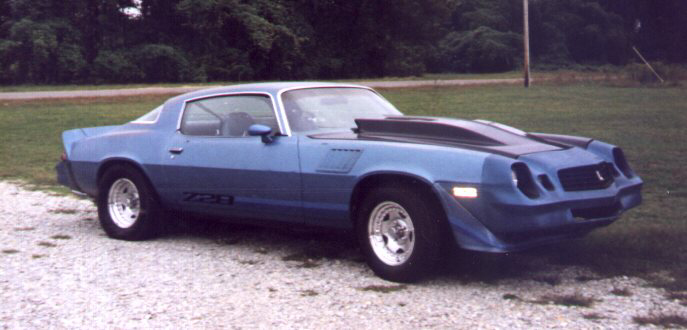
Kevin's 1979 Z-28
Be sure to check out my TPI 406 Chevy Powered 1985 Cutlass.
Diligence and Methodical Planning Pays Off
When I purchased the car, the original engine had been rebuilt and the following modifications had been made.
The engine was bored .030" over and flat top pistons replaced the stock dish type pistons. With 76cc heads, this resulted in approximately 9:1 compression ratio. The camshaft was replaced with an Edelbrock Performer camshaft. World Products Street Replacement 76cc heads replaced the stock heads and an Edelbrock Performer intake manifold replaced the stock intake. An Autozone remanufactured Quadrajet carburetor was installed as well as an Accel Blueprint HEI distributor.
The car was factory equipped with a TH350 and a 3.42 gear. The first night out, it weighed in at 3820 lbs with the driver and a 1/4 tank of gas. The tires were old Atlas radials in the factory size 225/70/15.
With these performance-enhancing products, I had expected to run in the low 15 second range and maybe even a high 14 on a good day.
The three runs that I may that first night are listed in the table below.
|
Run # |
1/8 ET/mph |
1/4 ET/mph |
Changes from previous run |
|
Run #1 |
10.184 @ 70.61 60' = 2.345 |
15.754 @ 88.32
|
Removed air filter, Ign. Timing 10 deg initial, 30 deg total. 22psi in rear tires. Shifted at 5000 rpm. |
|
Run #2 |
10.099 @ 71.01 60' = 2.299 |
15.648 @ 88.49
|
Removed a/c belt. Removed Toolbox from trunk. Advanced ignition to 14 deg initial 34 deg total. |
|
Run #3 |
10.290 @ 69.98 60' = 2.379 |
15.877 @ 87.90
|
Very little cool down. Changed Shift point to 5200 |
15.64 is a far cry from a high 14 second run. The weather didn't help matters either, as the temperature was in the upper 80's and the humidity was 80+ %. Next time out would be better.
At this point the car was still being held back by stock exhaust manifolds and a single 2 1/4" exhaust pipe that split into duals at the back of the car. A set of Dynomax ceramic coated headers were installed along with a true dual 2 1/4" exhaust system. See the table below for details. The old tires were replaced with new BFG 295/50/15 radials on back and 235/60/15 radials on front. This was a big mistake. The 295s were way too wide for the stock 15x7" wheels. (I actually told the tire shop to install 265/50/15 radials, but they goofed.)
Removing the cast iron exhaust manifolds and cleaning some of the junk out of the car, reduced the weight to 3775 lbs.
August 10, 1995
|
Run # |
1/8 ET/mph |
1/4 ET/mph |
Changes from previous run |
||
|
Run #1 |
10.026 @ 73.42 60' = 2.58 |
15.393 @ 91.93
|
28 psi in rear tires. Shifted at 5000 rpm. Ign. Timing at 14 deg initial. 34 deg total. |
||
|
Run #2 |
10.160 @ 73.12 60' = 2.65 |
15.538 @ 91.93
|
22 psi in rear tires. Removed air filter. |
||
|
Run #3 |
10.101 @ 73.96 60' = 2.643 |
15.441 @ 92.26
|
19 psi in rear tires. This is too low, but I didn't know it at the time. |
||
|
Run #4 |
10.026 @ 73.64 60' = 2.55 |
15.375 @ 92.20
|
Advanced ignition timing to 16 deg initial, 36 total |
||
|
Run #5 |
10.282 @ 73.33 60' = 2.678 |
15.659 @ 91.51
|
Advanced ignition timing again to 18 deg initial, 38 total |
||
|
Run #6 |
10.178 @ 72.92 60' = 2.64 |
15.589 @ 91.13
|
No change |
||
|
Run #7 |
10.002 @ 74.31 60' = 2.535 |
15.306 @ 92.76
|
Retarded timing back to 16 deg initial, 36 total. 25 psi in rear tires. |
||
Almost got a 9 second 1/8 mile. As you can see, the 60' times were terrible. The next step was traction bars. I built a set and installed them and removed my front and rear sway bars at the same time. I had no intention of removing the rear sway bar, but the design of my traction bars mandated it. The car weighed in at 3825 with driver and 3/4 tank of gas and a 40 lb toolbox in the trunk (for traction).
August 17, 1995
|
Run # |
1/8 ET/mph |
1/4 ET/mph |
Changes from previous run |
||
|
Run #1 |
9.971 @ 73.20 60' = 2.39 |
15.377 @90.99
|
28 psi in rear tires. Shifted @ 5000 |
||
|
Run #2 |
10.08 @ 72.83 60' = 2.380 |
15.44 @ 90.72 |
Richened carb w/ metering rods. Removed air filter. |
||
|
Run #3 |
9.868 @ 71.42 60' = 2.266 |
15.348 @ 90.41
|
Reinstalled original metering rods. Loosened secondary air valve. |
||
|
Run #4 |
9.877 @ 72.31 60' = 2.391 |
15.27 @ 91.57 |
Reduced rear tire press to 22 psi. Removed tool box from trunk. Loosed Sec air valve again. Let Chris drive. Spun. |
||
|
Run #5 |
10.003 @72.84 60' = 2.489 |
15.383 @ 91.70
|
Same as above, except spun worse |
||
Got that 9 second 1/8 mile. Now I had to have a 14 second 1/4 mile. In a couple of the previous runs, the car had a slight surge on top end, which denotes a lean condition. I was surprised that the car did not pick up when I richened the carb with the smaller metering rods. Since it did not pick up, I suspected that there was a restriction in the fuel system somewhere. The fuel filter and all of the rubber fuel line was replaced and I tried it again the next week.
The car had a full tank of gas and weighed in at 3840 lbs. The temp was 80 deg and humidity was approx. 70%.
August 24, 1995
|
Run # |
1/8 ET/mph |
1/4 ET/mph |
Changes from previous run |
|
Run 1 |
9.869 @73.08 60' = 2.328 |
15.291 @ 90.80
|
28 psi in rear tires. Engine temp was 185 at starting line. |
|
Run 2 |
9.627 @ 74.52 60' = 2.265 |
14.930 @ 92.63
|
Let engine cool for 90 minutes. Iced intake manifold. First 14 sec timeslip. |
|
Run 3 |
9.677 @ 74.42 60' = 2.285 |
14.99 @ 92.1
|
Let engine cool for 60 minutes. |
|
Run 4 |
NA |
15.46 @ 89.50 60' = 2.44 |
Let a friend drive. Shift point 4100 rpm. |
Finally! A 14 second run. My head grew about three hat sizes that night.
September 7, 1995
|
Run # |
1/8 ET/mph |
1/4 ET/mph |
Changes since previous run. |
|
Run 1 |
9.561 @ 75.05 60' = 2.213 |
14.823 @ 93.60
|
1/2 tank of gas. Air temp 78 deg. Humidity 30%. |
|
Run 2 |
9.610 @ 75.26 60' = 2.286 |
14.861 @ 93.64
|
Same as above, but spun a little. |
The car was getting faster every time out. It was almost too easy. I had the fever bad with all of those 14 sec. slips. I needed a 14.5 sec slip now. The entire exhaust system was replaced with a 2 1/2" system with a crossover pipe and Flowmaster 2 chamber mufflers. The results are shown in the table below.
|
Run # |
1/8 ET/mph |
1/4 ET/mph |
Change since previous run |
|
Run 1 |
10.356 @ 65.46 60' = 2.321 |
17.31 @ 63.29 |
2 1/2" exhaust system with crossover pipe and Flowmaster mufflers Note: Had to lift, car was popping and surging |
|
Run 2 |
9.798 @ 67.62 60' = 2.258 |
15.549 @ 87.47 |
Raised secondary metering rods approx. 1/16" Car was popping and surging (too lean) |
|
Run 3 |
10.282 @ 66.33 60' = 2.360 |
15.992 @ 88.37 |
Raised secondary metering rod approx. 1/16" Still popping |
|
Run 4 |
10.523 @ 64.25 60' = 2.385 |
17.751 @ 58.28 |
Same as above |
|
Run 5 |
10.687 @ 65.56 60' = 2.387 |
17.033 @ 81.08 |
Same as above |
|
Run 6 |
10.110 @ 69.81 60' = 2.313 |
15.725 @ 87.84 |
Closed choke 1/2 way |
|
Run 7 |
9.625 @ 72.05 60' = 2.261 |
15.129 @ 90.89 |
Same as above, but bent tang on carb to allow secondarys to open |
|
Run 8 |
10.204 @ 68.17 60' = 2.295 |
15.848 @ 89.33 |
Same as above |
As you can see the car was very inconsistent and considerably slower than before. After a lot of trial and error, I finally figured out that the problem was with the power piston spring. It was too weak. I ordered an assortment of power piston springs and used a heavier black spring. That fixed the problem. Unfortunately, it took several weeks to diagnose and fix the problem. After this I opened up a hole in the stock Z-28 hood, by removing the factory steel insert and cutting an opening in the stock fiberglass scoop.
August 1, 1996
Temp: 75 deg, humidity: 60 %
|
Run # |
1/4 ET/mph |
Changes since previous run |
|
Run 1 |
14.71 @ 93.90 60' = 2.21 |
Changed power piston valve. Loosened secondary air valve. Slightly richer sec. metering rods. Opened up hole in stock Z-28 hood. |
Now, that's more like it. Getting closer to those 14.5 timeslips. Now I had to get a little weight off the car, preferably off the nose. I decided to remove the a/c (it was hardly ever used anyway.)
August 15, 1996
Temp: 70 deg humidity: 60 %
|
Run # |
1/8 ET/mph |
1/4 ET/mph |
Changes since last run |
|
Run 1 |
9.416 @ 76.22 60' = 2.184 |
14.580 @ 95.26 |
Removed air conditioning from car. Iced intake manifold |
|
Run 2 |
9.412 @ 76.53 60' = 2.212 |
14.575 @ 95.15 |
Same as above |
|
Run 3 |
9.370 @ 76.58 60' = 2.167 |
14.526 @ 95.44 |
Removed spare tire / jack / rear seat cushions. Iced intake manifold |
|
Run 4 |
9.319 @ 76.79 60' = 2.158 |
14.471 @ 95.45 |
Iced intake manifold and let car cool down. |
|
Run 5 |
9.387 @ 76.41 60' = 2.204 |
14.551 @ 95.44 |
Did not ice intake. Car was a little warmer than last run. |
Now we're talking. The 14.47 was very encouraging. At this point I wanted to really improve the ET, so I bought a TCI 11" Breakaway torque converter. It would footbrake to 2200-2300 and flash to 2500-2600 rpm. I knew when I installed it that my et would improve, if I could get the car to hook. To this end, a set of stick Hoosier street tires were purchased. Unfortunately, the tires were around 2" taller than my BF Goodrich street tires. This hurt my gear ratio tremendously, but it did help traction. When installing the torque converter, the ignition timing was moved as well. I had intentions of setting it back to 16 initial /36 total degrees, but forgot. Consequently, I don't know where the ignition timing was set when I brought it to the track.
September 26, 1996
Temp: 80 deg humidity: 70 %
|
Run # |
1/8 et/mph |
1/4 et/mph |
Changes since previous run |
|
Run 1 |
9.468 @ 75.87 60' = 2.096 |
14.655 @ 94.99 |
Installed TCI 11" torque converter. Overadvanced ignition timing. Hoosier 27.5 x 8" x 15" tires. |
|
Run 2 |
9.320 @ 76.51 60' = 2.146 |
14.473 @ 95.45 |
Retarded ignition timing approx. 3 degs from initial setting. It still seems to be a little high. Iced intake manifold. |
As you can see, the car nearly duplicated its previous best run, which considering the ignition timing situation (I still don't know where it was set that night), the weather and the tires that were 2" too tall, was very impressive. The combination of the 11" converter and the stickier tires were great for the 60' times. This gave me my first 2.0 second 60'. With a little ignition timing adjustment, some agreeable weather and some shorter tires, I feel that it would have run in the high 14.20s or low 14.30s with this combination, but it was not to be.
At this point, I had recently purchased a small block 400 block and was ready to put some horsepower under the hood. See the list of modifications below.
Block - Bored .040" over and honed with torque plates installed
Crank - Stock nodular iron turned .010"/.010"
Rods - 5.7" 350 rods with ARP bolts. I polished the beams and had the big ends resized.
Pistons - Keith Black hypereutectic (part # KB-125) flat top pistons.
Rings - C&A Gapless Rings
Camshaft - Erson mechanical roller (part # 119800) Dur. @ .050" = 238 int./246 exh. 108 LS 106 int. CL .555 int lift/.555 exh lift w/ 1.5 ratio rockers.
Trick Flow Twisted Wedge Heads (pocket ported)
1.5 ratio roller rockers
Moroso Oil Pan w/ built in windage tray
Comp Cams .100" longer than stock pushrods.
Victor Jr. port matched intake manifold
Holley 750 double pumper
I built and installed this engine in December of 1996. The same 1 5/8" headers and 2 1/2" exhaust was used. It had so much torque that you could smoke the rear tires at will. I had intentions of getting an 11 second time slip, but knew that I would have to put all of the additional power to the ground to do so. The table below shows what happened the first night out.
March 20, 1997
Temp: 68 deg humidity: 50%
|
Run # |
1/8 et/mph |
1/4 et/mph |
Changes since previous run |
|
Run 1 |
8.806 @ 87.43 60' = 2.349 |
13.277 @ 110.55 |
SB 400 engine, First run is on BFGoodrich radial TA. First 60' was 1/2 throttle. Spun very badly for first 150' of track. Shifted at 5600 |
|
Run 2 |
8.214 @ 88.88 60' = 2.098 |
12.655 @ 110.76 |
Installed sticky Hoosier tires (13.5 psi) Shifted at 5600 |
Man, was I nervous that first night out. I was pleased with the car's performance and glad that I did not break anything. For the next night out, I installed an experimental 10" torque converter. See the table below for results.
|
Run # |
1/8 et/mph |
1/4 et/mph |
Changes since previous run |
|
Run 1 |
8.366 @ 86.37 60' = 2.120 |
12.919 @ 107.99 |
Experimental 10" torque converter. |
|
Run 2 |
8.212 @ 87.16 60' = 2.013 |
12.734 @ 108.57 |
Dropped tire pressure to 13 psi, did a better burnout |
|
Run 3 |
8.074 @ 87.42 60' = 1.915 |
12.581 @ 108.89 |
Dropped tire pressure to 12 psi, did a large burnout. |
This converter was very loose. It footbraked 3600 and flashed 4500 rpm. It also lost speed on the big end, although when the car hooked on the third run, it did produce a respectable et.
Next, I installed a TCI Super Street Fighter 10" converter (Part # 241022). It flashes approximately 3600-3700 and is much more streetable than the 4500 rpm experimental converter was. I also installed a pair of 28 x 10.5" MT slicks on some Convo Pro wheels for the track. I had bracket raced the car with this converter and with the slicks on a couple of 580-620 foot dragstrips, so I knew that the 60' would be in the 1.65-1.70 range at Memphis. It would be several weeks before I actually had the opportunity to go to a Test-n-Tune session and try it through the quarter mile. The results of my first full quarter mile run with slicks are shown below.
October 30, 1997
Temp: 65 deg humidity: 35%, big tailwind
|
Run # |
1/8 et/mph |
1/4 et/mph |
Changes since previous run |
|
Run 1 |
7.779 @ 89.42 60' = 1.721 |
12.204 @ 110.61 |
TCI 241022 torque converter and 28 x 10.5" MT slicks 12 psi in slicks, 36 degrees total timing |
|
Run 2 |
7.674 @ 90.74 60' = 1.699 |
12.021 @ 112.89 |
32 degrees total timing. 11.5 psi in slicks. Let car cool off. 10 mph tailwind. |
Almost in the 11s! If only I could have gotten one more run…but I was well satisfied with its performance for the night.
Next, I installed a Holley Blue electric fuel pump along with a Holley 750 vacuum secondary carburetor. At first, the vacuum secondary Holley was installed on the Victor Jr. Sixty foot times slowed to the 1.80 range. The secondary diaphragm spring was swapped out for the short yellow spring and the check ball was removed from the canister. A rear metering plate assembly was installed along with #81 rear jets and #73 front jets. The choke horn was cut off and a K&N stubstack was installed. This dropped the 60' to a 1.75 average. After this, a Performer RPM intake was installed. This dropped the 60' to a 1.65 average! See the table below for details.
July 30, 1998
Temp: 80 deg, humidity: 60%
|
Run # |
1/8 et/mph |
1/4 et/mph |
Changes since previous run |
|
Run 1 |
7.722@ 89.3 60' = 1.67 |
12.214 @ 109.8 |
Changed to Performer RPM intake, modified carb. |
|
Run 2 |
7.676@ 90.1 60' = 1.63 |
12.146 @ 110.21 |
Allowed car to cool down to 140 deg |
The car did not break into the 11s, but it did perform similar to the last outing. If you take into account the temp, humidity, and the wind, the car picked up a few hundredths. Next, the 3.42 gears were swapped for 4.10s and a Griffin aluminum radiator was installed (the car never gets over 170 degs now). It was bracket raced on a couple of short 1/8 mile drag strips in this condition. The sixty foots did not change with the 4.10s, but it seemed to pull a little better on the top end. After this, the stock Z-28 hood was removed and a fiberglass Harwood 4" Cowl induction hood was installed. See the results in the table below.
October 22, 1998
Temp 66 deg, humidity: 40%, 30.58 barometric pressure
|
Run # |
1/8 et/mph |
1/4 et/mph |
Changes since previous run |
|
Run 1 |
7.573 @ 90.22 60' = 1.634 |
11.939 @ 112.30 |
Changed 3.42 gear to 4.10. Griffin Al. Radiator. Harwood hood. |
|
Run 2 |
7.598 @ 90.12 60' = 1.652 |
11.962 @ 112.23 |
Same as above |
|
Run 3 |
7.611 @ 90.02 60' = 1.671 |
11.971 @ 112.01 |
Save as above |
Finally! In the 11s. It's time for a rollbar now.
5/30/1999
I removed the steel front bumper insert and dropped several pounds from the front end of the car. I brought it to Memphis in April '99 after removing the bumper, but forgot to bring my lug nuts to bolt on the slicks…had to run the street tires. Best run was 12.166 @ 112.70 with a 1.789 60'. I didn't realize it at the time, but I had way to little air pressure in the little 26x10.5 ET Streets. They don't respond the same as slicks. I had around 13-14 psi in them, but later found out that 22-25 psi seems to work better. Oh well, next time I'll have slicks on it.
A few weeks ago I took it to Blue Mountain Dragstrip in Ripley, MS and won the Footbrake class. Blue Mountain Dragstrip is around 600' long, it's not a true 1/8 mile. However the Camaro ran a 6.99 and had a all time best 1.57 60'. I'm sure this is a result of removing the front bumper brace.
November 1999. I also purchased a The Nitrous Works 300hp plate system a few weeks ago. After being put out in the 3rd round one night I decided to play with the N2O. My best all motor run that night was a 7.02. With the 125 hp jets, my et improved 3 tenths to a 6.72 w/ a 1.53 60'. I was hoping for a bigger improvement, but the kit was set pretty rich. A 1.499 60' would be nice, maybe next time.
September 2004. Sold! I recently sold the Z28 back to my friend Chris. He and I built an all forged 406 with ported Trick Flow 215cc runner heads and a Custom ground Comp Cams solid roller cam.
January 2006. The car responded favorable to the new engine. The first time to the track (it's new home track is in Hattiesburg, MS) Chris clicked off an 11.56 @ 117.5 on motor. He hasn't tried the nitrous kit yet.