Biotechnology Alliance Association
Background
Developing countries, Thailand included, have to use modern technologies in all kind of development in order to maintain their competitiveness. After the information technology, it is now the biotechnology era. Although this technology seems to be quite well known, from traditional biotech to advanced biotech, most of developing countries still face with difficulties in the acquisition and application of this technology. The Thai government has been trying to come up with the National Biotechnology Policy, but the part on advanced biotech, genetic engineering is still developing. It is anticipated that this government with the leadership of the Prime Minister, Dr Thaksin Chinnawat, will be able to complete this National Biotechnology Policy soon.
Genetically Modified Organisms (GMOs) are products derived from modern biotechnology or genetic engineering. The technology has not been accepted at present by many countries.. However, GM Crops have been approved for commercial production in many countries which covered more than 80 million hectares in 2004.
In Thailand, Thai government still confirms their policy on GMOs that GM crops are not allowed to be grown for commercial production, exception is made only for experimental purpose and only in the contained environment (green house) or in the laboratory. In addition, it is not yet allowed to conduct GM crop field trials in open fields. There are many results behide this decission. One of the main reason is that information on the knowledge of GMOs facts have not well distributed. Apart from this, the public has always received wrong information which has been distributed systematically.
It is very difficult for a single public or private agency to do this public education and awareness, especially the distribution of information alone. To cope with this difficulty, it is better to work together in networking in effort in providing GMOs fact information to the public. For this reason, a group of people from both public and private agencies have agreed to form a new organization, the Biotechnology Alliance Association (BAA) and it is now in official registration process.
Objectives of BAA
1. Support biotecnology to be used for country development
2. Provide information and facts about the risks and benefits in using biotechnology to the public
3. Assure the biosafety based on scientific knowlege
4. Promote technology transfer through lingkages
5. Coordinate with public and private sectors including international organization in regulating biosafety
BAA�s Executive Committee:
Dr Sutat Sriwattanapong President
Ms Darunee Edwards Vice president
Dr Supat Atthatum Public Relation
Mr Chawang Jao Reception
Miss Siriwan Phetsombat Registrar
Ms Chanika Iamsupasit Treasurer
Dr Nipon Iamsupasit Secretary
Mr Thawatchai Prasartsisupap Committee Member
Mr Kongtat Janchai Committee Member
BAA Management Team:
Mrs Chanika Iamsupasit BAA Manager
Miss Siriwan Phetsombat BAA Officer 1
(Vacant position) BAA Officer 2
BAA Operation Activities:
There are 5 main areas for BAA to be engaged with. These are as followed:
1. Committee Meeting: Six meeting a year are planned in order to follow up all issues to meet the goal related to BAA activity planning.
2. Gathering and Synthesized Information and Distribution: These are major tasks of BAA in order to produce information materials for distribution to all interested stakeholders. The tasks need a full-time staff to take responsibilty. Two major information areas that need to be gathering and synthesizing and those are 1) impacts of GM crops on environment and 2) impacts of GM food on human health. These information need to be documented in Thai and distributed.
3. Setting Up Networking: This activity is very important for BAA. It seems to be the best way for information distribution. Public agencies or some stakeholders that can coordinate public education and information distribution will be asked to submit their TOR and BAA will give them the support. At least 3 networks need to be set up 1) media network 2) farmer network and 3) school network.
4. Bio-Forum: At least 3 main forums need to be organized annually for all public and media audiences. Theme for each forum has not yet identified. However it depends on public interest and human resources available. Specific seminars will be organized as needed.
5. Publications: It is important to produce publication for distribution. Simple publications such as leaflet, brochure or pamphlet shoul be considerred for production. More over, an electronic mail is a promissing means for information distribution.
|
[�Դ�����Ҥ�][email me!]
|
|
��������ժ���Ҿ
|
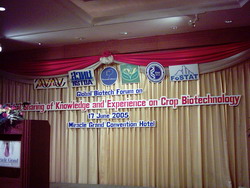
Global Biotech Forum on Global Sharing of Knowledge and Experience on Crop Biotechnology 17 June 2005, Miracle Grand Convention, Bangkok, Organized by National Center for Genetic Engineering and Biotechnology (BIOTEC), National Science and Technology Development Agency (NSTDA), Ministry of Science and Technology, Under co-operation with ISAAA/BAA
 ��ҧ ��ػ�ŷ����ҡ��û�Ъ�� �й��ʹͷ��������� ���
|
Govt. waking up to GM Field Trial
[�ҡ Naewna Aug 22, 05]
Dr Sutat Sriwattanapongse, President of Biotechnology Alliance Association (BAA), revealed that situation on GM crop planting tends to be continuously increased. There are 500 million Rai of GM crops planting area, benefiting about 8.25 million farmers in 18 countries around the world. Some 90% of these farmers are from developing countries such as China, Paraguay, India, Uruguay, Mexico, the Philippines. Particularly, the United States has advanced GM crops development and planted for internal use and export. However, in Thailand, the public is still not aware enough about the benefits of biotechnology because the correct information has not been provided.
Moreover, GM crops research and development in Thailand did not make a progress as the government is reluctant and did not have clear policies on that issue. Until now, GM plant field trials and commercialization were not allowed in Thailand. We can have the test only at laboratory or greenhouse level. If we did not urgently adjust the policies and regulations, it may not be in time and we may lose our market competitiveness. Expecting that the in the near future GM plants; for example; Bt cotton from India, Gm rice from China and Bt corn from the Philippines, would come to compete in Thai market surely. Therefore we should make a start now before too late.
�In fact, Thailand established Biotechnology Centre and had regulations on GM plants research prior to other countries in this region but it was interrupted by unclear government�s standpoint. Therefore we have to flex the regulations for GM field trials to study more on biosafety and other effects on environment to make biotechnology be an alternative. And GM plant for commercial would be another step of decision making after getting result from field trial testing.�
Dr Sutat also added that within this week the National Center on Genetic Engineering and Biotechnology (Biotec) coordinated with the Biotechnology Alliance Association (BAA) will draft roadmap on genetic engineering of plant; firstly focusing on non-food crops e.g. cotton and flowering plants like GM rose which many countries including the Netherlands has produced.
 Industries supports biotechnology, urging govt. for law release
[�ҡ Krungthepturakij, Aug 23, 05]
An academic from the UN urged the government speed up drafting regulation on GM crop testing after research and development on biotechnology was delayed by almost five years red tape. While industries accepted that in the long run GM plant could reduce fertilizer cost, pesticide cost and remaining agrochemical.
Dr Banphot Na Pomphet, an expert at Food and agriculture Organization of the United Nations said that Thailand has high biodiversity, in the past we have studied advanced biotechnology. Regrettably, delay in decision making caused loss of opportunity for example we ratified Convention on Biodiversity 20 years after signing the agreement.
Likewise, policy on biotechnology, he said, it is the time to make a political decision after pressure from causing GM testing moratorium.
�Almost five year passed Thailand�s GM plant testing was still frozen as we have to wait for biosafety law first. Previously, working group on environment arrive at an agreement that consideration process will be completed within six months after the moratorium. But now it has not finished yet.� Dr Banphot Na Pomphet commented during a seminar on Biotechnology for Thailand Agricultural Sector held by Biotechnology Alliance Association last week.
Genetically Modified Plant or GM was developed by biotechnology to resolve problems from plant diseases, pesticides by adding some part of genes from different species like bacteria, virus into plant for insect or herbicide tolerance. This technology has been used widely in many countries for instance insect tolerant Bt cotton, herbicide tolerant R&R (Roundup Ready) corn and soybean.
However, some activists still opposed on GM testing as it may cause superweed, insect mutation, crossbreeding between local and GM plants especially high cost GM seed patented by international corp.
Dr Chairerg Sagwuansupyakorn, a representative from Thai Seed Trade Association (THASTA), commented that biotechnology has been utilized in industries for a long time. In the long terms, GM plant can help with cost reduction because it can be tolerate to diseases. Some kind of seed has specific nutrient and involves with Material Science.
�World population was increasing while world area with limited agricultural area still remains. We cannot increase cropping area by cutting the forest, however, GM crop planting benefits more production on same area, reduces pesticide and chemical fertilizer usage then decrease remaining agrochemical.� Setthasan Setthakarun,a representative from Federation of Thailand Industries added.
ŧ����������ѹ��� 2 �ѹ��¹ 2548
��ҹ�Դ������ҧ�áѺ���ǹ��
����稨�ԧ
|
|
