The Truth About the Runes : Christian Runology of The Avalonian Catholic Church
Excerpts from Ongoing Research for a Book by The Most Rev. Jon Ryner
A Nidstang Curse
Copyright 2000 Jon Ryner
I cast this curse on wicked knaves,
who strive to spoil the sacred staves.
I rown this mighty, righteous spell,
that they ne'er drink from Mimir's Well.
So may the wights of vengeance race
to flay their souls of evil's trace;
And may they never rightly sooth
until they have discerned the Truth.
May they soon reap that which they sow,
while the true RUNA greater grow.
May seekers true be satisfied,
and be preserved from spoilers' lies.
What's a Nidstang? Click
here to learn more.
The older, mirrored page is
here.
The Grail Runes
"Wolfram says that to know the Grail you must 'learn your ABC's without
the aid of black magic.' Robert de Borron's Joseph is quite explicit.
The mystery of the Grail is the inner teaching. Jesus taught Joseph strange
words to vibrate over the cup that held the holy blood. This attempt to
clear away the underbrush of the Grail texts has shown that the source of the
Grail is that strange mixture of Celtic and Christian beliefs that developed
in the west of England and Ireland before the Empire crumbled. It was
defended by Arthur, and almost brought by him on to the stage of European
history at just about that juncture when the politics of the Empire would
have allowed a completely new direction, a completely new version based on
the inner teachings of the Christian mysteries."
--Vincent Bridges,
http://vincentbridges.com/Grail/histgrail.htm
A Personal Story
When I was in high school, my mother bought me a "Blum set". I found it quite interesting, even subscribing to his little journal, but I knew somehow he was all wrong. It was years later that I discovered what I thought was the original, i.e., patriarchal, Norse way.
To be continued...
The Origins of the Runes
"."--
There was once a time when the runes might have been more "gender balanced". For a discussion of the ancient androgynous Norse god Ing or Nj�rth and the matrifocal possibilities of the Norse before they became the Norse, see The Birth of Proto-Indo-European (though the author is hopelessly devoted to Gimbutas' seriously questionable "scholarship". But he does properly place a god for the real "blank rune" which is missing one, and this even Thorsson couldn't seem to do. It's also interesting that he reports about an ancient Old European script found in clay at an early Vin�a site, Tartaria, in Transylvania, dating to the middle of the 6th millenium, which makes it much older than the logographic script of Sumerian.
To be continued...
Runes in Eastern Europe and Russia
St. Ufilas: "the Moses of the Goths"
Coming soon...
Runes in Europe in the Middle Ages
In Futhark the fifth rune, Raido, means "carriage" or "wagon". See our discussion of the Visconti Tarot card on this subject.
Gebo means "sacrifice", so it is highly significant that a priest (not a bishop) crosses his stole in the X shape and binds it there prior to saying Mass in the old ceremonies, likewise that in more recent times, the "life-rune" Algiz and the ice or solidifying rune Isa were sewn unto the chasubles for Mass. There were some who knew!
To be continued...
Runes in America
Dispersionism enthusiasts can click here to read about the runic inscriptions in American and some of the evidence supporting their authenticity. This Webpage has lots of links to other Webpages and books.
Jesus (not Fenris!) Bound
As the identical Celtic and Norse portrayals of the initiated bard reveal,
the Celtic and Norse mysteries were interconnected or the same. There are
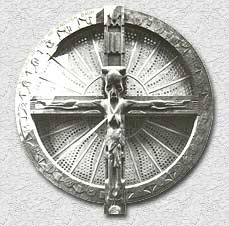
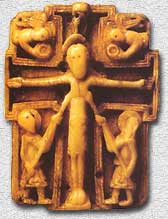
extant Celtic stones portraying the crucifixion showing Jesus emeshed
in and bound by vines. I had always thought this perhaps was related to
either:
1) evil earthly forces trying to "pin him down" and/or
2) some mysterious Gnostic understanding of his relationship with the earth
forces.
Imagine my surprised shock on reading this:
Later that afternoon, I returned to my office and started rereading the passages concerning the maninkari in Gerald Weiss's exhaustive study on Ashaninca cosmology. According to Weiss, the Ashaninca believe that the most powerful of all maninkari is the "Great Transformer" Avireri, who created life on earth, starting with the seasons and then moving on to the entirety of living beings. Accompanied sometimes by his sister, at others by his nephew, Avireri is one of the divine trickster twins who create by transformation and are so common in mythology.
It was in reading the last story about the end of Avireri's tracjectory that I had a shock. Having completed his creation work, Avireri goes to a party where he gets drunk on manioc beer. His sister, who is also a trickster, invites him to dance and pushes him into a hole dug in advance. She then pretends to pull him up by throwing him a thread, then a cord-- but neither is strong enough. Furious with his sister, whom he transforms into a tree, Avireri decides to escape by digging a hold into the underworld . He ends up at a place called River's End, where a strangler vine wraps around him. From there, he continues to sustain to this day his numerous children on earth.
No comment necessary, eh? (Emphases are the original author's, Jeremy Narby in his The Cosmic Serpent: DNA and the Origins of Knowledge, pages 106-107.)
To be continued...
All written material in this site is copyrighted by the Most Rev. Jon Ryner, except where noted.