The Truth About the Tarot
Excerpts from Ongoing Research for a Book by The Most Rev.
Jon Ryner
The Origins of the Tarot
The origins of the Tarot are shrouded in mystery. This is because no one
seems to know (or admits) what the cards' original purpose was. I began my
investigations in this area by using the same approach as the venerable
Adam McLean has in alchemy: by looking first at the earliest extant examples
of the
cards themselves, free from later spurious accretions (Kabbala, changed
card names, etc.). So what do we know?
The cards were not originally used for divination. This came much later.
Nor were they initially used for playing "the Tarot game", though this, as I
currently understand, began to be fashionable fairly quickly. Why would the
exoteric Church condemn playing a foppish, fadish game unless the images in
the cards themselves were suspect? Why would the Church condemn them in such
harsh words (such as "ladder to hell", etc.), without stating why they
were so dangerous? These were questions in the back of my mind as I began my
research. So what do we see?
The Visconti Tarots
I have in my library a Book of Hours that was done for a Visconti. It is
most interesting, in that a number of the images are extremely pagan in
appearance and obvious meaning. Is there evidence that the Visconti family
were heretics are involved with heretics?
Quite possibly. I seem to remember reading that they were supporters of
the Gugliemites, who elected their own pope, a woman. This is
interesting, given that the Cary-Yale Visconti Tarocchi contains both male and
female pages and knights. As Hank Harrison's research showed, powerful royals
were involved in pagan practices, preserving ancient stone building techniques
and their associated pagan lore, and practicing witchcraft, even in our own
day.
Then again, we have the cards. I originally suspected I would be working
along these lines when I looked at the Visconti-Sforza, but when I started
looking at the Cary-Yale Visconti, I knew I was on the right track.
This was the card that convinced me:
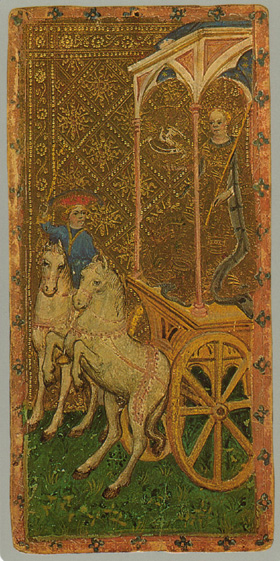 Is this not a strange version of The Chariot?
We clearly see an uncontrolled horse pulling an ornately carved Gothic cart
in which is a standing figure. There is a man on a second horse looking at
the figure in the cart, and both horses have stopped. The man raises his arm
as if signaling other(s) behind him not shown on the card.
Is this not a strange version of The Chariot?
We clearly see an uncontrolled horse pulling an ornately carved Gothic cart
in which is a standing figure. There is a man on a second horse looking at
the figure in the cart, and both horses have stopped. The man raises his arm
as if signaling other(s) behind him not shown on the card.
What we are seeing here is an ancient pagan ritual that the exoteric Church
tried to stamp out for centuries. An idol was placed in a cart, which was
attached to an ox or other animal. They were turned loose and wherever the
animal stopped was deemed to be sacred, and frequently a shrine or church was
erected on that spot. Obviously, the climax of this hoary rite was when the
actual temenos was revealed, and this precise moment is portrayed in this
Trump. We now have a valid reason the exoteric Church would condemn the Tarot,
without giving an explicit reason: the Tarot portrayed pagan rites (more on
this later) which it was trying to destroy, so it certainly didn't want to
draw attention to these rites. (Note our argument about this approach in the
arena of sexual images in churches elsewhere on this site.)
It is most important to note how radically different other later Tarot cards
are from the originals. Even "The High Priestess" was originally named The
Popess. And, provocatively, the Popess of the Visconti-Sforza as attired in
a good rendering of the very habit worn by nuns of the same order as the one
elected pope by the Gugliemites.
To be continued...
All written material in this site is copyrighted by the Most Rev. Jon
Ryner, except where noted.
The Avalonian Catholic Church
[email protected] (Remove nospam to reply.)