 Cannabis: The Philosopher’s Stone
Cannabis: The Philosopher’s Stone
Part 4: Medieval Alchemists and Cannabis
from Green Gold: the Tree of Life, Marijuana in Magic and Religion
by Chris Bennett, Lynn Osburn, and Judy Osburn
(published by Access Unlimited: [email protected])
1.The Knights Templar and Cannabis
2.Sufi Alchemists and the Grail Myth
3.The Alchemist Monk Francois Rabalais
4.Medieval Alchemists and Cannabis
4.Medieval Alchemists and Cannabis
The Arabs were responsible for the popular reintroduction
of Alchemy into medieval Europe. Jabir Ibn el-Hayyan, known as Geber[24]
in the West "has been acknowledged by both the Arab and European alchemists
as the patron of the art since the eighth century."[25]
Dr. M. Aldrich has commented that "skilled alchemists with pretty classy lab
equipment experimented with all kinds of potions; if Geber and others could
distill alcohol, they could have made hashish (or even hash oil), and, indeed,
Geber included banj among his powerful prescriptions. An amusing tale
of a hypocritical priest, from Arabian manuscripts dated about CE950, shows
that use of banj was secret and spread among religious persons who
professed against it."[26]
A number of Sufis can be tied to both hashish use and the alchemical
language, most notably the Arabian Alchemist Avicenna (known in Arabic as Ibn
Sina), Mansur el-Hallaj, and Farduddin Attar, the Chemist.
That the alchemists of the West knew they
were pursuing an internal goal is clear from their admonitions and
innumerable cryptic illustrations in their works. Alchemical allegory is by
no means difficult to read if one bears in mind Sufi symbolism. In the
seventeenth century, a thousand years after the time of their original
inspirer, Geber (born circa 721), the European alchemists were keeping lists
of successive masters, reminiscent of the Sufi "spiritual degrees." One of
the most interesting things about this fact is that these chains of
succession refer to people linked in the Sufic and Saracean traditions, but
otherwise have no common denominator. In the records, we find the name of
Mohammed, Geber, Hermes, Dante and Roger Bacon. — I. Shaw, The Sufis
Attar and other Sufis are reported to have used el-Khidr
(Khizr), the green man, as a hidden reference to hashish and bhang. In 1894,
J.M. Campbell commented that to the Moslem worshipper "the holy spirit in
bhang is not the spirit of the Almighty, it is the spirit of the great
prophet Khizr, or Elijiah."
In what can be considered more than a mere coincidence, we
find this same figure playing a highly regarded role in medieval alchemy.
Alchemists like Paracelsus and Eirenaeus Philalethes mention the name Elias,
which in the authorized version of the Bible is the same as Elijah, the
powerful magician-prophet of Tishpeh, whom the Sufis equated with Khidr, the
green man and patron saint of cannabis.
The real significance of the mysterious
Elias is given in an almost throw away phrase by A.E. Waite in The
Brotherhood of the Rosy Cross. He says: "I infer that enthusiasts [i.e.
those who looked forward to the coming of Elias] regarded it as a corporate
Elias." In other words, Elias was the symbolic figurehead of the new school
of alchemy whose adepts were now proving its reality among mankind."— Kenneth
Rayner Johnson, The Fulcanelli Phenomenon
My book is the precursor of Elias, designed to
prepare the Royal way of the Master... — Eirenaeus Philalethes, An Open
Entrance to the Closed Palace of the King
Nothing is concealed that shall not be
revealed. There are many more secrets concerning the transmutation, though
they are little known, for if they are revealed to someone their fame is not
immediately common. With this art, the Lord bestows the wisdom to keep it
secret until the advent of Elias Artista[27].
Then shall be revealed what has been concealed.—Paracelsus, "Book Concerning
the Tincture of Philosophers"
Idries Shah claims that Paracelsus and other medieval
European alchemist like Roger Bacon, Raymund Lully and Henry Cornelius
Agrippa, were transmitting Sufi knowledge in the West, acting as scouts for
the Arab dervishes and their system of attainment.
Paracelsus, who traveled in the East and
received his Sufic training in Turkey, introduced several Sufi terms into
Western thought. His "Azoth"[28]
is identical with the Sufi el-dhat (Pronounced in Persian and hence in
most Sufi poetry as az-zaut)....The stone, the hidden thing, so
powerful, is also called the Azoth in the West. Azoth is traced by
Orientalists to one of two words — al-dhat (or ez-zat), meaning
essence or inner reality; or else to zibaq, mercury. The stone
according to the Sufis, is the dhat, the essence, which is so powerful
that it can transform whatever comes into contact with it. It is the essence
of man, which partakes of what people call the divine. It is "sunshine,"
capable of uplifting humanity to the next stage....Owing to the Reformation,[29]
Paracelsus had to be careful how he expressed himself since he was projecting
a psychological system different from either the Catholic or the Protestant
ways. In one place he says: "Read with the heart until at some time the true
religion will come....
Heeven quotes Sufi dicta:
"Salvation is not attained by fasting, neither
wearing certain clothes, nor by flagellation. These are superstitions and
hypocrisy. God made everything pure and holy, man need not consecrate them." — Idries Shah,
The Sufis
[30]
Several mystics and Sufi masters, among
them al-Hallaj and especially Avicenna and Ibn Arabi, have presented alchemy
as a veritable spiritual technique. —M. Eliade, A History of Religious
Ideas, Vol. III
Dr. C.G. Jung, student of Freud, originator of Jungian
depth psychology and the father of modern analytical psychology, gathered the
largest collection ofancient alchemical literature in the world. Jung made
the following comments on alchemy and his work as a psychologist in his
autobiography:
As my life entered its second half, I was
already embarked on the confrontation with the contents of the unconscious.
My work on this was an extremely long-drawn-out affair, and it was only after
some twenty years of it that I reached some degree of understanding of my
fantasies. First I had to find evidence for the historical prefiguration of
my inner experiences. That is to say, I had to ask myself, "Where have my
particular premises already occurred in history?" If I had not succeeded in
finding such evidence, I would never have been able to substantiate my ideas.
Therefore, my encounter with alchemy was decisive for me, as it provided me
with the historical basis which I had hitherto lacked. I had very soon seen
that analytical psychology coincided in a most curious way with alchemy. The
experiences of the alchemists were, in a sense, my experiences, and their
world was my world. This was of course, a momentous discovery: I had stumbled
upon the historical counterpart of my psychology of the unconscious. — Carl G.
Jung, Memories, Dreams and Reflections
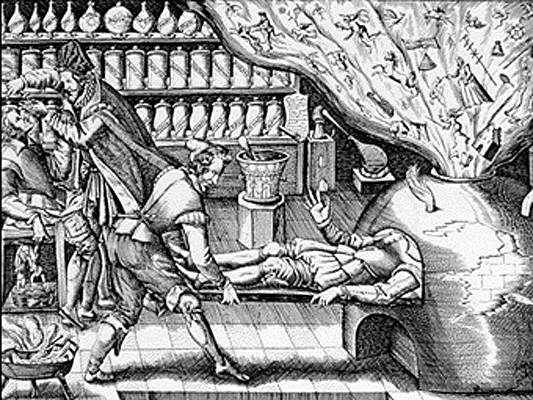
Expulsion of the
Demons, an anonymous engraving from the 1600s, is another classic example
of alchemical initiation hidden behind the facade of churchly pursuits. In
the foreground an alchemist (wearing a small Phygyric initiation cap)
cheerfully slides an associate head first into a large athanor (alchemical
oven) where the "demons" are baked out of his head into a billowing cloud
containing the universal elements in an expanding consciousness. The one who
is baked holds his hand up as if to say to the other, "hold steady, right
there, brother." Two mushrooms joined at the cap appear in the lower left of
his expanding mind-cloud. In the left foreground incense is vaporizing from a
bowl set on flaming coals in a squat pan on a tripod. Directly above it a
"bishop" is pouring an alchemical substance down the throat of a seated
initiate who is steadying the bishop’s arm that is holding a funnel in the
initiate's mouth. Supernatural arms extend from his seat and grasp a pan
below. Shelves of alchemical medicines are behind them. To the right of the
medicines is an alchemical still. A large mortar and pestle is on a stand in
the center of the engraving. The alchemists prepared sacraments to
investigate the mysterious murkiness (in the pan) below, others that
could blow your mind in the brilliance above. Balance was to be
achieved between the extremes. It is represented by the mortar and pestle in
the center. The two opposites must be meticulously ground together until they
become one.
There is a wealth of documents indicating medieval alchemists were
experimenting with methods to transmute base metals into gold. Most of the
alchemical manuscripts detail laboratory operations while discussing
philosophical and transcendent mystical states. Written accounts by credible
witnesses to transmutations record that some of them were indeed successful.
This Philosopher’s Stone or Universal Elixir was an alchemical preparation
made from the mineral kingdom. The Medieval philosophers claimed that when
properly prepared the mineral stone could transmute base metals into gold; in
minute dilutions it could end sickness and retard aging indefinitely,
transmuting the human organism into an immortal being. [31]
In what indicates a continuity of traditions, like the
Hindu and Chinese alchemists’ sacred elixir of immortality, the adepts
claimed that when taken in a minute dose, this substance would cause the
inbiber’s hair and teeth to fall out, later new hair and teeth grow in and
the successful alchemist became immortal. Unfortunately, many
pseudo-alchemists, called "sloppers," are known to have perished while
experimenting with these powerful concoctions. A much safer path was the
preparation of the Vegetable Stone.
The term alchemy was applied to a wide variety of different schools
of thought, dealing with philosophy, physics, chemistry, unlocking the
healing virtue in plants, and countless other subjects. In short, being an
alchemist was many different things to many different people and many
medieval alchemists pursued the Philosopher’s Stone as shaman mystics,
psychoanalysts, herbalist apothecaries, metallurgists and cabalists all in
one, in an attempt to find the very essence of creation.
It is neither the transmutation of base
metals nor the life-prolonging elixir which are the ultimate and absolute
objects of the alchemical search. Obviously the condition of perfection, or
of Supreme Illumination, which the discovery of the Stone affords, is quite
ineffable and transcends such mundane considerations as the supposed finality
of death. —Kenneth R. Johnson, The Fulcanelli Phenomenon
One of the most famous engravings from European alchemy is a woodcut esoteric
mandala designed by alchemical adept and doctor of medicine, Heinrich
Khunrath,for his masterful treatise Amphitheater of Eternal Wisdom
published in 1604. The alchemical mandala 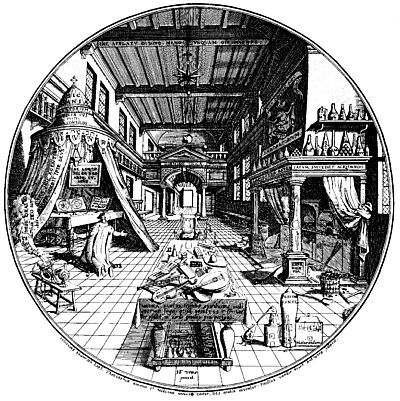 engraving titled "The First Stage of the Great Work" is a circle that
contains the alchemists’ workshop where all the elements in it are drawn in
perspective toward an offset center which is an open door above which is
written in Latin "While sleeping, watch!" On the left side the alchemist
kneels in supplication near the opening ofa Scythian-like tent. In the left
foreground before the tent is a large censor with smoke billowing forth from
it. In the smoke is written in Latin, "ascending smoke, sacrificial speech
acceptable to God."
engraving titled "The First Stage of the Great Work" is a circle that
contains the alchemists’ workshop where all the elements in it are drawn in
perspective toward an offset center which is an open door above which is
written in Latin "While sleeping, watch!" On the left side the alchemist
kneels in supplication near the opening ofa Scythian-like tent. In the left
foreground before the tent is a large censor with smoke billowing forth from
it. In the smoke is written in Latin, "ascending smoke, sacrificial speech
acceptable to God."
To the right of the center is laboratory equipment and
high above everything else alone near the ceiling beams is a curious
seven-leafed chandelier that is out of perspective compared to the converging
lines in the beams. The chandelier looks more like a seven-fingered
marijuana leaf with a flame at the tip of every finger. The only other flame
in the engraving is in the tent itself. The plaque below the flame in the
tent says "Happy is the one who follows the advice of God."
On the cross beam above the
seven-fingered marijuana-leaf chandelier is written "Without the breath of
inspiration from God, no one finds the great way."
Khunrath, as did all the alchemical masters, chose his
words well so that only the uninitiated would misinterpret his meaning. But
we know the tradition of cannabis incense use, especially by the Scythians in
tents. Heinrich’s cant, "ascending smoke, sacrificial speech acceptable to
God," harkens back to the Akkadian Counsels of Wisdom
; from ancient Mesopotamia,
"Sacrifice and (pious) utterance are the proper accompaniment of incense."
In all probability Heinrich Khunrath knew nothing about the Akkadian
Counsels of Wisdom. On the other hand, Khunrath declared the entrance
to eternal wisdom could be gained "Christiano-Kabalically, divino-magically
and even physio-chemically."[32]
He revealed the secret transforming substance was a red gum, the "resin of
the wise." Concerning the nature of the Stone Khunrath wrote: "[The]
Cabalistic habitaculum Materiae Lapidis was originally made known from on
high through Divine Inspiration and special Revelation, both with and without
instrumental help, ‘awake as well as asleep or in dreams.’" Khunrath said
that one could "perfectly prepare our Chaos Naturae in the highest simplicity
and perfection" through a "special Secret Divine Vision and revelation,
without further probing and pondering of the causes.... So work even in the
laboratory by thyself alone, without collaboration or assistants, in order
that God, the Jealous, may not withdraw the art from thee, on account of thy
assistants to whom He may not wish to impart it."[33]
Khunrath is telling the reader that his words are
Cabalistic, or in cant: esoteric meaning is hidden in his prose, analogical
artwork and the slang of the day. In his day using marijuana for religious
purposes was still considered diabolic and severely prohibited. One could
still be dragged before the Inquisition accused of committing satanic rites,
tortured into confessions leading ultimately to death and forfeiture of all
properties. His warning to work alone and beware of impious assistants is
always good advice — the profane naturally obstruct spiritual exploration.
However, such advice is imperative for survival if your religious sacraments
and spiritual explorations are prohibited by the dominant orthodox paradigm
controlling the state: beware of those with whom you would share the
"especial Secret Divine Vision" for they may foolishly reveal incriminating
evidence or worse, be informants working for the Inquisition that would turn
you in for a percentage of the forfeiture (finder’s fee) profits from the
seizure of your personal property.
Alchemists are, in fact, decided solitaries; each
has his say in his own way. They rarely have pupils, and of direct tradition
there seems to have been very little, nor is there much evidence of secret
societies or the like.[34]
Each worked in the laboratory for himself and suffered from loneliness. On
the other hand, quarrels were rare. Their writings are relatively free of
polemic, and the way they quote each other shows a remarkable agreement on
the first principles, even if one cannot understand what they are really
agreeing about.
The Medieval alchemists communicated with one another
through their writings. It was too dangerous for them to work together in
communal laboratories, and by their independence from each other they were
less vulnerable to attack from the prohibitionist Christian theocracy. They
also communicated with one another across time through their writings.
In Khunrath’s time hemp was a ubiquitous crop; its fiber
was essential to global economic trade, for the sails of the world merchant
fleets could be made from hemp fiber only—no other vegetable fiber sail cloth
could endure the stresses of wind and salt air on long ocean voyages.
Paradoxically, using hemp flowers as a religious sacrament was prohibited, yet
fields of hemp flowers could be found nearly everywhere. The European hemp
flowers routinely produce about one or two percent THC isomers
(Tetra-Hydro-Canabinol, considered the psychoactive carbohydrate family of
molecules in cannabis), whereas the resinous red hashish of Lebanon is about
ten times more potent. Khunrath praised the "red resin of the wise," calling
it the transforming substance.
In the Amphitheater of Eternal Wisdom Khunrath illustrates the
alchemical process, the marriage of the sun and the moon, with a peacock
standing on the two heads of the Rebis (opposite natures —sun and moon).
The inscription calls it the "bird of Hermes" and the "blessed greenness."
Gerard Dorn, a contemporary of Khunrath discusses the plant Mercurialis
whose properties were summarized from the Latin text by Carl Jung:
Like the Homeric magic herb Moly, it was found by
Hermes himself and must therefore have magical effects. It is particularly
favorable to the coniunctio because it occurs in male and female form and
thus can determine the sex of a child about to be conceived. Mercurius
himself is said to be generated from an extract of it...
Jung says there is no mention of the Mercurial plant in
the "Tabernae montanus, in which all the magico-medicinal properties of
plants are carefully listed."[35]
However, he did say the mysterious plant "is closely connected with the ‘tree
of the sea’ in Arabian alchemy and hencewith the arbor philosophicia
which in turn has parallels with the Cabalistic tree of the Sefiroth and with
the tree of Christian mysticism and Hindu philosophy."[36]
This prime matter which is proper for the form of
the Elixir is taken from a single tree which grows in the lands of the
West... And this tree grows on the surface of the ocean as plants grow on
the surface of the earth. This is the tree of which whosoever eats, man and
jinn obey him; it is also the tree of which Adam (peace be upon him!) was
forbidden to eat...
Jung connects the philosophical tree of the Arab
alchemists with the Haoma tree that grows in the cosmic ocean of the
Zoroastrian creation myth:
We may note the curious fact that a lizard is
concealed in the tree: "The evil spirit has formed therein, among those which
enter as opposites, a lizard as an opponent in that deep water, so that it
may injure the Haoma," the plant of immortality. In alchemy, the spiritus
mercurii that lives in the tree is represented as a serpent, salamander,
or Melusina.
Interestingly, as was mentioned earlier, Rabelais refers to the good Fly
Agaric mushroom twice in Gargantua and Pantagruel. In the chapter
mentioned earlier in which Rabelais comments that "a certain kind of
Pantagruelion is of that Nature that Fire is not able to consume it," is
a paragraph that refers to the alchemical salamander as well as a mysterious
treethat is of "a very marvelous nature" and "produceth out of its root the
good Agaric." Rabelais also burned cannabis incense, like Khunrath a century
later. Rabelais was familiar with the writings of Zoroaster and he
translated the works of the Roman historian Herodotus, who recorded an early
account of the Scythian marijuana smoke baths. In light of this, it is not
at all surprising to find the name of Zoroaster, who attained ecstasy through
hemp, mentioned in many of the old alchemical texts. Nor should it be
surprising to find the system of self initiation promoted by earlier
Zoroastrian influenced Gnostic alchemists, like Zosimos, continued on in
secret throughout the Middle Ages. 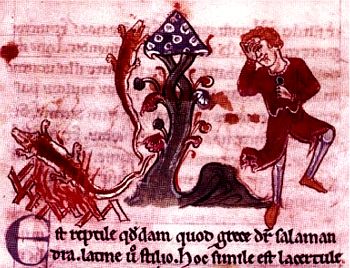 The salamander is a curious symbol in alchemy illustrated in many famous
alchemical texts including the Book of Lambspring. The key that
unlocked one aspect of its esoteric symbolism was found in a fourteenth
century painting from an alchemical text showing a man intoxicated on Amanita
muscaria mushrooms. He clutches one mushroom in his hand as he dances about
holding his other hand to his forehead as if the revelation is too intense.
Behind him a tree grows with a spotted mushroom for a top. A salamander or
lizard floats upward parallel to the Amanita tree. Next to it another
salamander roasts upon the fire in much the same way as the philosopher in
the Book of Lambspring roasts a salamander on a fork in a fire.
Perhaps five hundred years ago psychonauts called such a psychedelic trip
"roasting a salamander." And just as today, where psychonauts in quest of
knowledge often utilize marijuana and psychedelic mushrooms for similar
purposes, so too perhaps our Medieval ancestors burned incense and roasted
salamanders in order to achieve illumination.
The salamander is a curious symbol in alchemy illustrated in many famous
alchemical texts including the Book of Lambspring. The key that
unlocked one aspect of its esoteric symbolism was found in a fourteenth
century painting from an alchemical text showing a man intoxicated on Amanita
muscaria mushrooms. He clutches one mushroom in his hand as he dances about
holding his other hand to his forehead as if the revelation is too intense.
Behind him a tree grows with a spotted mushroom for a top. A salamander or
lizard floats upward parallel to the Amanita tree. Next to it another
salamander roasts upon the fire in much the same way as the philosopher in
the Book of Lambspring roasts a salamander on a fork in a fire.
Perhaps five hundred years ago psychonauts called such a psychedelic trip
"roasting a salamander." And just as today, where psychonauts in quest of
knowledge often utilize marijuana and psychedelic mushrooms for similar
purposes, so too perhaps our Medieval ancestors burned incense and roasted
salamanders in order to achieve illumination.
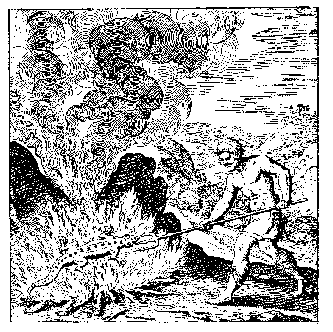
In fact, the description of the Salamander in The Book of
Lambspring has similarities to the sacred drink of the Mithraic Mysteries,
and the details of its production allude to alchemical laboratory operations
that produce a sublimate oil by carefully maintaining heat necessary to
vaporize the psychoactive resin produced on cannabis leaves and flowers.
Just before the dried vegetable matter carbonized in the retort a, viscous
red oil would appear in the neck of the glass receiver. This oily sublimate
they called the eagle, salamander or red lion. In 1939-40 chemist Roger
Adams produced what he called marihuana red oil by distillation; from it he
isolated over sixty psychoactive therapeutic compounds.
In all fables we are told that the
Salamander is born in fire.... It dwells in a great mountain which is
encompassed by many flames. And as one of these is ever smaller than another
— herein the Salamander bathes. The third is greater, the fourth brighter
than the rest. In all these the Salamander washes, and is purified. Then he
ties him to his cave, but on the way is caught and pierced so that it dies,
and yields up its life with its blood. But this, too, happens for its good:
For from its blood it wins immortal life, and then death has no more power
over it. Its blood is the most precious Medicine upon earth, the same has
not its like in the world. For this blood drives away all disease....
From it the Sages derive their science, and through it they attain the
Heavenly Gift, which is called the Philosopher’s Stone
There is this one green lion, which closes
and opens the seven indissoluble seals of the seven metallic spirits which
torments the bodies, until it has perfected them, by means of the artist’s
long and resolute patience.
Unlike the cemented dogma and dead traditions of the
Church, the Alchemical system continued to grow and expand in all areas of
thought. The 18th century occultist Francis Barrett wrote of the influence
of Zoroaster on the great and noble art of alchemy, in the clearest of terms:
Alchymy, the grand touchstone of natural wisdom,
is of divine origin: it was brought down from Heaven by the Angel Uriel.
Zoroaster, the first philosopher by fire, made pure gold from all seven
metals; he brought the sun ten times brighter from the bed of Saturn, and
fixed it with the moon, who thereby copulating, begot numerous offspring of
an immortal nature, a pure living spiritual sun, burning in the refulgency of
its own divine light, a seed of sublime and fiery nature, a vigorous
progenitor. This Zoroaster was the father of alchymy, illumined divinely
from above; he knew every thing, yet seemed to know nothing; his precepts of
art were left in hieroglyphics, yet in such sort that none but the favorites
of Heaven ever reaped benefit thereby. He was the first who engraved the
pure Cabala in most pure gold, and when he died, resigned it to his Father
who liveth eternally, and yet begot him not: that Father gives it to his sons,
who follow the precepts of Wisdom with vigilance, ingenuity, and industry,
and with a pure, chaste, and free mind.
FOOTNOTES
[24] We get the modern term "gibberish" from Geber’s name, and the complicated and cryptic alchemical papers associated with him.
[25] Idries Shah, The Sufis (1964).
[26] Dr. M. Aldrich, Cannabis and Its Derivatives.
[27] Elijiah the Artist.
[28] Another synonym for the “Philosopher's Stone.”
[29] Martin Luther and Paracelsus were contemporaries; Luther was ten years older than Paracelsus. During Paracelsus’ lifetime Luther and his band of Protestants were an oppressed minority and the Reformation had little effect on the "bombast" of Paracelsus.
[30] Strangely Shah makes no direct mention of the Sufis rich history with hashish, although he does comment that the medieval witches picked up their use of powerful hallucinogenic plant drugs like thorn apple (Datura stramonium), and mandrakes from an earlier dervish influence.
[31] We should however make it clear that Alchemy was a synthesis of many philosophical and protoscientific systems and techniques. There were alchemists who dealt with the metamorphic relationship between energy and matter. They worked to produce a universal elixir from the mineral kingdom and were especially fond of the clan of metals. This universal elixir from the mineral kingdom could transmute any of the base metals into gold. That was proof that the alchemist had indeed made the true mineral Stone capable of initiating a metamorphosis in a human that lead to transcendent illumination and immortality.
The fourteenth century adept Nicolas Flamel is the most celebrated of the gold making alchemists. He was a poor scribe that began his career working in a rented booth only thirty inches square in the rue des Ecrivains, Paris, opposite the Church of St. Jacques-la-Boucherie. There he copied manuscripts for a commission. After he and his wife Perronelle succeeded in making the mineral stone, the Flamels “began to endow chapels. churches, cemeteries, charnel-houses and hospitals all over the city, the deeds for which, according to constantly-quoted French archivists, still exist.” (Johnson, The Fulcanelli Phenomenon, p. 88) Flamel could not have been such a renown philanthropist on a meager scribe’s wages. And like music legends of the twentieth century, Elvis Presley and Jim Morrison, the death of the Flamels was said to have been staged so they could erase their personal history. In their case, because they were not aging like the vast majority of Parisian urbanites in the 1300s.
[32] Hienrich Khunrath, (1560-1605) Amphitheatrum Sapientiae Aeternae Christiano-Kabalisticum, (Hanau, 1609; French edition, 1899), translated by Emile Grillot De Givry in Picture Museum of Sorcery Magic and Alchemy, 1929; (English publication, 1963).
[33] Hienrich Khunrath, Von hylealischen Chaos, from Psychology and Alchemy, C.G. Jung (1953); Princeton University Press, 1968.
[34] In a footnote here Jung qualifies the statement: “I am setting aside the later Rosicrucians and the early ‘Poimandres’ community, of which Zosimos speaks.” In all the alchemical literature in between he found only one questionable passage relating to a secret strictly alchemical society. He said it "may go back to very early times and thus to the Gnostic societies. Agrippa mentions an alchemical initiation vow which may possibly refer to the existence of secret societies."
[35] Jung remarked the Tabernaemontanus does mention that a plant whose identity is obscured was “a cure for epilepsy and melancholic fantasies, makes sleepy and drunken like wine, is used in love-potions.”— Mysterium Coniuctionis page, 133.
[36] Mysterium Coniunctionis, pages 134, 135.
[37] Quoted in Psychology and Alchemy, page 460.
[38] Originally published in 1625 as one of 22 alchemical treatise collected in The Hermetic Museum.
[39] As quoted in Le Mystere Des Cathederales, Fulcanelli.
Next Section | Previous Section| Contents