SPAIN AND PORTUGAL TWO REIGNS - ONLY ONE KING (1580-1640)
|
-
-
Iberian Union
After Philip was declared king of Portugal, he decreed that his new
realm would be governed by a six-member Portuguese council; that the
Portuguese cortes would meet only in Portugal; that all civil, military,
and ecclesiastical appointments would remain Portuguese; and that the
language, judicial system, coinage, and military would remain autonomous.
Philip supported the two institutions in Portugal that he believed might
unite the two countries: the Jesuits and the Inquisition. One result was
that New Christians were persecuted even more severely.
|
3ª Dinasty - House
of Austria |
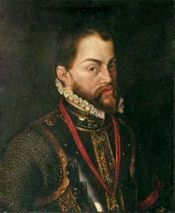
Philip I |
-
- Philip I
- (1580-1598) - Philip II of Spain
-
- The incorporation of Portugal into the Iberian Union was accepted by
the Portuguese nobility without much difficulty. The royal court had used
the language and etiquette of Castile since the fifteenth century, and
much serious work had been done in Castile by Portuguese writers, who were
conscious of belonging to a common Iberian culture. In the countryside,
however, there developed a current of resistance that took the form of a
messianic cult of the "hidden prince," Sebastião.
-
- Members of this cult
believed that Sebastião did not actually die at Alcázarquivir but would
return to deliver Portugal from Spanish domination. This cult became
deeply rooted, and over the years a number of impostors appeared and
sparked rebellions, all of which were easily put down. To this day,
Sebastianism (Sebastianismo), or the nostalgic longing for the
unattainable, is a continuing feature of Portuguese life.
-
- During the reign of
Philip II, the terms of the proclamation of the union of the two crowns
were generally upheld. With Philip's death in 1598 and the ascension to
the Spanish throne of his son, Philip III, much less respect began to be
paid to the provision that preserved Portugal's autonomy.
-
|
| |
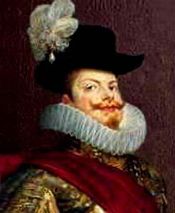
Philip II |
-
-
Philip II (1598-1621)- Philip III
of Spain
-
- Philip III did not visit Portugal until
1619, very near the end
of his reign, and he began to appoint Spaniards to the six-member
governing council as well as to lesser posts. His son and heir, Philip IV,
had no interest in government and consequently turned over the
administration of Portugal to the duke of Olivares.
-
- The duke alienated
Portuguese of all classes, including the hispanophile elite. In order to
prop up the waning power of the Spanish monarchy, he levied excessive
taxes and troop requisitions on Portugal to support Spanish military
activities, especially against France. Moreover, he sought to unify
Portugal with Spain.
|
| |
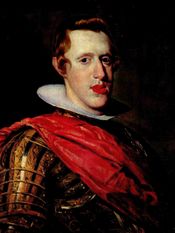
Philip III |
-
-
Philip III (1621-1640) -
Philip IV of Spain
-
-
In 1637 a rebellion broke out in Évora when the Spanish attempted to
collect these taxes by force. Portuguese nobles were summoned to Madrid
and ordered to recruit soldiers for war against France.
The Portuguese
nobility, encouraged by Cardinal Richelieu of France, who promised to
support a Portuguese pretender with soldiers and ships, began to conspire
against the Spanish. During the 1637 rebellion, the populace acclaimed João, duke of Bragança, as king. The duke, who was the nearest noble to
the House of Avis, was Portugal's leading aristocrat and largest landowner.
The choice of the populace was supported by the nobility, which conspired
to make João king. The duke, who was cautious, initially resisted
accepting the Portuguese crown, but eventually began to equip a private
army. In 1640 the Catalans rebelled against Philip IV, and, thus
encouraged, João's supporters went into action on December 1.
|
-
-
-
They entered
the royal palace and arrested Portugal's Spanish governor, the duchess of
Mantua, a cousin of the king of Spain. Five days later, the duke of Bragança arrived in Lisbon and was crowned as João IV (r. 1641-56), thus
restoring the Portuguese monarchy and founding a new ruling dynasty, the
House of Bragança.
Although Portugal's seaborne empire had begun to decline before the
sixty years of incorporation in the Iberian Union, the "Spanish captivity,"
as this period is called by the Portuguese, hastened this process.
The
Portuguese, who were dragged into Spain's wars with England and Holland,
began to see those two countries attack their holdings in Asia, as well as
in Brazil. By the time independence was regained, Portugal's empire was
greatly reduced, having lost its commercial monopoly in the Far East to
the Dutch, and in India to the English. Only the resolute action of
Portuguese settlers had saved Brazil from the Dutch, who had attacked Rio
de Janeiro and Baía, and occupied Pernambuco.
-
|
