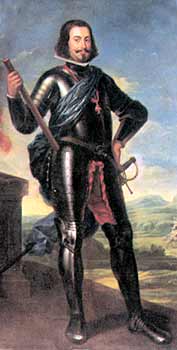
King João IV
-
-
Restoration
- D. João IV
(1640 - 1656)
João IV was proclaimed king by a cortes convoked in 164l. Faced with the general ruin of the realm and threats to his crown from Spain, his first act was to defend the kingdom. He immediately created a council of war, appointed military governors in the provinces, recruited soldiers, rebuilt forts, and constructed an arms foundry.
At the same time, he vigorously sought diplomatic recognition of his monarchy and Portugal's independence from Spain. On June 1, 1641, João IV signed an alliance with Louis XIII of France and soon made peace with Holland and England. By the time of his death in 1656, João IV had consolidated and restored the monarchy by making peace with former enemies, recouped some lost colonial possessions, and defeated Spanish attempts to reincorporate Portugal into the Iberian Union.
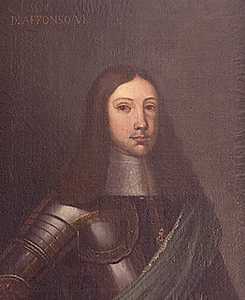
King Afonso VI
- Afonso VI (1656 -1683)
- When João died, his queen, Luísa de Gusmão, became regent because the royal couple's oldest son, Teodósio, had died three years before his father and their youngest son, Afonso, was only ten years old. Although a disease in infancy had left Afonso partially paralyzed and had impaired his intelligence, his mother succeeded in having him proclaimed king. Afonso VI (r.1662-67) grew into a degenerate who preferred riding, coursing bulls, and watching cockfights.
- His marriage to Marie-Françoise Isabelle of Savoy was annulled, and, in 1667, aware of the need for a successor, Afonso consented to his own abdication in favor of his brother, Pedro. During this period, the Portuguese managed to fight off the last attempt by Spain to reincorporate them into the Iberian Union by defeating the Spanish invaders at Ameixial near Estremós. In 1666, three years after this victory, Spain at last made peace and recognized Portugal's independence.
-
-
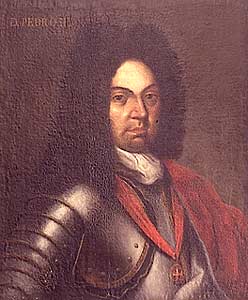
-
King Pedro II
- Pedro II ( 1683 - 1706)
-
When Afonso abdicated, he was banished to Terceira Island in the Azores and his brother, who had married Marie-Françoise, assumed the regency of the throne until Afonso's death in 1683, after which he ruled in his own right as Pedro II until 1706. During his regency,
Pedro had given the task of producing a coherent economic policy to Luís de Menenses, count of Ericeira, who was appointed head of the treasury. Known as the "Portuguese Colbert," Ericeira implemented mercantilist policies in Portugal similar to those of France. These policies sought to protect Portuguese industries against foreign competition. He published laws to enforce sobriety and criticized luxury. Ericeira organized the textile industry and imported looms from England. He stimulated the national production of wool and silk by decreeing that only Portuguese woolens and silks could be worn.
-
Development of Brazil
Having lost the empire in Asia, Portugal's policy makers turned their attention to Brazil, where they intensified the cultivation of sugar, cotton, and spices. This expansion of agriculture required a great deal of labor, which led to the importation of slaves from Angola and Guinea. Amerindians were saved from this fate by the Jesuits, who protected them from enslavement.
The southern part of Brazil was occupied first, and the north, later, owing to resistance put up by Amerindians allied with French pirates. In 1580 the Portuguese conquered Paraíba, and, later, Sergipe. In 1603 they penetrated to Ceará and, later, to Pará, where they founded the city of Belém. In 1637 Pedro Teixeira launched a daring expedition into the Amazon Basin, following the river to its headwaters near the Pacific coast. During the sixteenth and seventeenth centuries, various expeditions were sent into the interior, especially at the end of the seventeenth century when gold was discovered.
These expeditions were made up of adventurers known as bandeirantes (after the Portuguese word for flag) because they traveled under the flag of their leader, who took with him kin, friends, slaves, and friendly Amerindians. These expeditions, which followed rivers into the interior, lasted years. The most notable bandeirantes were Pais Leme, who traveled for seven years throughout present-day Minas Gerais, and his son-in-law, Manuel Borba Gato, who discovered several sources of gold on the Rio das Velhas. In addition to gold, diamonds were also found in abundance.
The discovery of gold and diamonds sparked a gold rush from all over the world to Brazil and from the central zones to the interior, which devastated Brazilian agriculture. The gold and diamonds enriched the Portuguese crown and allowed it to spend lavishly on imported goods and baroque palaces, thus destroying once again the initiatives previously taken for indigenous economic development.
Brazilian gold also encouraged England to update its commercial relations with Portugal. The Methuen Treaty of 1703 allowed the Portuguese a preferential duty on wine exported to England, in return for which Portugal removed restrictions on the importation of English-made goods. The Portuguese market was soon absorbing 10 percent of the English export trade, which represented an increase of 120 percent above the quantity of goods imported to Portugal before the treaty. Portuguese exports to England, mainly wine, rose by less than 40 percent. Gold from Brazil was used to pay for this trade imbalance.
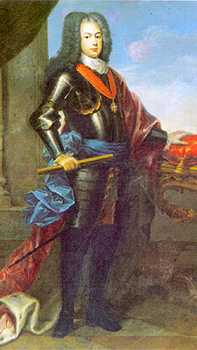
King João V
D.João V - O Magnífico (1706 - 1750)
Pedro II was succeeded by João V (r.1706-50), a youth of seventeen. He was an energetic king who introduced absolutist rule into Portugal, copying the style of the royal court of Louis XIV of France. Brazilian gold allowed João V to spend lavishly on major architectural works, the greatest being the royal palace at Mafra, begun in 1717, which sought to rival the Escorial in Spain.
He also endowed the University of Coimbra with an elegantly decorated library, and built the Aqueduct of Free Waters (Aqueduto das Águas Livres) that brought water to Lisbon. João encouraged the development of decorative arts such as furniture design, clockmaking, and tapestry weaving.
He pursued mercantilist policies to protect indigenous industries, including papermaking at Lousã, glassmaking at Marinha Grande, and textile weaving at Covilhã . He subsidized the publication of notable works such as Caetano de Sousa's História Geneológica da Casa Real. All in all, João V animated what has been called Portugal's second renaissance.
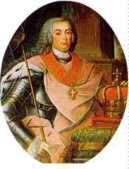
King José I
D. José I (1750 -1777)
- João V died in 1750 and
was succeeded by his son José I (r.1750-77) who was indolent and placed
the reins of government into the hands of Sebastião José de Carvalho e
Melo, later the Marquês de Pombal.
A petty noble who managed to surmount Portugal's rigid class system by a combination of energy, intelligence, good looks, and a shrewd marriage, Pombal became the veritable dictator of Portugal. Once Portugal's ambassador to Britain and Austria, Pombal had been influenced by the ideas of the Enlightenment. Realizing how backward Portugal was, he sought through a ruthless despotism to reform it and create a middle class.
- On the morning of
November 1, 1755, a violent earthquake shook Lisbon and demolished most of
the city. Thousands were killed in the subsequent fire and tidal wave.
Pombal, who was at Belém at the time, energetically took appropriate
measures.
He improvised hospitals for the injured, controlled prices for various services, requisitioned food from the countryside, and organized public security. He decided to rebuild the city after a survey of the ruins. Under the direction of the architect Eugénio dos Santos and the engineer Manuel da Maia, a master plan for a new city was drawn up.
The old city center was cleared of rubble and divided into squares of long avenues and cross streets. New buildings conforming to a standard architectural style were quickly erected using the latest construction techniques. Lisbon thus emerged from the earthquake as Europe's first planned city. Flanked by the Praça do Rossio at one end, and the Praça do Comêrcio at the other, this quarter of the city is known today as the Baixa Pombalina.
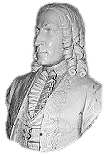
Pombal
- Marques de Pombal
- For his prompt and
efficient action, Pombal was elevated to chief minister, which allowed him
to consolidate his power. Desiring to destroy all forces within the
society that could oppose his plans for modernizing Portugal, he began to
systematically annihilate them, beginning with the nobility. An attempt on
the life of the king on September 3, 1758 provided Pombal with a pretext
to take action against the nobility. He accused many nobles of
responsibility for the attempt and arrested about 1,000 individuals. Many
confessed under brutal torture and were executed.
Pombal also attempted to rid Portugal of the Jesuits, whom he accused of taking part in the attempt on the king's life. He searched the houses belonging to the Jesuits, confiscated their belongings, closed their schools, and, in 1759, expelled them from the kingdom and its overseas possessions. In an effort to restrain the church, Pombal broke diplomatic relations with the Holy See in 1760 and imprisoned the bishop of Coimbra.
- Pombal's economic policies
were inspired by the protectionist doctrines of Colbert, which gave royal
companies monopolies in certain fields. Following the initiatives in this
regard established by the count of Ericeira, Pombal prohibited the export
of gold and silver. In order to increase cereal cultivation, he prohibited
the growing of grape vines in certain areas of the country.
He protected the winemaking industry by founding, in 1756, a company with a monopoly on exporting port wine. Pombal created other companies with exclusive rights to commercial activities in various regions of Brazil, as well as a fishing and processing company for sardines and tuna in Portuguese waters. He transformed the silk industry into a textile industry and turned over the operation of the glassmaking factory at Marinha Grande to a British manager, who introduced new manufacturing techniques.
Pombal also made notable changes in the area of education. After expelling the Jesuits and confiscating their schools, he took the first steps toward establishing a system of public instruction. He founded a commercial school and established schools, paid for with a special tax, in the major cities.
In addition, Pombal instituted numerous reforms of the university, whose decline he blamed on the Jesuits. He created two new departments--mathematics and philosophy--and increased the number of professors in the already existing departments. He put forward new methods of instruction based on the writings of Luís António Verney and António Nunes that stressed observation and experience, and set up laboratories, a natural history museum, a botanical garden, and an observatory.
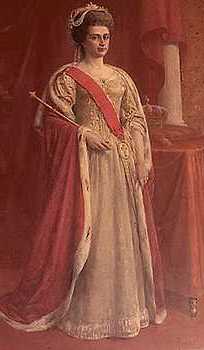
Queen Maria I
- D. Maria I (1777 - 1816 )- A Piedosa - A Pia ou a Louca
- José I died in 1777 and was succeeded on the throne by his daughter Maria I (r.1777-92), who dismissed Pombal and banished him to the village of Pombal.
- She immediately freed hundreds of prisoners, restored the old nobility to it former status, reestablished relations with the Holy See, revoked laws against the clergy, abolished many of the state companies, and generally dismantled Pombal's dictatorship.
- The strong, secular society that Pombal hoped to create did not materialize, and the old social and economic order quickly restored itself
-
-
Peninsular Wars
The events of the French Revolution, especially the regicide of Louis XVI and the Terror, made the rest of Europe's monarchs fear for their lives. The Portuguese monarchy, like others, took measures to prevent the infiltration of revolutionary propaganda into the kingdom. Maria I, who suffered nightmares and fits of melancholy, imagined that she was damned. In 1792 she turned the reigns of government over to her second son, Joã o, who was prince of Brazil. As the situation in France deteriorated, Portugal signed treaties of mutual assistance with Britain and Spain in 1793. In the same year, the Spanish army, reinforced by 6,000 Portuguese troops, attacked France across the Basque frontier. In 1794 the French launched a major counterattack, which forced the combined Spanish-Portuguese army to retreat from French territory. The French army reached the Ebro River and threatened Madrid.
In 1795 Spain made peace at Basel with France without consulting the Portuguese. Despite having fought with the Portuguese against France, the Spanish now allied themselves with the French and signed a secret treaty at San Idelfonso in 1800. In 1801 France and Spain sent the Portuguese an ultimatum threatening to invade Portugal unless it abandoned its alliance with Britain, closed its ports to the British and opened them to French and Spanish ships, and handed over one-quarter of its territory as a guarantee for Spanish territories held by Britain. The Portuguese refused to comply, and the Spanish marched into the Alentejo in May. After two weeks of fighting, the "War of the Oranges," as it is known, was concluded in 1801 at Badajoz. According to the terms of the peace treaty, Portugal agreed to close its ports to British shipping, granted commercial concessions to the French, paid an indemnity, and ceded Olivença to Spain.
When Napoleon became emperor in 1804, he renewed his struggle with Britain. The British declared a naval blockade of France, and, in retaliation, Napoleon decreed that all nations of Europe should break relations with Britain. Portugal declared itself neutral in the struggle. Napoleon ordered the Portuguese to close their ports to the British, which they were prepared to do if they could without breaking relations with their old ally. In October 1807, Napoleon signed a treaty with Spain at Fontainebleau, according to which France and Spain agreed to invade Portugal and partition the country, one-third going to France, one-third to Spain, and one-third to Spain's chief minister, Manuel de Godoy.
PENINSULAR WARS - 1807 - 1810
tHE THREE DEFEATED FRENCH COMMANDERS
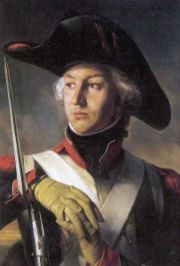
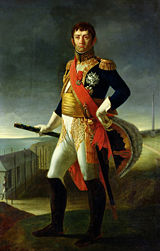
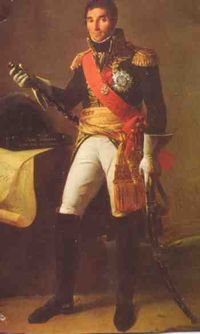
Jean-Andoche Junot Jean de Dieu Soult Jean-André Masséna
- On November 17, 1807, an army of French and Spanish soldiers under the command of the French general Andoche Junot entered Portugal and marched on Lisbon. The British were in no position to defend their ally; consequently, the prince regent and the royal family left for Brazil. On November 27, Junot's army took control of Lisbon.
- French occupation eventually sparked rebellions among the populace, and provisional juntas were organized in several cities. The junta in Porto, to which other local juntas finally pledged obedience, organized an army and, with British help, was able to defeat a strong French force at Lourinhã on August 21, 1808. After this defeat, the French opened negotiations with the Portuguese and signed the Convention of Sintra, which provided for the evacuation of Junot's forces. The government was placed in the hands of the juntas. In January 1809, the prince regent designated a British officer, William Carr Beresford, to reorganize the Portuguese army, granting him the rank of marshall and commander in chief.
- In March 1809, French troops under the command of General Nicholas Soult invaded Portugal once again. Entering the country from Galicia, they occupied Chaves and marched on Porto. A combined Portuguese-British army, commanded by Sir Arthur Wellesley, pushed Soult back to Galicia and defeated another French army at Tavera in Spain, after which Wellesley was made the duke of Wellington.
- The expulsion of Soult's forces gave the Anglo-Portuguese army time to prepare for Napoleon's third invasion, which was ordered in 1810. The third French army under the command of General André Masséna entered Portugal at Guarda and marched to Viseu. Because Wellington's forces held the main roads, Masséna took his army across the Buçaco Mountains and marched on Coimbra, which he sacked. Wellington withdrew his army southward, luring Masséna into positions he had prepared at Tôrres Vedras. Finding the positions impenetrable, Masséna, far from his source of supply and short of food, withdrew his forces. Wellington pursued Masséna and overtook him at Sabugal where his army was defeated. Masséna retreated from Portugal.
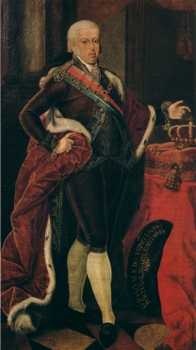
King João VI
-
-
Revolution of 1820
- D. João VI ( 1816 - 1826 )
In 1816 Maria I, after twenty-four years of insanity, died and the prince regent was proclaimed João VI (r.1816-26). The new king, who had acquired a court and government in Brazil and a following among the Brazilians, did not immediately return to Portugal, and liberals continued to agitate against the monarchy.
In May 1817, General Gomes Freire Andrade was arrested on treason charges and hanged, as were eleven alleged accomplices. Beresford, who was still commander in chief of the Portuguese army, was popularly blamed for the harshness of the sentences, which aggravated unrest in the country. The most active center of Portuguese liberalism was Porto, where the Sinédrio was situated and quickly gaining adherents. In March 1820, Beresford went to Brazil to persuade the king to return to the throne.
His departure allowed the influence of the liberals to grow within the army, which had emerged from the Peninsular Wars as Portugal's strongest institution. On August 24, 1820, regiments in Porto revolted and established a provisional junta that assumed the government of Portugal until a cortes could be convoked to write a constitution. The regency was bypassed because it was unable to cope with Portugal's financial crisis, and Beresford was not allowed to enter the country when he returned from Brazil.
- After the Vilafrancada, as the uprising is known, Miguel was made generalíssimo of the army. In April 1824, Miguel led a new revolt--the Abrilada--which sought to restore absolutism. João, supported by Beresford, who had been allowed to return to Portugal, dismissed Miguel from his post as generalíssimo and exiled him to France. The constitution of 1822 was suspended, and Portugal was governed under João's moderate absolutism until he died in 1826.
- In December 1820,
indirect elections were held for a constitutional cortes, which convened
in January 1821. The deputies were mostly constitutional monarchists.
They elected a regency to replace the provisional junta, abolished
seigniorial rights and the Inquisition, and, on September 23, approved a
constitution.
At the same time, João VI decided to return to Portugal, leaving his son Pedro in Brazil. Upon his arrival in Lisbon, João swore an oath to uphold the new constitution. After his departure from Brazil, Brazilian liberals, inspired by the independence of the United States and the independence struggles in the neighboring Spanish colonies, began to agitate for freedom from Portugal. Brazilian independence was proclaimed on October 12, 1822, with Pedro as constitutional emperor.
The constitution of 1822 installed a constitutional monarchy in Portugal. It declared that sovereignty rested with the nation and established three branches of government in classical liberal fashion. Legislative power was exercised by a directly elected, unicameral Chamber of Deputies; executive power was vested in the king and his secretaries of state; and judicial power was in the hands of the courts. The king and his secretaries of state had no representation in the chamber and no power to dissolve it.
Two broad divisions emerged in Portuguese society over the issue of the constitution. On the one hand were the liberals who defended it, and on the other, the royalists who favored absolutism. The first reaction to the new liberal regime surfaced in February 1823 in Trás-os-Montes where the count of Amarante, a leading absolutist, led an insurrection. Later, in May, Amarante once again sounded the call to arms, and an infantry regiment rose at Vila Franca de Xira, just north of Lisbon. Some of the Lisbon garrison joined the absolutists, as did the king's younger brother, Miguel, who had refused to swear to uphold the constitution.
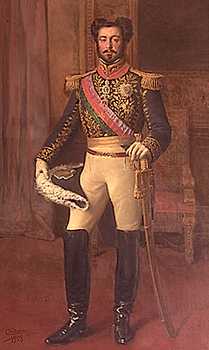
- King Pedro IV
-
-
War of the Two Brothers
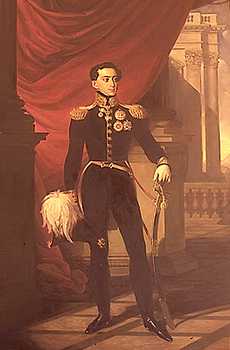
Pedro I - 1º Imperador do Brasil e Pedro IV de Portugal - João's death created a
problem of royal succession. The rightful heir to the throne was his
eldest son, Pedro, emperor of Brazil. Neither the Portuguese nor the
Brazilians wanted a unified monarchy; consequently, Pedro abdicated the
Portuguese crown in favor of his daughter, Maria da Glória, a child of
seven, on the condition that when of age she marry his brother, Miguel. In
April 1826, as part of the succession settlement, Pedro granted a new
constitution to Portugal, known as the Constitutional Charter. Pedro
returned to Brazil leaving the throne to Maria, with Miguel as regent.
The Constitutional Charter attempted to reconcile absolutists and liberals by allowing both factions a role in government. Unlike the constitution of 1822, this document established four branches of government. The legislature was divided into two chambers.
The upper chamber, the Chamber of Peers, was composed of life and hereditary peers and clergy appointed by the king. The lower chamber, the Chamber of Deputies, was composed of 111 deputies elected to four-year terms by the indirect vote of local assemblies, which in turn were elected by persons meeting certain tax-paying and property-owning requirements. Judicial power was exercised by the courts; executive power by the ministers of the government; and moderative power by the king, who held an absolute veto over all legislation.
-
King Miguel I
- D. Miguel I
- The absolutists, however,
were not satisfied with this compromise, and they continued to regard
Miguel as the legitimate successor to the throne because he was Portuguese
whereas Pedro was Brazilian.
In February 1828, Miguel returned to Portugal to take the oath of allegiance to the charter and assume the regency. He was immediately proclaimed king by his supporters. Although it initially appeared that Miguel would abide by the charter, pressure mounted for a return to absolutism.
A month after his return, Miguel dissolved the Chamber of Deputies and the Chamber of Peers and, in May, summoned the traditional cortes of the three estates of the realm to proclaim his accession to absolute power. The Cortes of 1828 assented to Miguel's wish, proclaiming him king as Miguel I and nullifying the Constitutional Charter.
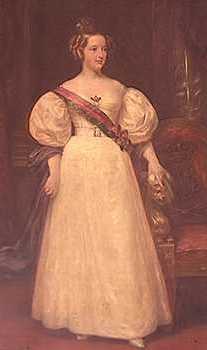
Queen Maria II
- D. Maria II ( 1834 - 1853 )
- This usurpation did not go
unchallenged by the liberals. On May 18, the garrison in Porto declared
its loyalty to Pedro, Maria da Glória, and the Constitutional Charter. The
rebellion against the absolutists spread to other cities. Miguel
suppressed these rebellions, and many thousands of liberals were either
arrested or fled to Spain and Britain. There followed five years of
repression.
In Brazil, meanwhile, relations between Pedro and Brazil's political leaders had become strained. In 1831 Pedro abdicated in favor of his son, Pedro II, and sailed for Britain. He organized a military expedition there and then went to the Azores, which were in the hands of the liberals, to set up a government in exile in March 1831.
- In July 1832, Pedro
occupied Porto, which was subsequently besieged by the absolutists. In
June 1833, the liberals, still encircled at Porto, sent a force commanded
by the duke of Terceira to the Algarve. At the same time, a liberal
squadron defeated the absolutists' fleet near Cabo São Vincente. Terceira
landed at Faro and marched north through the Alentejo to capture Lisbon on
July 24.
A stalemate of nine months ensued. The absolutists controlled the rural areas, where they were supported by the aristocracy and the peasantry. The liberals occupied Portugal's major cities, Lisbon and Porto, where they commanded a sizeable following among the middle classes. Finally, the Miguelists lifted their siege of Porto and marched on Lisbon, but they were defeated at Évora-Monte. Peace was declared in May 1834, and Miguel, guaranteed an annual pension, was banished from Portugal, never to return. Pedro restored the Constitutional Charter.
-
-
Moderate vs. Radical Liberals
Pedro survived his victory by less than three months. After his death, fifteen-year-old Maria da Glória was proclaimed queen as Maria II (r.1834-53). Despite their victory over the absolutists, the liberals were themselves divided between moderates, who supported the principles of the charter, and radicals, who wanted a return to the constitution of 1822. Maria's first government was made up of moderates headed by the duke of Palmela, whose government collapsed in May 1835.
He was succeeded by the duke of Saldanha, whose government fell in May 1836. In July 1836, radicals were elected from Porto by advocating a return to the constitution of 1822 as a way of resolving Portugal's economic crisis. When these deputies arrived in Lisbon, they were met by demonstrations supporting their cause. The following day, the moderate liberal government collapsed and, in September, the radicals, led by Manuel da Silva Passos, formed a new government. The radicals nullified the Constitutional Charter and reestablished the constitution of 1822 until it could be revised by a constituent cortes to make it more compatible with changed social and economic circumstances.
The actions of the radicals resulted in a violent reaction from the moderates, who saw their power threatened and considered the charter the symbol of the liberal victory in the War of Two Brothers. As a compromise, the Constituent Assembly, convoked in March 1838, attempted to reconcile the constitution of 1822 and the Constitutional Charter. In April 1838, Portugal's third constitution was approved.
The document abolished the royal moderative power and returned to liberalism's classical tripartite division of government into legislative, executive, and judicial branches. It reaffirmed, as did the 1822 constitution, that sovereignty rested with the nation. It abolished the Chamber of Peers and substituted a Chamber of Senators, and it established direct election of the Chamber of Deputies, although only selected citizens were allowed to vote. The monarch's role was enhanced and the Chamber of Senators was restricted to leading citizens, or notables.
The radicals, now called Septemberists after the September 1836 revolution, held office until June 1841. On that date, they were replaced in a bloodless coup d'état by moderates, who abolished the 1838 constitution and restored the charter. António Bernardo da Costa Cabral, who organized and led the revolt, took various measures designed to reform Portugal's political, economic, and social systems. Some of these measures, especially new sanitary regulations that prohibited burials in churchyards, stirred the rural countryside, still Miguelist, into active resistance against the liberal government in Lisbon.
The women of the Minho region, who had traditionally played an important role in churchyard burials, began to demonstrate against the authorities. Supported by the rural nobility and clergy, the Maria da Fontes, as this movement was called, spread throughout the rural north. Unable to suppress it by force, the government of Costa Cabral fell on May 20, 1846. The new government, a confusing hodgepodge of radicals and moderates, rescinded the cemetery regulations.
The government divided when the duke of Palmela, who was its prime minister, called for new elections in October, hoping to unite the moderates, themselves divided into two factions. This sparked a reaction by the Septemberists, who were particularly strong in Porto, where they rebelled and set up a provisional junta. The duke of Saldanha, Palmela's replacement, attempted without success to suppress the Septemberist rebellion, which by now had spread beyond Porto to other areas.
With the country on the brink of a second civil war, Queen Maria sought help from the Quadruple Alliance, consisting of Britain and France, as well as Spanish and Portuguese liberal elements. After the alliance imposed a naval blockade and sent troops, the Septemberists capitulated, Saldanha resigned, and a peace agreement was signed on June 29, 1847. Costa Cabral returned to power.
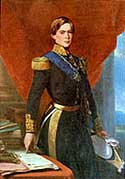
King Pedro V
-
Rotativismo
D. Pedro V ( 1853 - 1861 )
In 1851 Saldanha staged a revolt and, supported by the garrison in Porto, gained control of the government and sent Costa Cabral into exile. Saldanha and his followers were called Regenerators because they recognized the need to modify the charter to make it more compatible with the social and political situation.
These modifications appeared as amendments, the first of which was a new electoral law that made the franchise more acceptable to the Septemberists. Gradually, government became stabilized. The Septemberists began to be referred to as Historicals and, later, Progressives.
The Regenerators and Progressives were not political parties in today's sense of the term. The electorate comprised less than 1 percent of the population; therefore, the Regenerators and Progressives were essentially loose coalitions of notables, or leading citizens, based on personal loyalties and local interests. Elections were held after a change in governing factions to provide the new faction with a majority in the legislature.
By tacit agreement, one faction would govern as long as it was able and then turn over power to the other. After 1856 this practice of alternating factions at regular intervals, called rotativismo, was all but institutionalized and produced relatively stable government until the end of the nineteenth century.
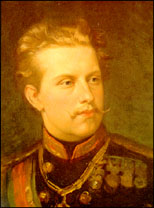
King Luís I
- D. Luís I
( 1861 - 1869 )
Portuguese Africa
With the advent of rotativismo and subsequent political stability, the attention of Portugal turned toward its colonial possessions in Africa. In East Africa, the chief settlement was Mozambique Island, but there was little control over the estates of the mainland where Portuguese of mixed ancestry ruled as feudal potentates. In West Africa, the most important settlements were Luanda and Benguela on the Angolan coast, linked to Brazil by the slave trade conducted through the African island of São Tomé. It was during this period that the Portuguese began to send expeditions into the interior.
In 1852 António Francisco Silva Porto explored the interior of Angola. In 1877 a scientific expedition led by Hermenegildo Capelo and Roberto Ivens, two naval officers, and Alexandre Serpa Pinto, an army major, departed from Luanda and traveled to the Bié region in central Angola, where they separated. Serpa Pinto explored the headwaters of the Cuanza River in Angola and followed the course of the Zambezi River to Victoria Falls in present-day Zimbabwe. Exploring areas now part of South Africa, he crossed the Transvaal and arrived in Natal in 1879.
-
- In 1884 Capelo
and Ivens departed from Moçamades on the coast of Angola and crossed the
continent through entirely unexplored territory, arriving at Quelimane on
the east coast of Mozambique in 1885. In the same year, Serpa Pinto and
Augusto Cardoso explored the territory around Lake Nyassa. Various
Portuguese, such as Paiva de Andrade and António Maria Cardoso, explored
the interior of Mozambique.
Despite Portugal's historical claim to the Congo region, the colonial ambitions of the great powers of the day--Britain, France, and Germany--gave rise to disputes about its ownership. Portugal therefore proposed an international conference to resolve the disputed claim to the Congo. This conference, which met in Berlin in 1884-85, awarded the Congo to the king of Belgium and established the principle that in order for a claim to African territory to be valid, the claimant had to demonstrate "effective occupation," not historical rights. The Berlin Conference, as it is known, resulted in the partition of Africa among the European powers, and awarded Portugal Mozambique, Angola, and Guinea.
In 1886 Portugal signed two treaties that delimited the boundaries between Portuguese territories and those of France and Germany. France and Germany recognized Portugal's right to exercise sovereignty in the interior territory between Mozambique and Angola. This claim was represented on a map, annexed to the treaty with France, on which the claimed territory was colored red. In order to validate this claim, the Portuguese published the "rose-colored map" and organized successive expeditions into the interior between Mozambique and Angola. Meanwhile, the British were also exploring the territory from south to north under the auspices of Cecil Rhodes, who had designs on the territory for the construction of a railroad that would run from Cape Town through central Africa to Cairo.
Portugal protested against the activities of the British in what they considered to be their territory. The British, having signed a number of treaties with African chiefs, claimed that the territory was under their protection and refused to recognize the rose-colored map. Moreover, they said the territory was not Portuguese because Portugal had not effectively occupied it as required by the terms of the Berlin Conference. Portugal proposed that the conflicting claims be resolved through arbitration. Britain refused and sent the Portuguese an ultimatum, on January 11, 1890, demanding the withdrawal of all Portuguese forces from the disputed territory. Portugal, faced with the armed might of the British, complied.
- The ultimatum of 1890
caused astonishment and indignation in Lisbon. As a result, the
Progressive government fell and a non-party government came to power. The
ultimatum was strongly denounced by Portugal's growing band of
republicans, who had organized themselves into a formal party in 1878.
The republicans based their appeals on crude nationalism and played on the fears of many that a continuation of the inept government of the liberals would make Portugal either a British colony or a province of Spain. Teachers, journalists, small-business persons, clerks, and artisans were drawn to republicanism, with its appeals to nationalism, universal suffrage, separation of church and state, and the abolition of the monarchy and nobility, which were seen as irrational institutions that sapped the strength of Portugal.
The appeal of republicanism was also enhanced by the collapse of rotativismo. After 1890 the system ceased to function smoothly. Conflicts between the Regenerators and Historicals, formerly settled in secret, were brought into the open in an effort to generate public support for the system. But open debate proved to be unsettling in Portugal's depoliticized society.
By 1906 neither faction could attain a parliamentary majority. In that year, the republicans managed to elect from Lisbon four deputies who proceeded to create tumultuous scenes in parliament. In May 1907, the situation came to a standstill.
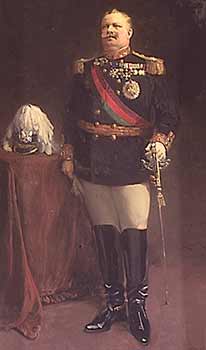
King Carlos I
- D. Carlos I
( 1889 - 1908 )
The king, Carlos I (r.1889-1908), dissolved parliament and gave to João Franco, a conservative reformist who had bolted from the Regenerators to form his own party, the power to govern by decree. João Franco's dictatorship was condemned by all political parties, and the republicans attempted an unsuccessful coup d'état. A crackdown on the republican movement followed. On February 1, 1908, the king and the royal family were attacked by two disgruntled republicans as they crossed the Praça do Comêrcio by open landau. The king and his youngest son were killed, and his oldest son, Manuel, survived a bullet wound in the arm. Manuel, who was eighteen at the time, became king as Manuel II (r.1908-10).
In an effort to salvage the monarchy, João Franco stepped down as prime minister and went into exile. New elections were held, but factionalism among the Regenerators and Historicals prevented the formation of a stable government even after six attempts.
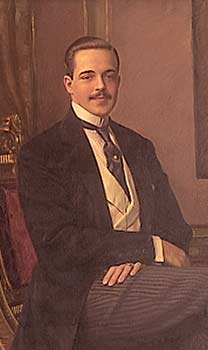
King Manuel II
- D. Manuel II ( 1908 - 1910 )
- On October 1, 1910, the appearance in Portugal of the president of the Brazilian republic after a visit to Germany provided a pretext for extensive republican demonstrations. On October 3, the army refused to put down a mutiny on Portuguese warships anchored in the estuary of the Tagus and took up positions around Lisbon.
- On October 4, when two of the warships began to shell the royal palace, Manuel II and the royal family fled to Britain. On October 5, a provisional republican government was organized with the writer Teófilo Braga as president.
