-
THE HOUSE OF AVIS
- When Fernando died in 1383, he left no male heir to the throne. His only daughter, Beatriz, was married to Juan I, king of Castile. The marriage writ stipulated that their offspring would inherit the Portuguese crown if Fernando left no male heir and that, until any children were born, Portugal would be ruled by a regency of Fernando's widow, Leonor Teles. When Fernando died, Leonor assumed the regency in accordance with the marriage writ.
- The assumption of the regency by the queen was badly received in many Portuguese cities because Leonor was a Castilian and considered an interloper who intended to usurp the Portuguese crown for Castile and end Portugal's independence. Leonor's principal rival for control of the throne was João, the master of the Order of Avis and illegitimate son of Fernando's father, Pedro I (r.1357-67).
- On December 6, 1383, João broke into the royal palace and murdered Count Andeiro, a Galician who had been Fernando's chancellor. Leonor Teles fled to the town of Alenquer, the property of the queens of Portugal. She appealed to Juan I for help, and he invaded Portugal in January 1384. Leonor abdicated as regent. In Lisbon the people proclaimed João to be the governor and defender of the realm. João immediately began to prepare an army and sent a mission to England to recruit soldiers for his cause.
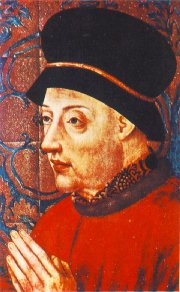
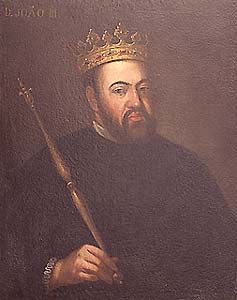
King D. João I
-
Wars with Castile The bourgeoisie of Lisbon, enriched by commerce, decided to support João and donated substantial sums for war expenses. Money also arrived from the bourgeoisie in Porto, Coimbra, and Évora.
The majority of the nobility, among whom national sentiment was not well developed and feudal customs based on oaths of vassalage were still obeyed, took the side of Juan of Castile, which gave him the support of fifty castles. A few nobles, however, including Álvaro Pais, João Afonso, and Nun'Álvares Pereira, were more attuned to national sentiment and sided with João.
- King D. João I - (1385-1433) - "O de Boa Memória"
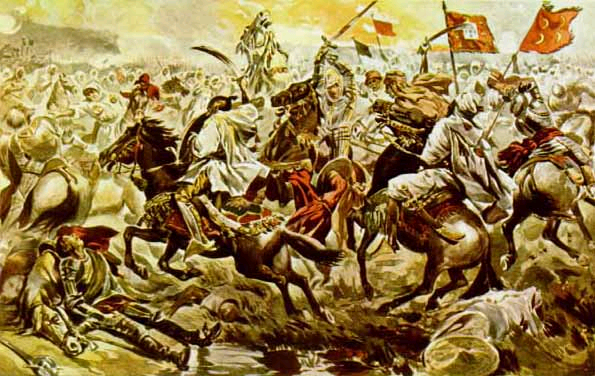
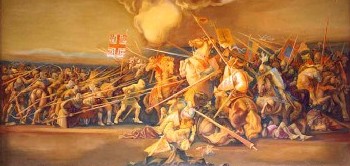
- In March 1384, Juan marched on Lisbon, which he besieged by land and sea. In April, in the Alentejo, Nun'Álvares Pereira defeated the Castilians at the Battle of Atoleiros, a victory that resulted from the new military tactic of forming defensive squares from dismounted cavalry because the Portuguese had far fewer troops than the enemy. The siege of Lisbon was broken after seven months by an outbreak of the plague in the Castilian camp, and Juan retreated to Seville to prepare another invasion the following year.
-
-
The retreat of the Castilians gave João an opportunity to legitimate his claim to the throne. In March 1385, a cortes was summoned to resolve the succession. João's case was argued by João das Regras, who attacked the claims of the various pretenders to the throne. On April 6, the opposition ended and João was proclaimed king as João I (r. 1385-1433). The new king named Nun'Álvares Pereira constable of Portugal. At the same time, a contingent of English longbowmen began to arrive. -
-
Nun'Álvares Pereira marched north in order to obtain the submission of Braga, Guimarães, and other places loyal to Juan, who responded by sending an army to attack Viseu. The Portuguese routed this Castilian force at Rancoso using the same new military tactic that brought them victory at Atoleiros. Juan, nonetheless, was still intent on besieging Lisbon and led his army southward. João I and Nun'Álvares Pereira decided to engage Juan's army before it arrived in the capital. The two armies met on the plain of Aljubarrota about sixty kilometers north of Lisbon on August 14, 1385. Using the same tactic of defensive squares of dismounted cavalry that had brought them success in previous battles, a force of 7,000 Portuguese annihilated and scattered a Castilian army of 32,000 in little more than thirty minutes of combat. Although additional battles were fought and final peace was not made with Castile until October 1411, the Battle of Aljubarrota secured the independence of Portugal for almost two centuries.
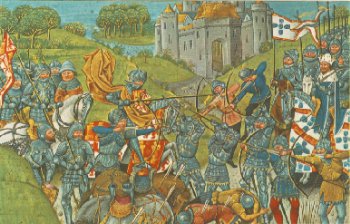
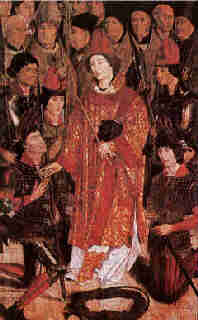
- A Ínclita Geração
-
Social Revolution
The crisis of 1383-85 that brought João I to the throne was not only a dynastic revolution; it was a social one, as well. João I distrusted the old aristocracy that had opposed his rise to power and promoted the growth of a new generation of nobility by confiscating the titles and properties of the old and distributing them to the new, thus forming a new nobility based on service to the king.
João rewarded the urban bourgeoisie that had supported his cause by giving it positions and influence and by allowing it to send representatives to the king's royal council. Artisans grouped themselves according to professions into guilds and were permitted to send delegates to the governing chamber of Lisbon, where they were actively involved in the administration of the capital and other cities.
The king also surrounded himself with skilled legalists who professionalized royal administration and extended royal jurisdiction at the expense of the old aristocracy. This new class of bureaucrats, having studied Roman law at the university, defended the Caesarist principle that the will of the king had the force of law. This belief encouraged the later development of absolutism in Portugal and pitted the king against the landed nobility, especially the old aristocracy that wished to regain its lost power and privilege.
-
Intradynastic Struggle
The future of the House of Avis seemed assured by the presence of João's five legitimate sons, but the king also provided for his illegitimate children as he had been provided for by his father. João conferred on his bastard son Afonso the hereditary title of duke of Bragança and endowed him with lands and properties that amounted to the creation of a state within a state supported by a huge reserve of armed retainers.
The House of Bragança accumulated wealth to rival that of the crown and eventually assumed the leadership of the old aristocracy in opposition to Avis.
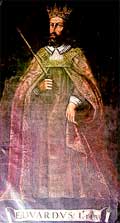
D. Duarte I
D. Duarte I " O Eloquente"(1433- 1438)
- When João I died in 1433, the crown was assumed by his eldest son, Duarte, who died five years later of the plague. Before his death, Duarte convoked a cortes in order to legitimate the compilation of Portuguese royal law, but the work was not completed until the reign of his son, Afonso, and is, therefore, named the Afonsine Ordinances.
- He also declared that the grants of land so lavishly awarded by his father to his supporters would have to be confirmed, as was the custom at the start of each reign.
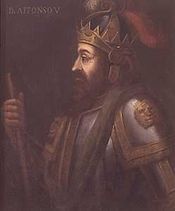
D. Afonso V
.
D. Afonso V ( 1438 -1481 ) - "O Africano"
- Afonso was six years old when his father
died and his mother, Queen Leonor of Aragon, assumed the regency. There
was opposition to the assumption of all authority by a woman, and Leonor
agreed that Duarte's brother, Pedro, should become regent.
This was opposed by Afonso, duke of Bragança, the eldest illegitimate son of João I. Both men aspired to gain influence over the young king by marrying him to their daughters. The populace of Lisbon strongly favored Pedro and acknowledged him as regent.
Pedro received confirmation for his regency by summoning the cortes at Évora and paved the way for his continuance in power by arranging the marriage of his daughter Isabel to the young king, who, when he reached his majority in 1446, agreed to the match and asked his uncle to continue the regency.
-
The duke of Bragança reasserted his ambitions and was able to influence the young king to dismiss Pedro by convincing him that his uncle was plotting to seize the throne. Pedro was banished to his estates. When rumors of a plot against him surfaced, he decided to resist and marched on Lisbon, where he had the support of the populace.
Pedro was met by the troops of the king and the duke of Bragança at the Battle of Alfarrobeira on May 24, 1449, where he was killed and his army defeated. This battle resulted in the enlargement of the property and wealth of the illegitimate line of the House of Avis, which allowed it to enjoy enormous influence over the pliable Afonso V until his death in 1481.
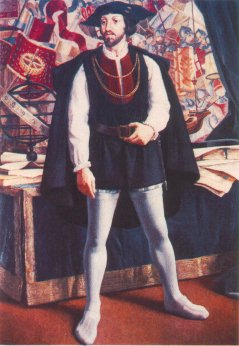
D. João II - O Príncipe Perfeito
Assertion of Royal Supremacy
D. João II (1481-1495)- "O Príncipe Perfeito"
When Afonso's son and heir, João II (r.1481-95), assumed the throne, the power of the Braganças and their supporters had reached its height. The new king, who was more resolute than his father, convoked a cortes at Évora, where he imposed a new written oath by which nobles swore upon their knees to give up to the king any castle or town they held from the crown.
At Évora commoners complained about the abuses of the nobility and asked for the abolition of private justice and the correction of abuses in the collection of taxes. The king ordered that all nobles present their titles of privilege and that his constables be admitted to their estates in order to investigate complaints concerning administration.
- These measures provoked a reaction by
the nobility led by the powerful Fernando, duke of Bragança, who
conspired against the king with the help of the king of Castile. Upon
learning of the intrigues of Fernando, the king accused the duke of
treason and tried him at a special court in Évora. He was sentenced to
death and beheaded in the main square on June 29, 1484.
The king confiscated his properties and those of his accomplices, some of whom were also killed, while others fled Portugal. A second conspiracy was hatched by the duke of Viseu, but it, too, was discovered, and the duke was killed, perhaps by the king himself, in Setúbal. These events established the supremacy of the crown over the nobility once and for all.
- The maritime expansion
of Portugal was the result of the threat to Mediterranean commerce that
had developed very rapidly after the crusades, especially the trade in
spices. Spices traveled by various overland routes from Asia to the
Levant, where they were loaded aboard Genoese and Venetian ships and
brought to Europe. Gradually, this trade became threatened by pirates and
the Turks, who closed off most of the overland routes and subjected the
spices to heavy taxes. Europeans sought alternative routes to Asia in
order to circumvent these difficulties.
The Portuguese led the way in this quest for a number of reasons.
First, Portugal's location on the southwesternmost edge of the European landmass placed the country at the maritime crossroads between the Atlantic and the Mediterranean.
Second, Portugal was by the fifteenth century a compact, unified kingdom led by an energetic, military aristocracy, which, having no more territory on the peninsula to conquer, sought new fields of action overseas.
Third, Portuguese kings were motivated by a deeply held belief that their role in history was as the standard-bearers of Christianity against the Muslims.
Fourth, Portugal's kings had, since the founding of the monarchy, encouraged maritime activities. Dinis founded the Portuguese navy, and Fernando encouraged the construction of larger ships and founded a system of maritime insurance.
Finally, Portugal led the world in nautical science, having perfected the astrolabe and quadrant and developed the lantine-rigged caravel, all of which made navigating and sailing the high seas possible.
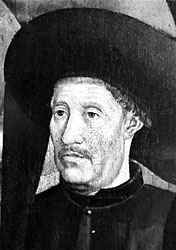
Prince Henry
-
Early Voyages
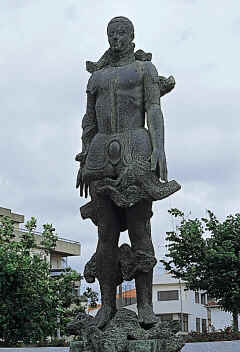
Prince Henry the Navigator
- Portugal's maritime expansion began in
1415 when João I seized Ceuta in Morocco, the western depot for the spice
trade. The military campaign against Ceuta was launched for several
reasons. First, war in Morocco was seen as a new crusade against the
Muslims that would stand Portugal well with the church. Second, there was
a need to suppress Moroccan pirates who were threatening Portuguese ships.
Third, the Portuguese wanted the economic benefit that controlling Ceuta's vast market would bring to the crown. Finally, the campaign against Ceuta was seen as preparatory to an attack on Muslims still holding Granada. The possession of Ceuta allowed the Portuguese to dominate the Straits of Gibraltar.
After the conquest of Ceuta, Prince Henry the Navigator, who had participated in the campaign as an armed knight, settled at Sagres on the extreme end of Cape St. Vincent, where in 1418 he founded a naval school. He continued to direct Portugal's early maritime activity. As the master of the Order of Christ,
Prince Henry was able to draw on the vast resources of this group to equip ships and pay the expenses of the early maritime expeditions. Prince Henry was motivated by scientific curiosity and religious fervor, seeing the voyages as a continuation of the crusades against the Muslims and the conversion of new peoples to Christianity, as well as by the desire to open a sea route to India.
- Shortly after establishing his school, two
of Prince Henry's captains discovered the island of Porto Santo, and the
following year the Madeira Islands were discovered. In 1427 Diogo de
Silves, sailing west, discovered the Azores archipelago, also uninhabited.
Both Madeira and Porto Santo were colonized immediately and divided into
captaincies. These were distributed to Prince Henry's captains, who in
turn had the power to distribute land to settlers according to the Law of
the Sesmarias.
Prince Henry's plan required the circumnavigation of Africa. His early voyages stayed close to the African coast. After repeated attempts, Gil Eanes finally rounded Cape Bojador on the west coast of Africa in present-day Western Sahara in 1434, a psychological, as well as physical, barrier that was thought to be the outer boundary of the knowable world. After passing Cape Bojador, the exploration of the coast southward proceeded very rapidly. In 1436 Gil Eanes and Afonso Baldaia arrived at the Senegal River, which they called the River of Gold when two Africans they had captured were ransomed with gold dust. In 1443 Nuno Tristão arrived at the Bay of Arguin off the coast of present-day Mauritania.
These voyages returned African slaves to Portugal, which sparked an interest in the commercial value of the explorations, and a factory was established at Arguin as an entrepôt for human cargo. In 1444 Dinis Dias discovered the Cape Verde Islands, then heavily forested, and Nuno Tristão explored the mouth of the Senegal River. In 1445 Cape Verde was rounded, and in 1456 Portuguese arrived at the coast of present-day Guinea. The following year, they reached present-day Sierra Leone. Thus, when Prince Henry died in 1460, the Portuguese had explored the coast of Africa down to Sierra Leone and discovered the archipelagoes of Madeira, the Azores, and the Cape Verde Islands.
- During the reign of
João II, the crown once again took an active role in the search for a sea
route to India. In 1481 the king ordered a fort constructed at Mina de
Ouro to protect this potential source of wealth. Diogo Cão sailed further
down the African coast in the period 1482-84. In 1487 a new expedition led
by Bartolomeu Dias sailed south beyond the tip of Africa and, after having
lost sight of land for a month, turned north and made landfall on a
northeast-running coastline, which was named Terra dos Vaqueiros after the
native herders and cows that were seen on shore. Dias had rounded the Cape
of Good Hope without seeing it and proved that the Atlantic connected to
the Indian Ocean.
In the meantime, João sent Pêro da Covilhã and Afonso de Paiva, who were versed in warfare, diplomacy, and Arabic, on a mission in search of the mythical Christian kingdom of Prester John. Departing from Santarém, they traveled to Barcelona, Naples, and the island of Rhodes, and, disguised as merchants, entered Alexandria. Passing through Cairo, they made their way to Aden, where they separated and agreed to meet later in Cairo at a certain date.
Afonso de Paiva went to Ethiopia, and Pêro da Covilhã headed for Calicut and Goa in India by way of Ormuz, returning to Cairo via Sofala in Mozambique on the east coast of Africa. In Cairo he learned from two emissaries sent by João II that Afonso de Paiva had died. One of the emissaries returned to Portugal with a letter containing the information Pêro da Covilhã had collected on his travels. Da Covilhã then left for Ethiopia where he was received by the emperor but not allowed to leave.
He settled in Ethiopia, married, and raised a family. The information provided in his letter complemented the information from the expedition of Bartolomeu Dias and convinced João II that it was possible to reach India by sailing around the southern end of Africa. He died during preparations for this voyage in 1494.
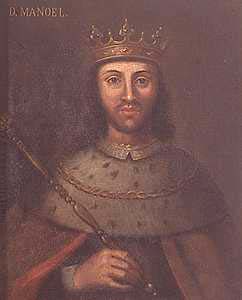
Manuel I
D. Manuel I (1495-1521) "O Afortunado"
-
Manuel I assumed the throne in 1495 and
completed the preparations for the voyage to India. On July 8, 1497, a
fleet of four ships commanded by Vasco da Gama set sail from Belém on the
outskirts of Lisbon. The expedition was very carefully organized, each
ship having the best captains and pilots, as well as handpicked crews.
They carried the most up-to-date nautical charts and navigational instruments. Vasco da Gama's fleet rounded the Cape of Good Hope on November 27, 1497, and made landfall at Natal in present-day South Africa on December 25.
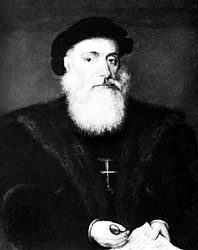
Vasco da Gama
- Vasco da
Gama
The fleet then proceeded along the east coast of Africa and landed at Quelimane in present-day Mozambique in January 1498, followed by Mombasa in present-day Kenya. An Arab pilot directed the fleet to India.
After sailing for a month, the fleet reached Calicut on the Malabar coast in southwest India. In August, after sailing to Goa, the fleet left for Portugal, arriving in September 1499, two years and two days after the departure.
- In 1500 Manuel organized a large fleet of
thirteen ships for a second voyage to India. This fleet was commanded by
Pedro Álvares Cabral and included Bartolomeu Dias, various nobles,
priests, and some 1,200 men. The fleet sailed southwest for a month, and
on April 22 sighted land, the coast of present-day Brazil.
Cabral sent a
ship back to Lisbon to report to Manuel his discovery, which he called
Vera Cruz.
The fleet recrossed the Atlantic and sailed to India around Africa where it arrived on September 13, 1500. After four months in India, Cabral sailed for Lisbon in January 1501, having left a contingent of Portuguese to maintain a factory at Cochin on the Malabar coast.
-
-
Colonization of Brazil
The growth of Portuguese interests in the Americas was slow, the king being absorbed with establishing Portuguese hegemony in Asia. In addition, the Treaty of Tordesillas of 1494, arranged by Pope Alexander VI, divided the unexplored world between Spain and Portugal and forbade Portugal from exploring beyond a meridian drawn 1,600 kilometers miles west of the Cape Verde Islands. In 1502 Fernão Noronha was given a three-year commercial monopoly on dyewood in return for exploring 300 leagues (about 1,500 kilometers) of the Brazilian coast each year.
During the last years of Manuel I's reign, the first colonists were sent to Brazil to establish a sugar industry. Additional colonists were sent during the reign of João III, and, in 1530, Martim Afonso de Sousa was named major captain of Brazil and invested with the power to distribute land among captains or donatários, much as had been done in Madeira when it was colonized a century before. These captaincies were large strips of land that extended from the coast into the interior. The captains settled colonists in their respective captaincies and were required to provide them protection and justice.
As the captaincies were independent of one another, they were unable to defend themselves from foreign pirates. Consequently, João III appointed a governor general with authority over the captaincies. The first governor general, Tomé de Sousa, was appointed in 1549 and established his capital at São Salvador da Baía. He defeated French pirates in a naval engagement in the bay of Rio de Janeiro. Intensified colonization under de Sousa began in the form of coastal settlements and spread to the interior. The colonists cultivated indigenous crops, especially manioc, and introduced new ones such as wheat, rice, grapes, oranges, and sugarcane from Madeira and São Tomé. Sugar soon became Brazil's most important export.

 I
I