 The Ruins of Mexico: Virtual Tour Website
find a
site home
The Ruins of Mexico: Virtual Tour Website
find a
site home
|
|
Few sites are as easy to get to or as advertised as Chichén Itzá. Buses leave frequently from all of the major towns in Yucatán, or Cancún, but a whole day is needed; some would argue more. Full services are found at the entrance, including cafés, shops and a museum. There is almost no shade, so sun hats and cream are absolutely essential. Culture: Early Post-Classic Maya
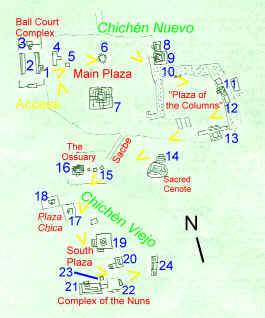
Despite having been extensively excavated and restored, and considering that it was one of the most recent empires in the Mayan chronicle, the history of Chichén Itzá deeply divides archaeologists. The contraversy rages over the exact identity of the rulers and cultural influence over this once great city. Few argue that Chichén Itzá began life during the Puuc era, when the region was dominated by the Late Classic centre of Uxmal; this is plainly evident from the architecture in the old section of the city (Chichén Viejo). But then an event occurred, subsequently immortalised in mythology, that changed the city and the whole region forever. In 987AD, in Tula, which at that time was the capital of the powerful Toltec empire in Central Mexico, a fight for rulership ended with the expulsion of the defeated king, Topilzin Quetzalcoatl. According to the legend, he sailed away into the Gulf of Mexico on a raft of serpents and at that point entered into Mayan myth with his arrival off the Campeche coast. There then ensued a series of battles culminating with the Toltec king fighting his way inland to wrestle Chichén Itzá from its Mayan lords. The Puuc centres went into decline; they were probably subjugated; and a grand new empire across the whole northern part of the peninsula was established. The marks of this Toltec influence are apparent from such structures as the Temple of the Warriors, whose similarity to Pyramid B at Tula is a well documented fact. Topilzin Quetzalcoatl also reportedly brought with him the cult of the Feathered Serpent, widely practised across Central Mexico, and the normalistaion of heart sacrifice. In short, the cultural effects were immense and far-reaching. The argument that has so intrigued historians is whether in fact the influence had been the reverse, and whether the cultural and architectural features listed above had actually evolved here and were exported to Tula; there are already some sites in Central Mexico, notably Cacaxtla, with considerable Mayan influence. Whatever the story, the power of Chichén Itzá continued for some two hundred years before its collapse at the beginning of the thirteenth century. The Itzá Maya founded a short-lived home in Mayapan, but the glory of Chichén Itzá was never to be recaptured and it remained only in memory until the first picks and shovels of the European explorers began to uncover what had once been. For more about other Cities of the Early Post-Classic Maya, see Cultural History. Tour (Scroll down to follow complete tour, or click on feature below and use your BACK key to return to the map) The route around Chichén Itzá is a fairly well prescribed one. We shall do nothing new here and simply follow the crowds around this large complex.
Coming through the entrance, we arrive into the Main Plaza, part of Chichén Nueva, which is a great flat arena containing many of the most important finds at Chichén Itzá. The shape of El Castillo immediately catches our eye, but we will head, for the moment, to the north-west corner of the plaza, to our left. This is the Ball Court Complex and set against the wall facing the Main Plaza we find the Temple of the Jaguars. This was added at a later date to the main court, and includes a jaguar throne inside the chamber that jutts out from the temple's main body.
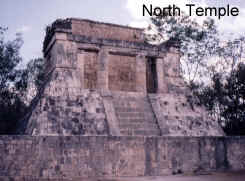
The Great Ball Court itself is the largest not only in Mexico but in all of Mesoamerica. Its area is 168 by 70 metres. The walls are sheer and retains the original hoops. There are temples at the north and south ends of the court; the North Temple is the most ornate; it looks almost Greek in form, with reliefs of plants and animals.
Adjacent to the Ball Court Complex, on the north side of the Main Plaza, are several small structures of interest. The first is the tzompantli, a perfect example of the "skull-platform" found widely in Central Mexico which was believed to have been a product of Toltec culture. This structure is covered with skull motifs and was almost certainly used for the storage of the heads of captives or sacrificial victims.
Directly next to the tzompantli is the Platform of the Eagles and Jaguars, a pyramidal altar with serpent heads. It looks like it could have been stolen from Teotihuacan, so closely is the tablud-tablero design adhered to. Platform of the Eagles and
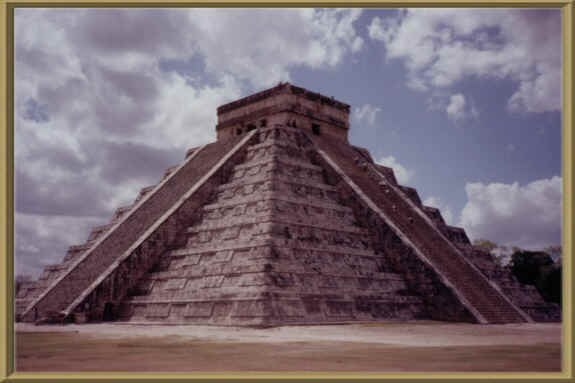
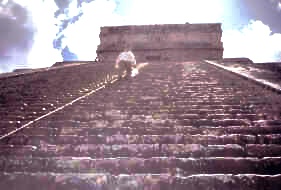
Jaguars Next, we come to the larger Platform of Venus. This square, stepped altar possesses motifs around its side which are thought to show the head of the planet Venus emerging from a monster-serpent. Now, we are ready to turn our attention to the Castillo, the clear showpiece of this tour. This monumental, perfectly proportioned pyramid, one of the subsequent restorational triumphs of Mexico, originally had a staircase on each side, although now only two are climbable. At the top, from which a fine view of the whole of Chichén Itzá can be obtained, is a large, square temple with outer and inner chambers decorated with warrior figures. The two entrance columns on the main north face are carved as serpents. At the spring and autumnal equinoxes, is the famous effect when a shadow cast as a snake moves down one of the staircases for which many people travel especially to witness. The verdict of the archaeologists is that this is a trick resulting from the building's restoration and is no mystical phenomenon.
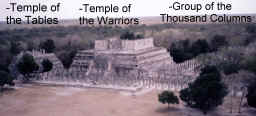
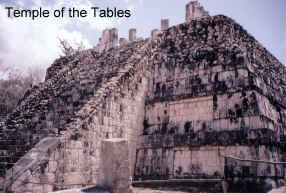
Next to the foot of the northern staircase is a gate, opened at 11am, through which one may enter into the Castillo´s extremely humid interior. A flight of steps leads up the side of a hidden, inner pyramid over which the larger one was much later constructed. We arrive at a guarded room with several treasures including a painted jaguar throne and a fantastically decorated chac-mool. This chamber has something of the Tutankhamun about it. On the east side of the main plaza are the other important features of Chichén Nuevo. At the north-east corner stands a small pyramid entitled the Temple of the Tables. On its flat top are many inscribed columns.
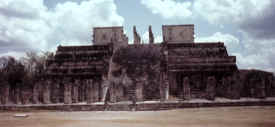
Next to this is the much larger and more important Temple of the Warriors that was the focal point for ritual sacrifice during the Toltec phase. There is a wall encompassing the top platform and a host of interesting, inscribed columns, including a famous chac-mool that gazes into the Main Plaza, but unfortunately both it and the previously mentioned building were out of bounds at the time of writing.
On a platform in front of the Temple of the Warriors and extending in two strips to the south and east are a myriad of upright sentinels known collectively as the Group of the Columns. The resemblance with Tula here is striking, although here, each one is inscribed with a figure: ruler, warrior or captive. It makes an impressive sight. Group of the Thousand
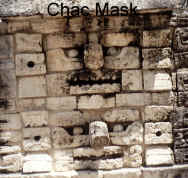
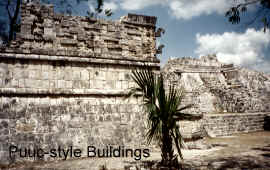
Columns The Group of the Columns encloses three sides of a plaza now overgrown, but on its east side is an interesting little complex consisting of buildings decorated with a typically Puuc kind of motif. There is also to be found an altar with a double Chac mask.
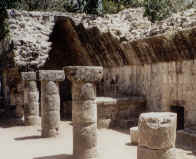
Chac Complex To the south is the Steam Bath - a broken, vaulted building considered noteworthy because of its constructional features.
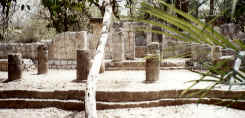
On the south flank of this so-called plaza will be encountered another interesting, but mysterious structure. This is known as the Marketplace and consists of a long, stepped platform giving access to an enclosed, square patio with a central depression surrounded by tall, thin columns (supposedly the highest Mayan columns anywhere). The title Marketplace is purely hypothetical. Marketplace This terminates the tour of the newer, Toltec section of the city, and we will strike away now in a south-west direction. If we care to deviate slightly to the left, we will pass the Sacred Cenote (if we are careful not to fall into it first). This is a deep and wide natural depression filled with murky water used as a sacrificial well - people as well as animals and objects were thrown in - and some have argued that the entire location of Chichén Itzá hinged on this important water source with undoubted religious significance too. Next to the cenote is the crumbling Temple of Xtoloc with low walls and columns.
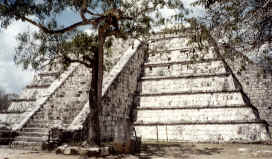
Continuing on, we will stumble over a wide causeway; this was an ancient sacbe: a long road with religious importance. This will lead us into Chichén Viejo, beginning with an open space known as the Ossuary. First up are a line of three, stepped platforms in similar vein to the Platforms of Venus and the Eagles and Jaguars encountered in the Main Plaza, that is with serpent head sculptures and decorated friezes. Triple Bone Platforms Behind these platforms stands a good-sized pyramid that is known either as the Pyramid of the Ossuary or the High Priest´s Grave. It bears a striking resemblance to the larger Castillo and was obviously the precursor to the latter edifice. Unfortunately, the temple atop lies in ruins and the pyramid itself is currently unclimbable.
The path leads south for a hundred metres until it skirts around the base of a building set up on a cobbled platform. This is known as the Red House and to view it properly, we will need to enter a small plaza to its south-west. The Red House has three separate chambers (one with the expected red decoration) but its most interesting feature is its well preserved roof comb; a much more recognisably Mayan element. The Red House On the north side of this small plaza is another building of similar design, but far worse presentation. This is the House of the Deer, so-called because of a now-destroyed mural.
South of these buildings, we come upon the South Plaza, the main area of Chichén Viejo. On the east side is a large, low platform housing a curious and famous construction labelled the Caracol (Snail). This is a circular building with a spiral interior and roof structure. From slits carved into the walls, it has been ascertained that this edifice served as an observatory from which incredibly accurate data concerning the motions of planets was derived. The Caracol Next to the Caracol, on the east side of the South Plaza, is the ruined Temple of the Reliefs. Originally with two upper rooms of columns, some have thought it to be a precursor of the Temple of the Warriors in Chichén Nuevo, bringing into doubt that building´s supposed Toltec roots. There is a vaulted space at the front under a ruined platform.
Our tour brings us inexorably towards the Complex of the Nuns that faces on to the plaza at the south. This is the artistically most vivid and detailed part of the city. The Complex of the Nuns Before us stands the Nunnery itself: a large, ornate structure of monumental proportions, clearly of the Puuc style that we also see at Uxmal. The building was originally conceived as two structures, but over the years was merged and successively embellished. Incidentally, the title Nunnery was based purely on a Spanish visualisation of this building. There is a wide, crumbling stairway on the north flank leading to a latterly added temple. Under this is a passageway that leads around to the south side. It is not permitted to enter nor to climb the Nunnery itself.
On the east side of the Nunnery we find a small plaza and see splendid and intricate carvings over doors and along friezes, including an impressive serpent mouth carving over the easterly door. The aethetic effect of these buildings is quite wonderful. Nunnery: East View Seperate from the main Nunnery block is a smaller, free-standing structure of unique appearance. Dubbed the Church, it is full of reliefs and masks of beautiful design, highlighting the very best that the Puuc has to offer.
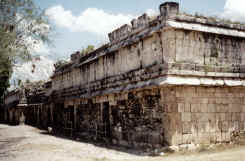
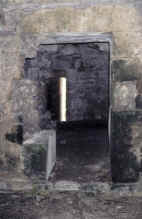
A hundred metresdue east stands a long, low structure seemingly of the same period but of more solid construction and with far less decoration. Known as the Akabdzib ( the writing in the dark) , it has several doorways that lead into a veritable labyrinth of corridors and chambers. The name refers to an interior engraving of a throned personage.
Akabdzib This, at last, brings us to the end of the viewable objects at Chichén Itzá, although more ruins lie all around waiting for excavation. |
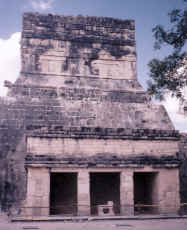 Temple of the Jaguars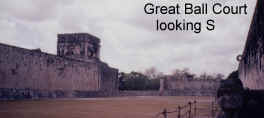
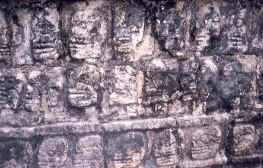 Tzompantli: Detail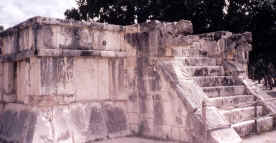
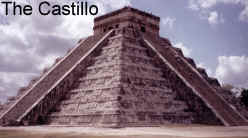
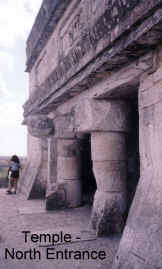
 Temple of the Warriors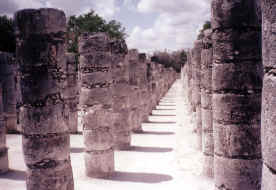
 Steam Bath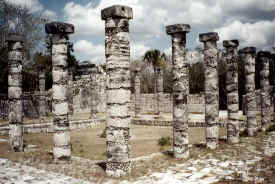
 Temple of Xtoloc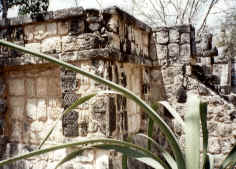
 Pyramid of the Ossuary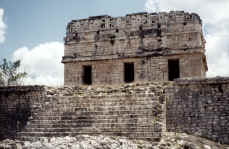
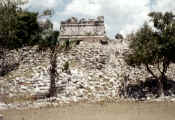 House of the Deer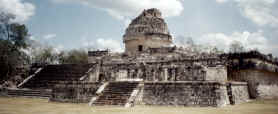
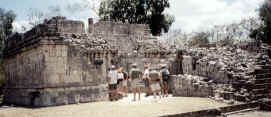 Temple of the Reliefs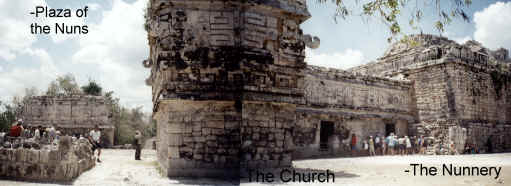
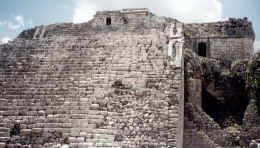 Nunnery Stairway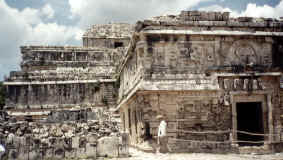
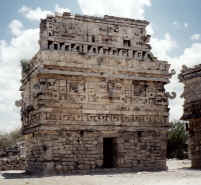 The Church