Block Heat Flows by Conduction
 |
|
|
Some strategies to achieve this are:Increase thermal resistance of the component
If values of Relative Humidity are known then we can refine on conduction:
If Max RH > 70% use insulation with low mass (also if mechanical cooling.
If Max RH<=70% use mass with insulation (if no mechanical cooling)Use insulating material in walls, ceilings and floors
Use air chambers in walls, ceilings, and floors
Increase outer surface resistance of walls and roofs
Increase thermal resistance of windows
Use of mass and thickness of architectural elements as regulators of the buildings inner temperature
Reduce outer temperature variation using materials with high density and thermal capacity
Materials with appropriate effusiveness, diffusiveness and conductivity must be proposed in order to reduce amplitude
Other strategies to reduce heat flow by conduction
Reduce the surface in contact with heat exchanges
Reduce inner and outer temperature differenceBlock heat losses by conduction from the building
Zones:
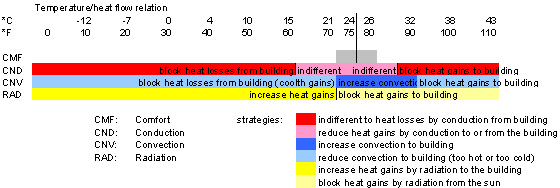
The “block heat flows from conduction” zone, theoretically, should be defined upwards of 32 C and downwards of 15 C., which is symmetrical around the comfort point of 24 C. But, due to the influence of solar radiation which affects surface temperature and thus the heat flow by conduction, the upper zone of block heat gains by conduction begins at 29 C (85 F), while the lower portion is below 15 C. The further we go in either direction, away from the comfort zone, the more we need to block heat flow by radiation. When we go downwards we need to block heat losses from the building, because it should be warmer than the outside air and when we go upwards we need to block heat gains.