Chains
A. What is a Chain?
A "Chain" is a rule used to easily determine the outcome of
a complex battle resulting from a series Spell or Trap cards played
by both players. For example, let's say that a player uses a Spell Card.
That Spell Card is placed in a hypothetical link called Chain Link 1.
If the player's opponent responds by playing one of their own Spell
or Trap Cards, a Chain has been started, with this card placed in Chain
Link 2. Using this method to deal with subsequent plays, the links are
stacked from bottom to top until both players have finished playing
cards. The effects are then resolved, starting at the top link and working
down to the Chain Link 1 at the bottom.
B. Opponent's Chance to Respond
The player whose Trap or Spell Card has been countered always has a
chance to respond with another play - an opportunity that could result
in adding yet another link to the Chain. When making a play on a Chain,
you must always ask your opponent, "Do you wish to continue?".
If you continue play without asking your opponent, they may raise an
objection that will lead to a Replay (Replay Rules).
Example: This is an example of a Chain:
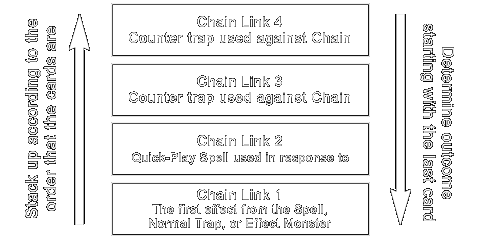
The outcome is determined starting with the most recent card played
at the top of the Chain links, and proceeding down to Chain Link 1.
C. Spell Speed
Spell, Trap, and Effect Monster Cards all have different speeds. You
can only respond to a card and start a Chain by playing a card of equal
or greater speed. The exception to this rule are Spell Speed 1 cards,
which CANNOT be used against each other.
Spell Speed 1: This is the slowest of all the Spell Speeds. Spell
Speed 1 cards cannot be played against each other.
Spell Speed 2: These cards can be used against a card with a
Spell Speed of 1 or 2. Spell Speed 2 or 3 cards can be used against
them.
Spell Speed 3: This card can be used against any Spell Speed.
Only another Spell Speed 3 card may be used against it.
|