Dueling Rules - Part Five |
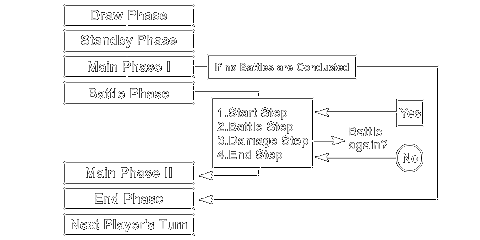
Gameplay Terminology Phases - Phases define the order in which actions can be undertake by a player during their turn. Each phase is limited to a specific set of actions. Phases Od Gameplay Repeat these phases for each subsequent turn.
A. Draw Phase During this phase, you may also change the Attack or Defense Position of cards already placed on the field. The position of each card can be changed only once in a single turn, during either Main Phase 1 or 2. The Damage Step details how this position effects the outcome of a Duel. At the end of Main Phase 1, you can choose to enter the Battle Phase or proceed to the End Phase (the starting player cannot conduct a Battle Phase in their first turn). I.Set or Summon Monster Cards: During either Main Phase 1 0r 2 of your turn, you can play (Summon or Set) only 1 Monster Card on the field. To Set a Monster Card, select it from your hand and place it face- down horizontally (Defense Position) on an open space in the Monster Card Zone. To Summon a Monster Card, select it from your hand and place it face-up vertically (Attack Position) on an open Monster Card Zone space.
Summoning a monster without the aid of Spell or effects is called a Normal Summon. A Normal Summon can only be conducted once in a single turn, during either Main Phase 1 or 2 (keep in mind that only 5 Monster Cards are allowed in the Monster Card Zone at any given time). When playing a Monster Card to the field, a player must choose to place the card in 1 of 2 positions: Attack Position or Defense Position. For Attack Position, place the card face-up and vertical (a Summon). For Defense Position, place it face-down and horizontal (a Set). A Monster Card on the field in face-down Defense Position IS NOT considered to be summoned. Instead, it has simply been Set and can be summoned with a Flip Summon (Flip Summon). The Attack or Defense Position of a Monster Card already placed on the field may only be changed once in a single turn, during either Main Phase 1 or 2. With the exception of special conditions, once the position of a Monster Card has been changed, the card must remain in the changed position throughout the turn in progress.
When summoning a monster that is Level 5 or higher (indicated by the number of stars that appear on the upper right of a Monster Card), you must offer 1 or more of your Monster Cards on the field as a Tribute by sending them to the Graveyard. If you are summoning a monster that is Level 5 or 6, you must offer 1 monster as a Tribute, and if you are summoning a monster that is Level 7 or higher, you must offer 2 monsters. A Tribute Summon is considered a Normal Summon. Therefore, a Tribute Summon and another Normal Summon CANNOT be performed in the same turn. Aside from a Normal Summon, there are 2 additional ways to summon a monster: Flip Summon and Special Summon. b. Flip Summon The act of turning a card from face-down Defense Position to face-up Attack Position is referred to as a flip. Intentionally flipping a card and positioning it for an attack is termed Flip Summon. Remember that a Monster Card placed face-down on the field (a Set) is not considered as summoned - it is considered summoned for the first time when it is flipped face-up. However, when a face-down Monster Card is flipped face-up as the result of an attack or an effect from another card, it is not considered to be Flip Summoned. Its flip effect, however, is activated as soon as it is flipped face-up. A Flip Summon card is not considered a Normal Summon. Therefore, you can perform a Normal Summon and 1 or more Flip Summon(s)in the same turn. If you have multiple face-down monsters you can Flip Summon as many or as few as you wish, but keep in mind that you can only change the position of a Monster Card once during any given turn. c. Special Summon A Special Summon is when Fusion, Ritual, Spell, Traps or Monster Effects used to place another monster on the field. A Special Summon is different from a Normal Summon in that it can be used repeatedly within the same turn to summon monsters onto the field. Be sure to follow the specific instructions printed on the cards when executing a Special Summon. II.Set or Play Spell & Trap Cards: With the exception of Field Spell Cards, a player can have only 5 Spell and/or Trap Cards on the field at the same time in the Spell & Trap Card Zone. This 5-card limitation also applies to any Equip Cards the player may have attached to an opponents Monster Card. A Spell Card can either be Played (face-up) or Set (face-down) on the field. When a Spell Card is placed face-up, it is immediately activated. A Trap Card must always be placed face-down on the field (Set). For Spell or Trap effects, follow the instructions listed on each card. II.Set or Play Spell & Trap Cards: With the exception of Field Spell Cards, a player can have only 5 Spell and/or Trap Cards on the field at the same time in the Spell & Trap Card Zone. This 5-card limitation also applies to any Equip Cards the player may have attached to an opponents Monster Card. A Spell Card can either be Played (face-up) or Set (face-down) on the field. When a Spell Card is placed face-up, it is immediately activated. A Trap Card must always be placed face-down on the field (Set). For Spell or Trap effects, follow the instructions listed on each card. Summary Once a Spell Card is placed face-up on the field, it is activated immediately and is then destroyed. Equip and Field Spell Cards (generally used to modify the strength of a Monster Card) and Spell Cards with a "Continuous" icon remain on the field. Trap Cards are usually destroyed immediately after being activated unless they have a "Continuous" icon. Controlling an Opponent's Monster Certain Spell and Trap Cards have the effect of giving you control over an opponent's monster. When this occurs, use the following rules: When you take control of an opponent's monster, move the Monster Card to your own Monster Card Zone. A monster you control counts towards your 5-card Monster Card Zone limit. Therefore, you cannot take control of an opponent's monster if your Monster Card Zone is filled. Equip Spell Cards attached to a Monster Card always stay in the Spell & Trap Card Zone of the person who played the card and count toward the 5-card Spell & Trap Card Zone limit for that player. The Equip Spell Cards effects don't change, even if the Monster and Equip Spell Cards are on different player's fields. Monster Cards under your control can be used in the same way as your own Monster Cards: to attack, defend, or to use as a Tribute. Controlled Monster Cards that are destroyed or offered as a Tribute are sent to your opponent's Graveyard. D. Battle Phase Keep in mind that the starting player cannot conduct a Battle Phase in their first turn, even if they have placed a Monster Card on the field. Quick Guide Start step - Declare that you are entering the Battle Phase. You and your opponent may both play Quick-Play Spell and/or Trap Cards. Battle step - Select and announce 1 monster to attack with, and declare 1 of your opponent's monsters your target (the monster you wish to attack). You and your opponent may both play Quick-Play Spell damage. Damage step - Calculate the damage points of the designated monsters. If a monster has a Flip Effect, apply it immediately after damage calculation. However, a Flip Effect does not affect monsters that have already been destroyed as a result of damage calculation. End step - Resolve all battles by repeating the Battle and Damage Steps as many times as necessary, then declare an end to your Battle Phase. You and your opponent may both play Quick-Play Spell and/or Trap Cards. I. Start Step The attacking player chooses 1 of their monsters and designates 1 of the opponent's monster as a target. Play then proceeds immediately to the Damage Step, returning to the Battle Step if the attacking player wishes to attack again with another monster. If the opposing player has no monsters on the field, the selected monster's attack will inflict Direct Damage on the opposing player's Life Points (Direct Damage). A monster in the Attack Position does not have to attack. Depending on the situation, you can choose whether or not a monster will participate in battle. Once a monster attacks, it may not be changed to Defense Position in the same turn. In addition to monster attacks, both players may use their Quick-Play Spell and Trap Cards during this step.
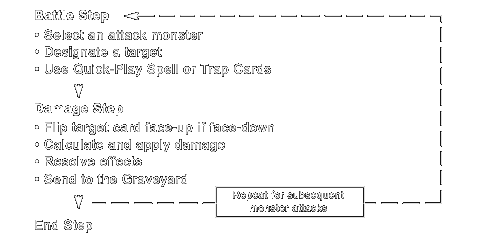
Replay Rules Returning gameplay to a previous step and playing that step over again is known as a "Replay". For Example, if the number of your opponent's monsters on the field change due to the effect of Trap or Quick-Play Spell Cards during your Battle Step, a Replay is triggered. When this occurs, play returns to the beginning of the Battle Step with the attacker choosing a new attacking monster and target. Replays can only be triggered by the effects of Trap or Quick-Play Spell Cards. Example: During your Battle Step, you have declared an attacking monster and designated an opponent's monster as a target. Your opponent then activates their "Ultimate Offering" Trap Card, allowing them to summon another monster to the field. Since your opponent now has a different number of monsters on the field than they did when the Battle Step began, a Replay is triggered and you may again choose a monster to attack and designate a target for the attack. Because a Replay returns play to the beginning of the current Battle Step only, monsters destroyed in previous Battle Steps are unaffected. III. Damage Step In this step, the players calculate the damage from the monster's attack. A monster destroyed as a result of battle is sent to the owning player's Graveyard. The Damage Step is conducted in the manner described in the following pages. During the Damage Step, only Spell or Trap Cards that modify the Attack and/or Defense of a monster may be played. In addition, these cards can only be played before the calculation of damage. Upon completion of the Damage Step, return to the Battle Step if the attacking player wishes to attack again with another monster. a. When the Opponent's Monster is in Attack Position
Attack Results: When the attacking monster's ATK points are higher than the ATK points of the opponent's monster, the opponent's monster is destroyed. Damage: Subtract the ATK points of the opponent's monsters from the ATK points of the Attacking Monster. This result is subtracted from the opponent's Life Points. ii. Attacker's ATK Points = Opponent's ATK Points Attack Results: When the attacking monster's ATK points are equal to the ATK points of the opponent's monster, the result is considered a draw, and both monsters are destroyed. Damage: Neither player takes any damage. Their Life Points remain the same.
Attack Results: When the attacking monster's ATK points are lower than the ATK points of the opponent's monster, the attacking monster is destroyed. Damage: Subtract the ATK points of the attacking monster from the ATK points of the opponent's monster. This result is subtracted from the attacker's Life Points. b. When the Opponent's Monster is in Defense Position
Attack Results: When the attacking monster's ATK points are higher than the DEF points of the opponent's monster, the opponent's monster is destroyed. Damage: Neither player takes any damage. Their Life Points remain the same.
Attack Results: When the attacking monster's ATK points are equal to the DEF points of the opponent's monster, neither monster is destroyed. Damage: Neither player takes any damage. Their Life Points remain the same. iii. Attacker's ATK Points < Opponent's DEF Points Attack Results: When the attacking monster's ATK points are lower than DEF points of the opponent's monster, neither monster is destroyed. Damage: Subtract the ATK points of the attacking monster from the DEF points of the opponent's monster. This result is subtracted from the attacker's Life Points. c. Direct Damage: When the Opponent Has No Monsters
Following the Damage Step, the attacking player can return to the Battle Step, choose another monster, and engage in another battle. Keep in mind that each Attack Position monster may only attack once per turn. The player can repeat these steps as many times as they have monsters available to attack. Examples of Battle & Damage Steps (Battle Step) (Damage Step) 3. Calculate Damage: 4. Apply the Effects of Effect Monsters: 5. Send to the Graveyard: 6. Determine Whether to Attack Again IV. End Step E. Main Phase 2 |