It is well-known that a line can be easily divided into any given number of equal parts, using ruler and compass. However, if we try to do the same with an arbitrary angle, the situation is quite different. For example it has been proven by P. L. Wantzel (1836)[1] using group theory developed by Galois[2], that it is impossible to trisect every angle using only ruler and compass. However, the search for approximate solutions to this problem turned to be very popular.
In this paper will be shown how we can approximately divide a given angle  by a
constructible number
by a
constructible number  using a ruler and a compass. It is a trivial task to divide
 by
by  ,
,  , and for any other
  we have
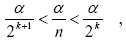
where  .
.
Let us begin with  , and let the given angle be
 shown in Fig.1.
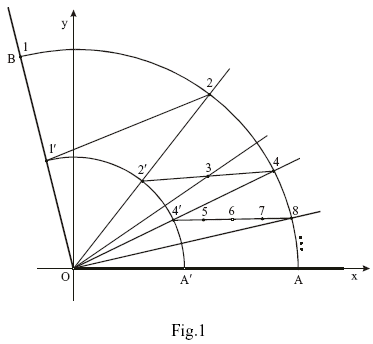
In Fig.1 the following relations hold

and

Next we will show that  . Let
. Let  . From Fig.1 follows
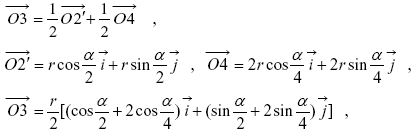
and finally
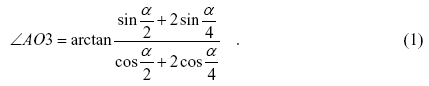
If we expand the right-hand side of (1) in Taylor series in terms of , we get

From (2) we can conclude that .
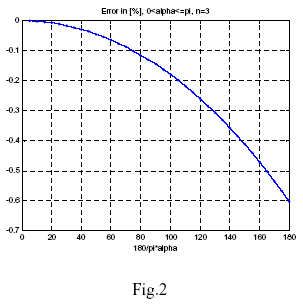
In Fig.2 is shown the relative error for and  .
.
Let us now discuss the general case, Fig.3.
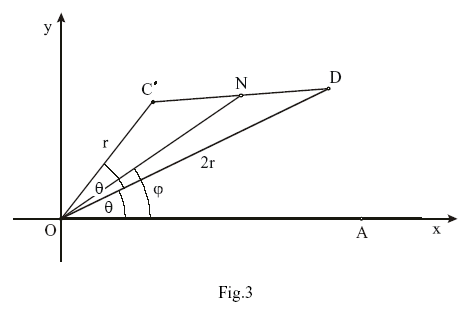
Suppose that  ,
,  and
and  , where
 , so we have
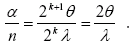
Then with obvious notation we may represent by the line point  on the line segment
 in Fig.3 . So we have
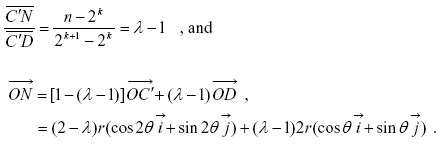
Let  , then

From (3) we see that if  , then
 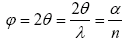 , and likewise if
 , then
 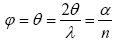 as expected. For
  such that
 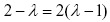 , it is
  , from (3) follows
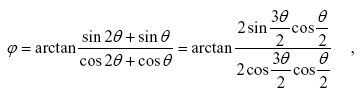
so  . In this case
  bisects
  and
and  . Hence for
 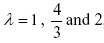 ,
,  and the construction is exact.
It is convenient to expand (3) in Taylor series in terms of  for
for  ,
aided by the fact that it must be exact for . We find
,
aided by the fact that it must be exact for . We find

where the first few  are
are
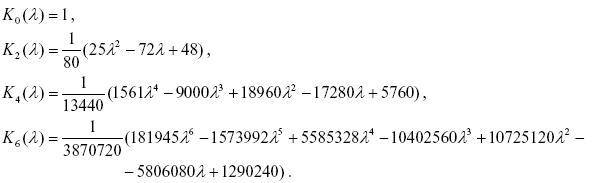
It is interesting that  have all their roots in the interval
  .
.
If we write error 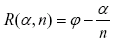 , and relative error

then for  from (4) and (5) we get

Then for  and
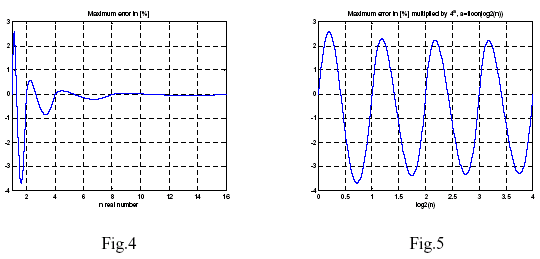
and  , numerical search using (3) and (5) gives maximum
 occurring at
  approximately, with
 (slightly over 3.5%), and (6) gives
  , close to the correct value,
suggesting that we have convergence in (4) for
, close to the correct value,
suggesting that we have convergence in (4) for  and
and  ,
see Fig.4 and Fig.5.
,
see Fig.4 and Fig.5.
We can achieve more accuracy at the cost of increased constructing effort, see Fig.6.
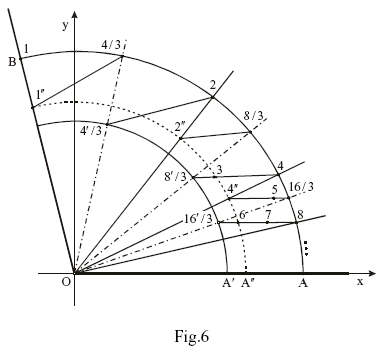
In Fig.6 the following relations hold
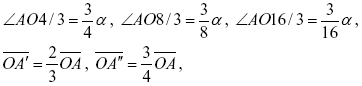
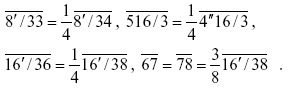
According to Fig.6 there are two cases:
If  , then
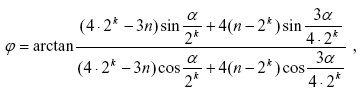
else if 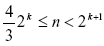 , then
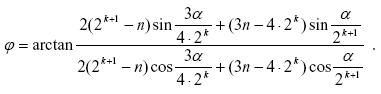
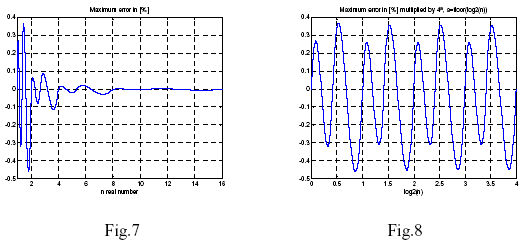
The relative error is shown in Fig.7 and Fig.8.
[1] Pierre Laurent Wantzel. http://www-history.mcs.st-and.ac.uk/Biographies/Wantzel.html
[2] Evariste Galois. http://www-history.mcs.st-and.ac.uk/Biographies/Galois.html
See also:
Avni Pllana "Approximate Angle Trisection" http://www.geocities.com/approx_trisect/
Avni Pllana "Angle Trisection using Limacon of Pascal" http://www.geocities.com/trisect_limacon
Avni Pllana "Approximate Construction of Heptagon and Nonagon" http://www.geocities.com/london_blue_catharin/