The World of Allosaurus
The habitat in which Allosaurus lived was not a lush rainforest or swamp as it has often been portrayed. Allosaurus' environment was like the Serengeti in that it had seasons of rainfall punctuated by periods of severe drought. The landscape was rather open with patches of conifers, ferns, and cycads. Conspicuously absent is grass - it had not yet appeared. There would have been shallow lakes and streams, most of which would have dissapeared during the long dry season. This dry season certainly took a seemingly heavy toll on life in this ecosystem. The position in which many late jurassic dinosaur skeletons are found indicate that they were victims of drought; the neck and tail of these dinosaurs are pulled back toward each other in an arc as a result of the animals' bodies dessicating under the sun in extremely dry conditions.
Dinosaurs that co-existed with Allosaurus
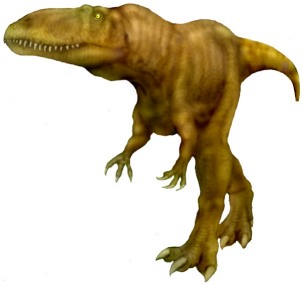 |
At least two genera of large predators shared Allosaurus' environment, Torvosaurus and Ceratosaurus. It is not known if they directly competed with Allosaurus for food, or if, to some extent, each specialized in feeding on particualr prey items. Whatever the case neither of these predators were nearly as numerous as Allosaurus. Among the small predatory dinosaurs in this ecosystem, Ornitholestes is the most well known. It had a proportionately small head so it can reasonably be speculated that it specialized in killing small prey such as lizard-like animals, insects, fish, and hatchling dinosaurs, including Allosaurus chicks. In turn, Ornitholestes may have been a prey item for older Allosaurus.
The gigantic sauropods were seemingly by far the most numerous herbivores in this environment. Some of these creatures were over 100 ft. in length and weighed in excess of 50 tons. These animals certainly had a profound effect on the vegetation their ecosystem, both in the amount of devastation they caused and in the benefit of the "fertilizer" they left behind.
With its tiny head, huge body and plated-back, Stegosaurus is the most easily distinguishable dinosaur in this habitat. Though it had a short neck, it was not restricted to feeding on low growing plants. It could have easily reared onto its hindlegs,using its tail as a support, in order to feed on higher vegetation. For protection against predators such as Allosaurus, Stegosaurus possessed a powerfully muscled tail equipped with massive spikes. A few Allosaur bones have been found with puncture marks that may have been caused Stegosaurus tail-spikes.
The ornithopods, small to mid-size bipedal herbivores, were probably a favorite prey item of Allosaurus. With the exception of the speed of the smaller individuals, these animals seem to have possessed no defense mechanisms against large predators
 |
Sign GuestBook | View GuestBook or email me: [email protected] |
 |
