A L L O S A U R U S
Introduction
skeleton
species
feeding & hunting
intraspecific interactions
relatives
habitat
links

Acrocanthosaurus atokensis
R E L A T I V E S
The Superfamily Allosauroidea


All members of this group are typically characterized by light skulls decorated with hornlets and/or crests, hands equipped with three talons, and a powerful S-curved neck. Their bodies are laterally flattened to a large extent. It seems most basal forms possessed larger crests. Allosauroid remains have been found on every continent, including antarctica. Some members of this group were among the largest land predators in the Earth's history. This page gives a brief description of several Allosauroids.


BASAL ALLOSAUROIDS


Monolophosaurus jiangi

MONOLOPHOSAURUS
Type Species: jiangi
Skull Length: 63cm
Length: 5 meters
Weight: 0.6 tonnes
Period: Jurassic (oxfordian)
Location: China
This genus is characterized by a single large ridge-like crest on top of its skull.

CRYOLOPHOSAURUS
Type Species: ellioti
Skull Length: 65cm *estimate
Length: 7 meters
Weight: 2.5 tonnes
Period: Jurassic (pliensbachian)
Location: Antarctica
The remains for which this genus is named is a skull which is missing most of the front half. The most immediately distinguishing feature of the skull is its strange ornamentation. Unlike the crests found on other theropod skulls, it was much more visible from a frontal view rather than from the side. C.ellioti is significant because it was the first large dinosaur from Antarctica to be described. Interestingly, the skull shows characteristics that would associate Cryolophosaurus with Allosaurids or Sinraptorids, but most of the post-cranial material associated with it, if it does indeed belong to Cryo, displays ceratosaur-like features. However, the pelvis has characteristics similar to that of a Sinraptorid.

Family: SINRAPTORIDAE


SINRAPTOR
Type Species: Dongi
Skull Length: 85cm
Length: 7 meters
Weight: 2.5 tonnes
Period: Jurassic (Kimmeridgian-Tithonian)
Location: China
A fairly large predator that lived in an Arid environment. Sinraptor is known from a fairly complete subadult skeleton. Interestingly, the skull of the specimen is scarred by partially-healed bite marks inflicted by a theropod of a about the same size, seemingly another Sinraptor.

Fukuiraptor kitadanensis

FUKUIRAPTOR
Type Species: kitadanensis
Length: 4.2 meters
Weight: 0.5 tonnes
Period: Cretaceous (Albian)
Location: Japan
The only theropod from Japan known from reasonably complete remains. Upon the discovery of one of its large curved manual claws, Fukuiraptor was mistakenly believed to be a dromaeosaur (researchers thought it was a toe-claw). However, more complete finds revealed it was actually an allosauroid that is closely related to Sinraptor.

YANGCHUANOSAURUS
Type Species: Shangyouensis
Skull Length: 110cm
Length: 10.8 meters
Weight: 3.4 tonnes
Period: Jurassic (Kimmeridgian-Tithonian)
Location: China
A massive predator from China, Yangchuanosaurus is known from a few fairly complete skeletons. Yangchuanosaurus possessed a ridge of slightly elongated vertabrae that started at its back and continued to its tail. In life this would have formed a low "sail".

SZECHUANOSAURUS
Type Species: campi
Length: 4 meters
Weight: 0.15 tonnes
Period: Jurassic (oxfordian-tithonian)
Location: China
Szechuanosaurus was a relatively small predator with a very light build. It is known from a mostly complete skeleton, which, unfortunately, lacks most of the skull. The exact relationship to other allosauroids is uncertain, but the known remains seem to indicate that Yangchuanosaurus is its closest relative.

LOURINHANOSAURUS
Type Species: antunesi
Skull Length: ?
Length: 4.5 meters
Weight: .6 tonnes
Period: Jurassic (kimmeridgian-tithonian)
Location: Portugal
A mid-size allosauroid from Portugal which was described in 1998. This dinosaur is the first non-avian theropod found with gastroliths (gizzard stones). Lourinhanosaurus is distinguished from all other allosauroids by its vertabrae, all of which are longer than tall. Unfortunately, the skeleton found lacked the skull and the parts of the pelvis which would tell us for certain if this is an allosaurid or sinraptorid, though some primitive characteristics of the skeleton indicate this is probably a sinraptorid.

Family: ALLOSAURIDAE


ACROCANTHOSAURUS
Type Species: atokensis
Skull Length: 129 cm
Length: 11.5 meters
Weight: 3.5 tonnes
Period: Cretaceous (albian)
Location: North America
A massive predator known from the creataceous rock Oklahoma and Texas. Its most distinguishing feature is perhaps the "sail" of elongated neural spines that ran the length of its back and neck. These spines are believed by some to have acted as an attachment points for large muscles. If this is the case, Acrocanthosaurus would have been very strong (even for a 11.5 meter theropod!). Due to the elongated spines Acrocanthosaurus was forced to carry its head with its neck extended, so it did not possess the strong S-curve seen in other allosaurs. Once thought to be a Carcharodontosaurid, characteristics on a fairly complete, recently described, individual show this dinosaur belongs within the Allosauridae.

NEOVENATOR
Type Species: salerii
Length: 8 meters
Weight: 0.75 tonnes
Period: Cretaceous (BarremianAptian)
Location: Europe
Neovenator is known from a fairly complete skeleton that was discovered in the UK. It was a large, but very lightly built predator. The most distinguishing feature on Neovenator is its rounded snout, which has been described as resembling a modern-day puffin's.


Subfamily: Carcharodontosaurinae

This subfamily includes the largest land predators of all time. Genera within this family are typified by small forelimbs and massive heads. It has been suggest that the assignment of the family Carcharodontosauridae to the Allosauroidea may be incorrect - several features of their skeletons indicate they may be more closely related to the abelisaurs than to the allosaurs (though that is highly unlikely).

GIGANOTOSAURUS
Type Species: carolonii
Skull Length: 165cm
Length: 14 meters
Weight: 8 tonnes
Period: Cretaceous (Cenomanian)
Location: Argentina
Giganotosaurus was a truly monstrous predator. Its jaws were lined with 8 inch blade-like teeth which were used to slice the flesh of its victims. A bite to the belly or hindlimbs probably would have inflicted crippling wounds on even the largest of prey. Giganotosaurus was more massive than T.rex, but the largest of all theropods is a recently discovered carcharodontosaur that has yet to be named.

CARCHARODONTOSAURUS
Type Species: saharicus
Skull Length: 163cm
Length: 13 meters
Weight: 7.5 tonnes
Period: Cretaceous (Cenomanian)
Location: North Africa
Carcharodontosaurus is so named for its shark-like teeth. It was a giant predator that was strikingly similar to Giganotosaurus.

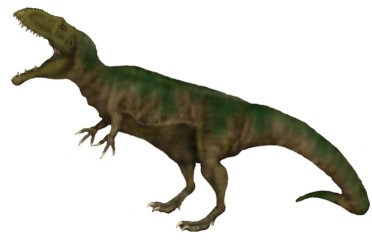
Giganotosaurus carolinii


comments?
Sign GuestBook | View GuestBook
or email me: [email protected]
1
Hosted by www.Geocities.ws