T171 - TMA04

Essay
IntroductionThe first message was sent on the ARPANET, the predecessor to the Internet, in 1969. At that time there were only 4 nodes linked on a single network and access was limited to a chosen few. Today there are an estimated 300 million people world-wide with Internet access (1). We can access the Internet from the workplace, educational establishments, libraries and cafes. In the home we can access through our computers, televisions and games consoles and our mobile phones give us access when we are on the move. As the Internet becomes an integral part of our everyday life, many newspapers and magazines are beginning to label specific individuals as "The Father of the Internet". In order to assess whether such a label is justifiable, this report looks back to the time when the Internet was just a dream. It investigates the technological developments that facilitated the birth of the Internet and some of the men involved in their conception, design and implementation. By evaluating the importance of these men's roles in creating the Internet as we know it today, this report also asks: "Is one of these men "Father of the Internet" ?
Photograph sources (2)
The VisionIn 1960 JOSEPH C. R. LICKLIDER published the first of a series of documents in which he introduced the concept of the "Galactic Network". These papers outlined his vision of computers, linked world-wide through a series of networks, able to store and share information. The esteem LICKLIDER evoked as an experimental psychologist and his influential position at the Advanced Research Project Agency (ARPA), lent his papers weight and encouraged and inspired others to bring his dreams to fruition as the Internet of today.
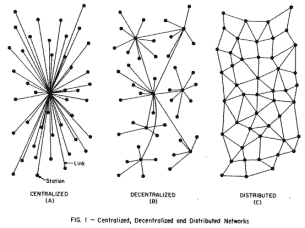
The MechanicsIn 1962 DONALD WATT DAVIES pioneered packet switching, which facilitates the exchange of information between computers. It is the key idea that makes the Internet robust, enabling the construction of network protocols and guaranteeing that data arrives undamaged at its destination. Davies achieved this breakthrough while trying to solve the problem caused by the incompatibility of the analogue signals used by conventional telephone systems and the digital information stored on computers. At the same time, but in a different continent, PAUL BARAN was working on similar lines, but in order to solve a different problem. BARAN was endeavouring to build a distributed network that would be difficult to disable because its control was not centralised and had more connections than were actually needed.
His research resulted in a form of packet switching and led to his inventing the basic technology needed to implement the ARPANET, predecessor to the Internet.
The ARPANETLICKLIDER's vision inspired ROBERT TAYLOR, who joined the Advanced Research Project Agency (ARPA) in 1965, to seek funding to research the linking together of computer terminals and to write the paper "The Computer as a Communication Device " in April 1968. After his success in financing the project he appointed LARRY ROBERTS to head it. Together with a team of computer scientists and students they pursued their belief that computers would one day link people, throughout the world, to share resources and communications. They achieved the first stage of this dream when they created the ARPANET. This was the first wide area packet switched network and provided the technological foundations for the Internet. The research carried out at ARPA was sponsored by the US GOVERNMENT and they, therefore, also deserve a great deal of credit for the results obtained.
The first node to join the ARPANET was established at UCLA by LEONARD KLEINROCK and was chosen because it was considered that KLEINROCK had played a fundamental role in establishing data networking technology over the previous ten years. In 1969, KLEINROCK and his team, which included graduate students VINT CERF, STEVE CROCKER and JON POSTEL, sent the first messages over the ARPANET. In 1972 a public demonstration of the ARPANET was held. This resulted in the crucial formation of the Network Working Group, which, in turn, led to the introduction of Requests for Comments (RCFs).
The RFC'sRequests for Comments were established by STEVE CROCKER and set a precedent for the openness that made the Internet possible. They allowed the exchange of information on a previously unknown scale that continues and indeed epitomises the culture of the Internet. Essentially a 'Request for Comment' is the presentation of someone's ideas, questions or comments for further comment, suggestion or criticism. The use of RFCs facilitated the pooling of knowledge and resources and allowed technical advancement to progress more rapidly than it would have otherwise.
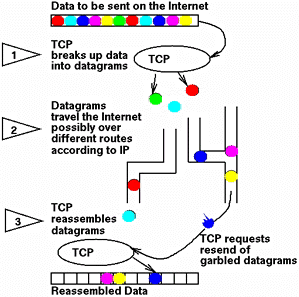
The ProtocolsThe success of the ARPANET led to the development of other packet switched local and wide area networks, operating independently and exchanging information only with their own nodes. It became clear that, in order to realise the dream of the 'Galactic Network', a means would have to be found to weave all these networks, including the ARPANET together. ROBERT KAHN and VINT CERF worked together and solved this problem by inventing TCP/IP, a combined set of protocols that performs the transfer of data between computers. TCP/IP is an open standard which supports the interoperation and interconnection of networks and computers regardless of architecture. TCP, or Transmission Control Protocol, monitors and ensures the correct transfer of data. IP, or Internet Protocol, receives the data from TCP, breaks it into packets and transmits it to a network within the Internet. The implementation of TCP/IP by the ARPANET and other networks allowed them to join together and form the world-wide network of networks now known as the Internet.
TCP/IP later evolved to become a suite of protocols that incorporated the TCP and IP protocol functions with others used on the Internet, including electronic mail and the World Wide Web.
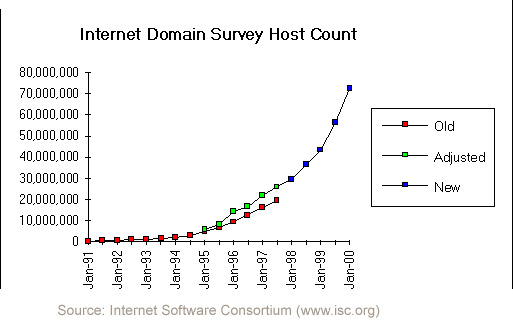
The Killer ApplicationsAlthough TCP/IP allowed the Internet to become a reality, it was still a long way from the Internet that we know today. When TCP/IP was widely adopted and became the Internet's standard protocol in 1983 there were only 562 computer hosts on the Internet. Today there are over 85 million (1). It was not until 1991, when TIM BERNERS-LEE invented the World Wide Web(WWW) that the Internet began to show signs of the exponential growth that became the phenomenon of the late 1990's.
The Internet finally became a mass medium when MARC ANDREESSEN invented Mosaic in 1994 and the Internet became almost synonymous with the WWW. Mosaic was a browser with a graphical user interface, which allowed users to 'surf the web' easily and quickly often with little more than the click of a mouse. This was, to many, the real beginning of the Internet as we know it today.
The ConclusionsThis report details the main technological advances and names some of the people that have been integral in bring us the Internet as the table below summarises.
Other people, writing a similar report, would probably include people such as VANNEVAR BUSH, DOUG ENGLEBERT, FRANK HEART or any of the many others who played their own important roles in the creation of the Internet. Therefore, in conclusion, I feel that the label "Father of the Internet" is not justified and that no single person or group of people can lay claim to the title. Each stage of the creation of the Internet was dependent on the work of people at an earlier stage and also relied on the collaborative work of many people around the world. This mirrors the opinion of Vint Cerf, who states, in the January 2000 edition of Voice and Data Communication e-magazine:
Whilst it cannot be said that there is a "Father of the Internet", I would argue that, amongst it creators, there exists a common bond which might be termed the "Spirit of the Internet"; where people collaborate instead of compete and openness and pursuit of visions are the prime objectives. Not only have the creators of the Internet put the World at our fingertips, they have created a new community with shared aims and where mutual support and encouragement are paramount. |

 |
 |
 |