Glastonbury is regarded today by many as a place where, as Dion Fortune put it, "the veil is thin," by which she meant the veil between this world and the next, and it is this quality which imbues the site with its psychic reputation. In the eagerness for "New Age" developments and associated doctrines - mostly derived from theosophy - the essence of the legends, and possible psychic "facts" has become obscured by this same theosophical "New Age" overlay. But the mystery which is Glastonbury, and even its raison d'être is Christian, and bears little relation to so-called new age thinking whatever, even though in this 21st century the town is inundated with the new age commercialism common to many towns and cities today.
There is plenty to excite the interest of the psychically-inclined, even so, but while most modern interest is in and around the town, it is of small consequence without the ruins of the great Christian Abbey of Saints Peter and Paul which still remain, and of the mystery and churches which preceded it.
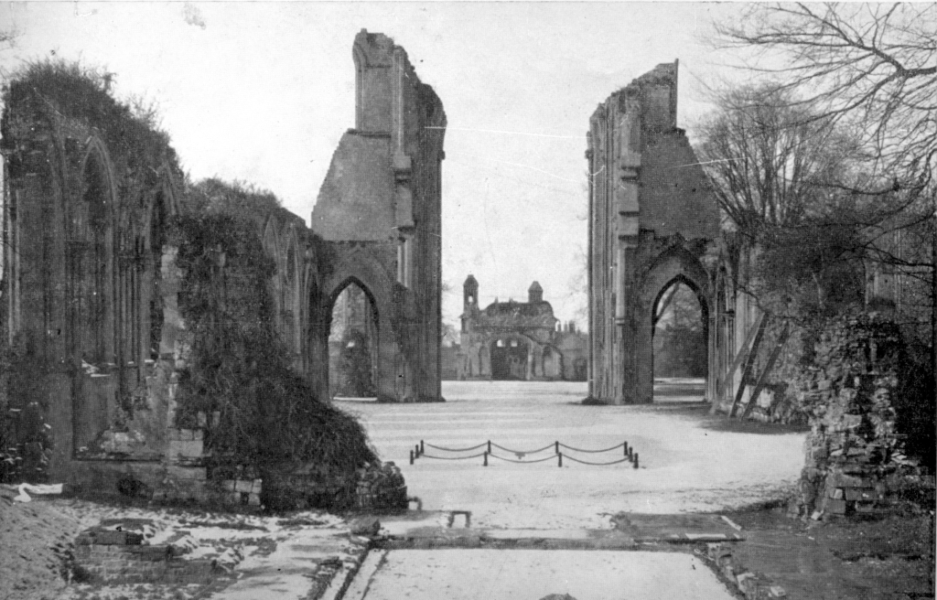
Glastonbury Abbey looking west. Two small towers of the church of St. Mary, built over the site of the first wattle church, are at the far end of the picture
The Legend and the Mystery
According to the New Testament, Joseph of Arimathea, a rich merchant, begged Pilate for the body of Jesus, which was granted, and Joseph placed the body in his own existing tomb. The Glastonbury legend states that “immediately” after the crucifixion, in the year 37 of the Christian era, Joseph, who was indeed a rich tin merchant, came to Britain bringing with him two cruets containing the blood and sweat of Jesus. He then followed the ancient “tinners way” via the Mediterranean via Marseilles, through France. As a tin merchant he would have visited Cornwall (St. Michael’s Mount) as well as Glastonbury in Somerset, where there were a number of mines in the Mendip hills.
Although traces of his visits exist in Cornish legend, for whatever reason, he settled at Avalon, now Glastonbury, with eleven other disciples, plus or including Mary Magdalene, and Mary the mother of Jesus, Saint John having placed her in Joseph’s care.
There, with the blessing of the local “king” he was granted land, tax free, upon which he built a wattle and daub round church, with smaller round cells for the hermit disciples, one or two of whose names survive. When he died, he was buried near or on the site of his own cell.
From earliest times, this church was dedicated to Saint Mary, which is unusual, as dedications to her did not normally otherwise take place before the fourth or fifth centuries, when the cult of the Blessed Virgin became important to the Roman Church. Which Mary was originally commemorated is not clear, but the road facing the abbey itself has long been called Magdalene Street, and there is a later small chapel extant in Magdalene Close.
Whatever we may choose to make of the “two cruets” aspect of the legend, his main contribution was to bring the fledgling new religion to Britain – the first to do so, and the earliest of all missionaries to the West. With the passage of time, the old wattle church fell into disrepair, and was covered over by a rectangular wooden building to protect the sacred site, possibly by St. Patrick, who placed the tiny monastic community under a rule. Later, under Dunstan, they would receive the Benedictine Rule, which they retained until the dissolution of the monasteries circa 1539 under Henry VIII as part of his break with Rome.
Later, a much larger abbey church was built to the east of the original site (still preserved). This was destroyed by fire in 1184 following a terrible accident with a wax taper, which set light to the veil of the sanctuary (an Eastern Church practice). In fact, Glastonbury, as part of the Ancient Celtic Church in Britain, followed the Eastern Orthodox tradition of celebrating The Holy Mysteries rather than the later Latin Mass, and the monks adopted a tonsure similar to that of the East.
This is most natural, as Britain was evangelised from Palestine, not Rome, and its church rejected the claims of the Roman Church brought by Augustine in the sixth century, refusing to acknowledge the Bishop of Rome as “Pope” or “Bishop of Bishops.”
A new and magnificent church dedicated to Saints Peter and Paul eventually replaced that destroyed in the fire, and a new Norman style church of St. Mary was built above the original sacred site of the original wattle church. It is the ruins of this church complex that the visitor sees today, and is illustrated above. The town itself grew up around the Abbey, which had need of many hands and trades.
The well and the Tor would have been objects of veneration long before the Christian era, and the church acknowledged the ancient tradition by erecting a small church on the top of the Tor. This was dedicated to St. Michael – a common practice by which high places were claimed for the new religion. In ancient times the well would certainly have been regarded as miraculous, though a well as such may not have been in existence at that time, as its source as an underground spring poured – and still does – a continuous supply of water without fail. Its natural course is downhill from the site of the present Chalice Well garden into what is now Chilkwell Street and down towards the abbey, which still retains its own well in the crypt of the old church of St. Mary.
The real mystery of Glastonbury is the continuous celebration of The Holy Mysteries, the Eucharist, or Mass, in a monastic, not secular context. This ceased around 1539, when Henry VIII destroyed the monasteries and claimed their considerable wealth and treasure for the new “Protestant” kingdom.
But the sanctity and the mystery remain, and the Eucharist is still celebrated in the crypt of St. Mary’s Church, including, from time to time, the Eastern Rite Holy Mysteries with which the story of Glastonbury begins.
The Holy Thorn
The Story of Joseph's arrival states that when arriving, probably by boat, as the great plain south of Glaston would have been a tidal estuary, Joseph planted his staff in the ground on Wirral or "Wearyall" hill, a little south of the abbey site.The staff, it is said, took root, and blossomed on Christmas Day every year (according to the Julian calendar, our January 7thAt a much later time it was attacked by a Puritan as idolatrous, who paid for his deed with his life when the axe slipped.The Holy Thorn, alas did not survive, but there was enough time to take cuttings from it, which were grafted onto native local hawthorn trees.One of these survives in the approxiate original site on Wirral Hill, and another in the Abbey grounds, near St. Patrick's chapel. The Holy Thorn still blossoms on Old Christmas Day, on January 7th, as well as in the English Spring. A fresh bloom is sent to H.M. The Queen every year at Christmas.
King Arthur
In the late 12th century, at a time when funds were desperately needed to help build the new church following the fire of 1184, the monks claimed to have discovered the remains of King arthur and his Queen in the monks' cemetery. There were re-interred with great ceremony in the chancel, the the west of the high altar, where a plaque marks the spot today.Subsequent excavations have also revealed remains that are in accord with Arthur and his wounds. Perhaps he was re-interred after the dissolution, or there may have been other men of great physical stature who received similar wounds defending Britain who were buried in our mystic and psychic Avalon, the ancient name for Glastonbury.
The Glastonbury Zodiac
In the 1920s a Mrs. K.E. Maltwood discovered a giant astronomical zodiac with the aid of aerial photography. This is about thirty miles in diameter, within which Glastonbury is a small part of the sign of Aquarius, symbolised by a phoenix, the beak of which appears to point to the Chalice Well.The zodiac has only ten signs of varying size, a schema seen elsewhere in ancient zodiacs. Cancer and Libra are the two absent signs, and Leo and Virgo are very large.One theory places the origin zodiac in pre-historic times, partly because the zodiac is delineated by earthworks, natural geological features, and ancient pathways and streams. Using astronomical calculations, the fixed star Spica lies in the eye of the Bull, Taurus, which would give (so it is understood) a date around 2700 B.C.In support of this theory the work of the ancient Sumerians in the Middle East is cited as support, as its people used very similar methods of commemoration. It is also suggested that the very word, "Sumer" is the origin of the name "Somerset."
Images of the Holy Thorn and the site of King Arthur's tomb will appear in subsequent pages.