PIONEERING BASICS 2

Pioneering Basics Pioneering Basic 3

Cat’s paw
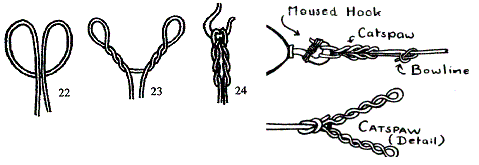
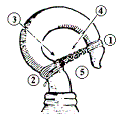
An ingenious but most effective way of hitching a rope to a hook. With this knot, it does not matter whether the rope is wet or dry, rough or slimy: it will not slip or jam, yet it can be cast off immediately. To make the Cat’s paw, take two bights, one in each hand (22). Twist them away from you three full turns (23), put the two bights together and slip them over the hook (24).

Constrictor knot
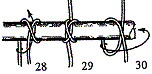
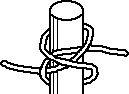
Given the name “constrictor” since, when made, it grips tighter than a boa constrictor. It can be used in practically every case where a binding knot is needed around a convex object or shape. It has one other feature which should be borne in mind – once tied it is often impossible to untie, and you may need a knife to remove it. Fig 28 shows the usual way to tie the Constrictor knot (29). If it is being made near the end of its base, it can be tied as in fig 30. The constrictor knot is important as temporary whipping and as permanent binding from which you need more than one in a row, but not in line. It is almost the strongest among the 'simple' hitches. Only the double constrictor is stronger.

Fireman’s Chair Knot
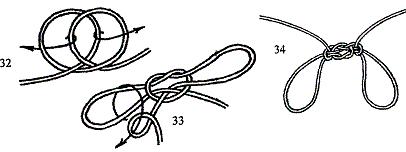
A double loop knot used for lowering an injured person from a height. In use, one end is manipulated from aloft, and the free end is used to control the direction of lowering. Make a Clove hitch in hand (32) and pull the two inner parts through the outer parts as shown by the arrows in the illustration. This gives you two loops with an overhand knot in the centre. Draw out the two loops to appropriate lengths (you may want one larger than the other) and then add half hitches either side of the centre knot, as indicated by the arrow in fig 33. Fig 34 shows the finished knot. In use, the patient, if conscious, might sit in one lop while the other forms a back rest; alternatively, one loop may be placed around the shoulders and up by the arm-pits while the other goes behind the knees, the patient practically lying in the knot.

Highwaymans’s Hitch
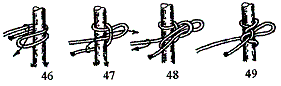
Also known as the Draw Hitch. A useful knot for securing a horse, or a boat, or in self-rescue. The knot will take any strain on the standing part, but spills at once when the end is pulled. Legend tells us that highwaymen secured their horses to any convenient support while about their nefarious business, then, leaping onto their horses, they snatched the end and were away without having to take time to untie the knot. To tie the knot, make a large loop, pass this around the post (46), insert a hand into the loop and pull. The standing part through to form a further loop, taking up all the slack of the first loop (47). Put the hand through this new loop, take hold of the end some way from its extremity and pull through, again taking up the slack of the second loop (48). Pull on the standing part until all is tight (49).


Scaffold Hitch
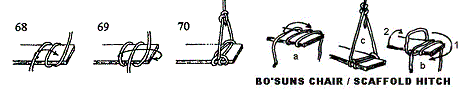
An easy way of slinging a plank to make a platform. Make two round turn inthe middle of the plank, lift the left hand part over the middle part and then the rope which was formerly the middle rope goes over both the other parts of the rope and down under the end of the plank. Then end off with a bowline

Previous Next
Hosted by www.Geocities.ws

1