 Team History
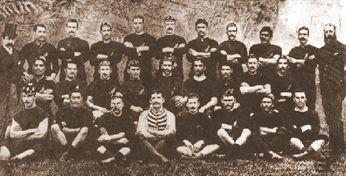
Ever since the original "All Black" team of "New Zealand Natives" led by Joseph Warbrick, the Haka has been
closely associated with New Zealand rugby. It is admired the world over by rugby fans of every persuasion, even if one or two opponents ?notably England's Richard Cockerill in 1997 and the Irish a few years before in Dublin failed to treat the call to battle in the spirit in which it was intended.
In many ways you can examine the Haka ?"Ka mate, ka mate" is the variation most associated with the All Blacks ?and use it to define the team's history and the mark it has left on world rugby.
Fierce determination, commitment and a high level
of skill are combined into a singular approach to the game. But don't forget, the Haka can be used in the welcoming and entertaining of visitors too.
"All Blacks" is not a term confined solely to Test rugby, which can sometimes be confusing for outsiders. A player may earn selection for the All Blacks without playing at Test level. This has probably helped cement the idea of the All Blacks in the public's minds because touring teams to the British Isles and elsewhere have built up an identity based on their collective appearance and achievements, whether playing Tests or not.
How the All Blacks' name came about was the subject
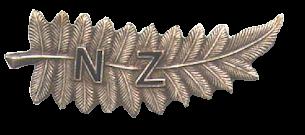
of some debate. The most likely is that a correspondent for the Daily Mail in London in 1905, JA Buttery, coined it because of the team's uniform. The Native side which played 74 matches, an incredible number to modern eyes, in Britain in 1888 turned out in all black playing strip. In 1893, TR Ellison proposed a black jersey with silver fern leaf and a black cap with silver monogram for a New Zealand tour to Australia.
The first official international was against Australia in August 1903 when Billy Wallace, one of the game's immortals, scored the first points. Wallace scored 246 points in 26 matches on the 1905 tour and Jimmy Hunter scored 42 tries. The captain, Dave Gallaher was known for his innovative role as a "rover" outside the scrummage. Just one match of the 32 was lost, 3-0 to Wales and that with a "try" by All Black Bob Deans that never was, and which has caused interest and debate ever since. The referee John Dallas of Scotland was said to be a long way behind the play and Deans later sent him a telegram: "Grounded ball six inches over line. Some Welsh players admit try. Hunter and Glasgow can confirm was pulled back before referee arrived. Deans." On such determination and fortitude was the All Blacks legend built.
The All Blacks received the Springboks in 1921 and returned to Britain in 1924. They had a trial run in Australia which came a cropper with a defeat by New South Wales (later classified as a Test match). At home before departing for Britain they were beaten 14-3 by Auckland. The "worst team ever fielded" was one unkind description. But this team became Cliff Porter's "Invincibles", travelling through the British Isles unbeaten in 28 matches, scoring 654 points to only 98.
The 1930s were years of mixed success ?defeats by England and Wales in 1935 and a lost series at home to the Springboks in 1937. Despite the apartheid bar in South Africa which prevented the selection of Maori players by New Zealand, touring carried on there and in 1949, under Fred Allan, the All Blacks lost all four Tests. A 17 year old full-back called Don Clarke announced himself with six points for Waikato in the Ranfurly Shield in 1951 but he did not achieve Test status until 1956. Clarke's straight-on goal kicking helped him to 207 points in 31 Tests as the All Blacks moved into the 1960s. Great memories included Clarke's six penalty goals in a Test win over the Lions at Dunedin in 1959 and a 60 yard dropped goal against the 'Boks a year later.
At the same time the All Blacks seemed to become less adventurous. It was time for some great forwards to occupy pole position in the hearts of New Zealand rugby fans. Colin "Pine Tree" Meads, said to run up hills with a sheep under either arm, was one typical of the hard-nosed brigade. Meads had his low moments, including being sent off in Scotland, but he won 55 caps and was undoubtedly one of the finest locks of all time.
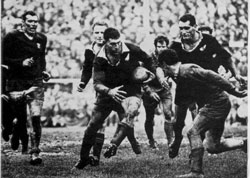
Wilson Whineray, Kel Tremain and Brian Lochore were other colossuses bestriding world rugby at the time. Occasionally they cut loose, as when destroying the Barbarians at the end of the 1963 tour with an outrageous try by Whineray. In 1967 there was a 17-match unbeaten tour of the British Isles, France and Canada, and wins over Australia and South Africa inside the next three seasons cemented the All Blacks as the world's best.
The 1972-3 tourists to the British Isles carried this weight of expectancy and, nothwithstanding the sour Keith Murdoch affair, played some fine rugby in front of an audience increasingly aware of them through the media. Ireland drew with them 10-10 but the other three Tests were won, including against Wales who at the time might have had pretensions to world-beating status.
The production line of kids desperate to wear the black jersey continued to roll through the 70s and 80s. Bryan Williams, Stu Wilson, Dave Loveridge, Bernie Fraser and company proved that All Black back play could be exciting. Up front the generations turned until new maestros such as Wayne Shelford and Michael "Iceman" Jones took their places in All Black folklore.
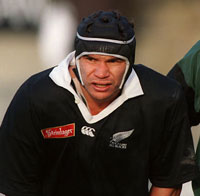 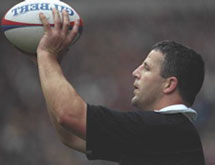
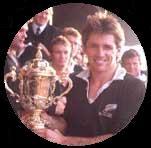
The first Rugby World Cup of 1987, although lacking the isolated South Africans, was a fitting stage for New Zealand to be crowned world champions ?officially. There was scarcely a threat to their path to the final and a 29-9 victory over the reigning Five Nations champions France at Eden Park. Oxford University scholar and scrum-half David Kirk lifted the Webb Ellis Trophy.
The 1991 World Cup team were accused of being uncommunicative but they had quality all the same, and lost to Australia in the semi-final in Dublin. In 1995 new stars like Andrew Mehrtens and Jonah Lomu had emerged but the force was with host nation South Africa in the final.
Now there are wonderfully creative but powerful backs such as Christian Cullen and Jeff Wilson to carry the All Black tradition forward. It is in good hands.
|




