 |
ALL BLACKED OUT! |
|||||||||||||||||||
|
|
|


 The Haka
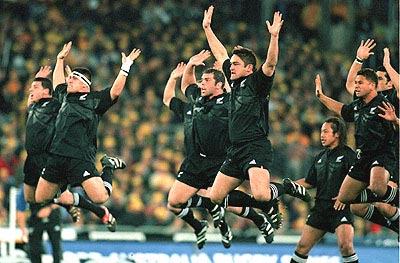
| Ka mate! Ka mate! Ka ora! Ka ora! | I die! I die! I live! I live! |
| Ka mate! Ka mate! Ka ora! Ka ora! | I die! I die! I live! I live! |
| Tenei te tangata puhuru huru | This is the hairy man |
| Nana nei i tiki mai | Who fetched the Sun |
| Whakawhiti te ra | And caused it to shine again |
| A upa ... ne! ka upa ... ne! | One upward step! Another upward step! |
| A upane kaupane whiti te ra! | An upward step, another.. the Sun shines !!! |
| Hi !!! |
| Listen to the All Blacks perform the Haka before a match! |
| Download the MP3 version of
the Haka
Watch the Adidas Haka ad Take a look at this great Haka picture. This picture was taken in 1997 in Australia. |
GENERAL:
For most non-Maori New Zealanders today their knowledge of Haka is perhaps limited to that most performed of Haka called "Ka mate, Ka mate" . Many sports teams and individuals travelling from Aotearoa overseas tend to have the haka "Ka mate" as part of their program.Perhaps the sports team that has given the haka the greatest exposure overseas has been the All Blacks, who perform it before their matches. It has become a distinctive feature of Aotearoa' s premier sports team.
HAKA ORIGIN:
In around 1820 a chief by the name of Te Rauparaha composed Ka Mate, the most well known haka.Te Rauparaha was High Chief of the Ngati Toa and held sway over lands from Porirua right up the Kapiti Coast to Levin or thereabouts, and also Kapiti Island.
"Ka mate! Ka mate!" were the words uttered by Te Rauparaha as he hid himself in a kumara pit from his pursuing enemies, the Ngati Tuwharetoa.
Fleeing for his life he came to Te Wharerangi and asked for his protection. Although reluctant, Te Wharerangi eventually agreed and bid him hide in a kumara pit. His wife, Te Rangikoaea sat over the entrance to it. There are two stories put forward as to why Te Rangikoaea sat over the entrance thus.
The first has it that no male of consequence would ever put himself in a position where he would be beneath the genital organs of a woman. Thus the hiding place would be discounted by the pursuers. Of course Te Rauparaha was willing to forego custom in order to survive.
The second tells that she sat there in order to have a neutralising effect on the incantations recited by the pursuing Chiefs; the female organs were believed to have a shielding effect.
As the pursuers arrived, Te Rauparaha muttered "Ka Mate! ka mate!" under his breath (I die! I die!), but when the Rotoaira chief indicated the man they sought had gone to Rangipo he murmured "Ka Ora! ka ora!" (I live! I live!). However when Tauteka doubted the words of Te Wharerangi he gloomily muttered "Ka mate! ka mate!" once again. Then, when his pursuers were convinced he was not in Te Wharerangi's pa, but had made for Taranaki he exclaimed "Ka ora, ka ora! Tenei te tangata puhuruhuru nana nei i tiki mai whakawhiti te ra!" (I live! I live! For this is the hairy man who has fetched the sun and caused it to shine again!).
The hairy man in the Haka refers to the chief Te Wharerangi who gave Te Raparaha protection despite his wish not to be involved. Te Wharerangi was a man of very noticeable hairy habit.
"Upane", literally means "terrace", and probably refers to the steps which were cut into the side of the pit for access to and from it. Each "upane" describes the tentative steps Te Raparaha made as he emerged from the pit to see if the coast was clear.
One could imagine his joy at not only eluding certain death by a whisker, but also coming out of the dark kumara pit into the light of the day - "Whiti te ra! Hi !"
Going on from the kumara pit to the court yard of Te Wharerangi, before Te Rangikoaea and the assembled people, Te Rauparaha then performed his famous haka, which he had composed whilst in hiding. The variation of this used by the All Blacks is given below, together with the translation. Note that the words have been split in some cases to indicate the cadence of the syllables as the haka is performed.
THE HAKA AND RUGBY:
As far as rugby is concerned the first haka in an overseas representative match was performed by the New Zealand Native Team to tour the UK in 1888-89. It isn't clear whether or not it was Ka Mate which they performed, but it is probable. Apparently at some venues they went to some trouble to entertain, bringing out mats and other items onto the field to complement the performance. In fact this team was not entirely composed of Maori, as many assume. The tour was not 'officially' sanctioned, and cost each player the large sum of 250 pounds passage. This made it impossible to find the required number of Maori, and at least two 'dark-skinned' pakeha were included.The first use of the haka by the All Blacks was by the "Originals" in 1905 on the first overseas tour by a full-scale New Zealand representative side. It was also on this tour that the name 'All Blacks' was used. The two most distinctive features of the New Zealand team were thus instigated right from the very beginning. The haka became a permanent fixture for the All Blacks from then on.
An interesting little anecdote is told regarding the 1924 New Zealand team which became known as the famous "Invincibles", due to their winning every match on tour.
This team had as their most famous son, a young Maori boy called George Nepia. He it was who led the All Black haka, Ka Mate, in the first match against Devon on September 13th, 1924. The haka was enthusiastically received by the crowd of 18,000, who then watched the All Blacks win 11-0, but a "prominent university sportsman" who attended was moved to write a letter which appeared in the next day's paper. In it he asserted: "Cat-calls were quite uncalled-for", and added: "South Africans do not open their games with Zulu cries!". Obviously, this gentleman had never visited either country.
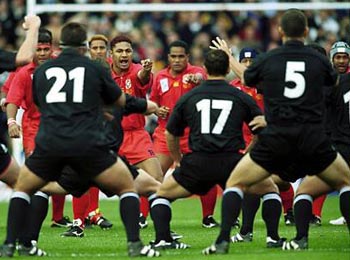
The All Blacks "Haka" and the Tongans "Ikale Tahi"
More Haka Pictures:


