WILD FLOWERS OF THE ALGARVE,
SOUTHERN PORTUGAL
THE MINT FAMILY
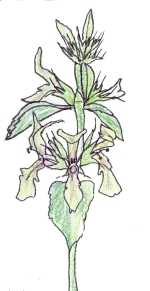 Stachys ocymastrum
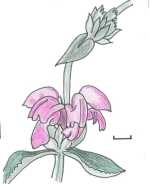
Phlomis purpurea
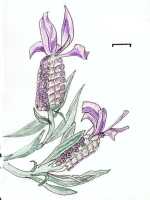
French lavender
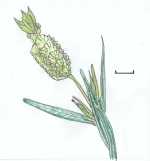
Lavendula viridis |
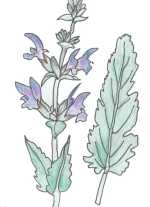
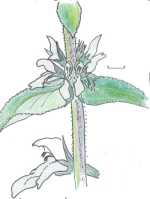
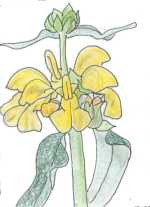
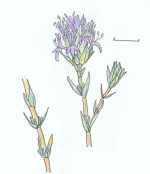
The Mint family (Lamiaceae) is well represented in the Algarve. Usually highly aromatic they are well adapted to the long dry summers. The plants have four-sided stems and simple leaves in opposite pairs. The flowers of these plants are typically two-lipped, the petals forming a corolla tube which divides in two. They are arranged in whorls either in an elongated spike or grouped in a bunch. By the end of March, the sages are in bloom. Salvia officinalis was planted at the side of the roads by the road workers. Its silvery grey leaves and violet flowers produce a striking display. Look for it particularly along the road to Quereca. Now is the time to break off a woody piece and strike it in a pot. By Christmas you will have a healthy plant to provide you with sage for the Christmas turkey stuffing. Salvia verbenaca is a wild species whose leaves have an irregular margin. The Jerusalem sage (Phlomis fruticosa) found in the Eastern Mediterranean is often grown in gardens. A related species Phlomis purpurea, is common here. It has widely spaced whorls of purple flowers. The Horehounds are another group with representatives here. The White Horehound, Marrubrium vulgare is an example which has an unpleasant odour when the leaves are crushed. The Lavenders grow vigorously and by March their brilliant purple spikes of flowers appear. Look carefully at a flowering spike of the common French Lavender. (Lavandula stoechas).The flowers are tiny dark structures under the bright purple bracts. Later in April a green Lavendar blooms. Lavandula viridis grows only in the Algarve and South western Spain. It has pale green bracts and flowers. Small wild thyme bushes are very characteristic of rocky barrocal hillsides. These tough woody little bushes with their tiny needle-like leaves produce a soft display of violet flower heads in late June and July.
|
Wild Clary
White Horehound
Jerusalem Sage
Wild thyme
|
© (Text and Artwork) Irene Shepard 2002 .