WILD FLOWERS OF THE ALGARVE
SOUTHERN PORTUGAL
THE LEGUME FAMILY
|
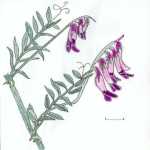
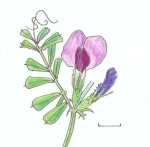
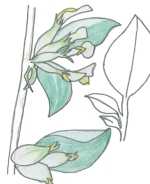
Vicia bengalhensis
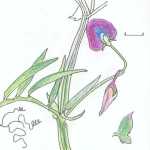
Lathryus Note stipules, tendrils
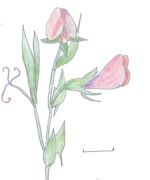
Lathyrus cicera
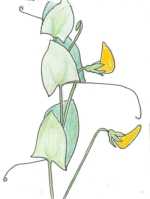
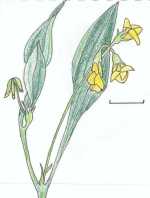
Lathyrus abhaca Note shield shaped stipules |
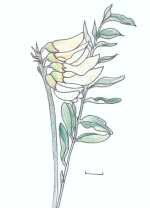
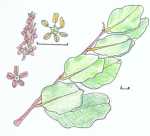
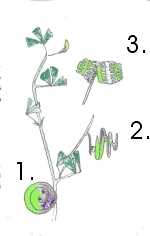
This is another family of flowering plants which is well represented in the Algarve. Legumes are found among the common crop plants, in gardens and parks and in the wild. One of the earliest crops grown in small fields and gardens patches is the broad bean (Vicia fabia). A wild member of the same genera Vicia bengalhensis blooms with furry purple and maroon flowers at the end of March and April. The Carob tree (Ceretonia siliqua) is a member of one branch of this family. This tree has two characteristics common to many legumes: the leaves are divided into leaflets and the fruit is a long dark brown pod. The tree flowers between September and January. Flowers, greenish yellow and reddish brown, are produced on short racemes arising directly from the trunk of the tree. Mimosa trees with their bright yellow pompom flowers are much admired for their brilliance in the Spring. They are all Acacia spp and were planted for a variety of reasons: as a source of tan bark, for pulp paper production and as a dune stabilizer. However they are now recognized as evasive and a risk to local flora. A recent leaflet produced (2002) by the Algarve Regional Director for the Environment (DRAOT) explained how they oould be eradiacated. One of the first of the wild legumes to flower is a small bushy vetch with pinnate leaves, (about 50cms high) with large off white pea type flowers with greenish purple sepals. It is Astragalus lusitanicus. In March when you travel along the highway, IP1, the bushy white broom Lygos monosperma looks magnificent, up to two metres tall and full of white flowers. In March and April the wild sweetpeas, Lathyrus spp start to bloom, A large number of Lathryus are found in south western Europe and are identified by a number of interesting features. The stems of the plants may be winged as in Lathyrus cicera. At the base of the leaf stalk there is a leaf like structure called a stipule. These vary tremendously. The yellow vetchling Lathyrus aphaca has large shield shaped stipules that function as leaves because the leaves have been changed structurally into tendrils. Tendrils are common in the genera, often replacing leaflets at the end of a pinnate leaf. These plants are also identified by their characteristic pods. One genera, whose species become noticeable only when seed pods form, are the large Disc Medick and the Toothed Medick (Medicago spp). The two species found in the Barrocal have tiny (1-2 mm) yellow flowers but produce pods about a centimetre in diameter,Medicago orbicularis like a small Chinese lantern (1 and 2) and Medicago polymorpha a prickly spiral hedgehog!(3) The bladder vetch, Anthyllis tetraphylla has yellow flowers and a silky, calyx which inflates after the flower is fertilized and the fruit forms. This species has leaves made of three leaflets, the terminal one the largest. Finally a related pair of species, Scorpiurus muricatus and vermiculatus flower with bright yellow flowers in April. The former bears flowers in groups of three or four and the latter solitary ones. |
Astragalus lusitanicus
Carob leaf and flower
Lathyrus
Medick 1.& 2. M. orbicularis 3. M.polymorpha
Bladder Vetch |

© (Text and Artwork) Irene Shepard 2002 .