Destination
BALI PULAU DEWATA
General Information About Bali
Bali is a land that seems to have a magnet at its very heart. It is a feeling that is difficult to understand unless experienced but once visited you are surely compelled to come back and you may even want to stay forever, such is its pull. Maybe its Bali’s beauty, maybe the friendly people, or maybe even the influence from spirits that certainly abide in this place. Bali goes under many names. Some call it the ‘island of the gods’, others Shangri-La. The ‘last paradise’, the ‘dawning of the world’ and the ‘centre of the universe’ are yet more names for this truly beautiful tropical island inhabited by a remarkably artistic people who have created a dynamic society with unique arts and ceremonies.
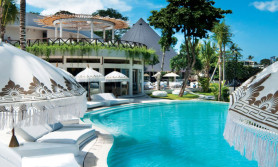
Bali is small, just 140 Km by 80 Km and lies between Java, the most highly populated and influential of all the islands, and Lombok, one of the quieter and moderately slower paced islands. Like many islands, Bali has developed a world of its own. It not only captures what is special about Indonesia but also has a uniqueness of its own. Daily life on Bali is culturally linked to satisfying and appeasing the gods, spirits and demons in the midst of breathtaking panoramas of cultivated rice terraces, impressive volcanoes and pristine beaches. Bali’s main volcano, Gunung Agung, is still active and sometimes explosive and is considered sacred among local people as it is believed to be the centre of the universe.
Lying just 8o south of the Equator, Bali can boast a tropical climate with just two seasons a year and an average temperature of around 28o Celsius. It has a whole range of different environments and activities for the tourist, many of which are covered in these homepages.
Economically and culturally, Bali is one of the most important islands of Indonesia. Rice is grown on irrigated, terraced hillsides; other crops include sugar cane, coffee, copra, tobacco, fruits and vegetables. Cattle and hogs are also raised. The Balinese are skilled artisans, particularly in woodcarving and in fashioning objects of tortoiseshell and of gold, silver and other metals. The Balinese are noted for their traditional dance, the distinctive music of the gamelan and for their skills in weaving cloth of gold and silver threads, Songket, as well as for embroidering silk and cotton clothing. Bali of today is one of the twenty six provinces of the Republic of Indonesia, divided administratively between eight districts that take their names and boundaries from the island’s old Hindu kingdoms.
RAJA AMPAT
Geography Of Raja Ampat
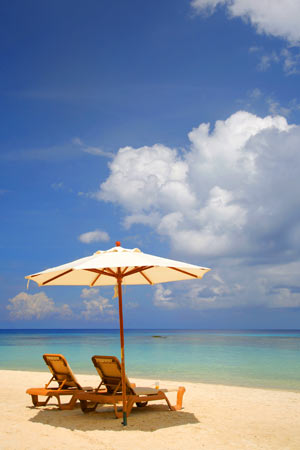
The name of Raja Ampat comes from local mythology that tells about a woman who finds seven eggs. Four of the seven eggs hatch and become kings that occupy four of Raja Ampat biggest islands whilst the other three become a ghost, a woman, and a stone. History shows that Raja Ampat was once a part of Tidore Kingdom, an influential kingdom from Maluku. Yet, after the Dutch invaded Maluku, it was shortly claimed by the Netherlands. The main occupation for people around this area is fishing since the area is dominated by the sea. They live in a small colony of tribes that spreads around the area. Although traditional culture still strongly exists, they are very welcoming to visitors. Their religion is dominantly Christian.
The oceanic natural resources around Raja Ampat give it significant potential as a tourist area. Many sources place Raja Ampat as one of their top ten most popular places for diving whilst it retains the number one ranking in terms of underwater biodiversity. According to Conservation International, marine surveys suggest that the marine life diversity in the Raja Ampat area is the highest recorded on Earth.[2] Diversity is considerably greater than any other area sampled in the Coral Triangle composed of Indonesia, Malaysia, Philippines, Papua New Guinea, Solomon Islands, and Timor-Leste. The Coral Triangle is the heart of the world's coral reef biodiversity, making Raja Ampat quite possibly the richest coral reef ecosystems in the world.
The area's massive coral colonies along with relatively high sea surface temperatures, also suggest that its reefs may be relatively resistant to threats like coral bleaching and coral disease, which now jeopardize the survival of other coral ecosystems around the world. The Raja Ampat islands are remote and relatively undisturbed by humans.
The high marine diversity in Raja Ampat is strongly influenced by its position between the Indian and Pacific Oceans, as coral and fish larvae are more easily shared between the two oceans. Raja Ampat's coral diversity, resilience, and role as a source for larval dispersal make it a global priority for marine protection.
1,508 fish species, 537 coral species (a remarkable 96% of all scleractinia recorded from Indonesia are likely to occur in these islands and 75% of all species that exist in the world), and 699 mollusk species, the variety of marine life is staggering.[3] Some areas boast enormous schools of fish and regular sightings of sharks, such as wobbegongs.
Although accessing the islands is not that difficult, it takes some time. It takes six hours flight from Jakarta, the capital city of Indonesia to Sorong. Then, taking a boat to reach the islands is necessary.
LOMBOK
The beautiful Of Lombok Island
Little is known about the Lombok before the seventeenth century. Before this time it was made up of numerous competing and feuding petty states each of which were presided over by a Sasak 'prince'. This disunity was taken advantage of by the neighbouring Balinese who took control of western Lombok in the early seventeenth century. The Makassarese meanwhile invaded eastern Lombok from their colonies in neighbouring Sumbawa. The Dutch had first visited Lombok in 1674 and the Dutch East India Company concluded its first treaty with the Sasak Princess of Lombok. The Balinese had managed to take over the whole island by 1750, but Balinese infighting resulted in the island being split into four feuding Balinese kingdoms. In 1838, the Mataram kingdom brought its rivals under control. Relations between the Sasak and Balinese in western Lombok were largely harmonious and intermarriage was common. In the island's east, however, relations were less cordial and the Balinese maintained control from garrisoned forts. While Sasak village government remained in place, the village head became little more than a tax collector for the Balinese. Villagers became a kind of serf and Sasak aristocracy lost much of its power and land holdings.
uring one of the many Sasak peasant rebellions against the Balinese, Sasak chiefs sent envoys to the Dutch in Bali and invited them to rule Lombok. In June 1894, the governor general of the Dutch East Indies, Van der Wijck, signed a treaty with Sasak rebels in eastern Lombok. He sent a large army to Lombok and the Balinese raja capitulated to Dutch demands.(see Dutch intervention in Lombok) The younger princes however overruled the raja and attacked and routed the Dutch. The Dutch counterattacked overrunning Mataram and the raja surrendered. The entire island was annexed to the Netherlands East Indies in 1895. The Dutch ruled over Lombok's 500,000 people with a force of no more than 250 by cultivating the support of the Balinese and Sasak aristocracy. While the period was one of deprivation for the Sasak, the Dutch are remembered as liberators from Balinese hegemony. During World War II a Japanese invasion force comprising elements of the 2nd Southern Expeditionary Fleet invaded and occupied the Lesser Sunda Islands, including the island of Lombok. They sailed from Soerabaja harbour at 09:00 hrs on 8 March 1942 and proceeded towards Lombok Island. On 9 May 1942 at 17:00 hrs the fleet sailed into port of Ampenan on Lombok Island. The Dutch defenders were soon defeated and the island occupied.
Following the cessation of hostilities the Japanese forces occupying Indonesia were withdrawn and Lombok returned temporarily to Dutch control. Following the subsequent Indonesian independence from the Dutch, the Balinese and Sasak aristocracy continued to dominate Lombok. In 1958, the island was incorporated into the province of West Nusa Tenggara with Mataram becoming the provincial capital. Mass killings of communists occurred across the island following the abortive coup attempt in Jakarta and Central Java. During President Suharto's New Order administration, Lombok experienced a degree of stability and development but not to the extent of the boom and wealth in Java and Bali. Crop failures led to famine in 1966 and food shortages in 1973. The national government's transmigrasi program moved a lot of people out of Lombok. The 1980s saw external developers and speculators instigate a nascent tourism boom although local's share of earnings was limited. Indonesia's political and economic crises of the late 1990s hit Lombok hard. In January 2000, riots broke out across Mataram with Christians and ethnic Chinese the main victims, with alleged agents provocateur from outside Lombok. Tourism slumped, but in recent years has seen a renewed growth.