|
|
|
|
Partner Selection criteria for International Joint Ventures Selecting partners with compatible skills is not necessarily synonymous with selecting compatible partners. This article identifies and discusses several criteria executives may employ when evaluating suitability if partners for joint ventures with a long term, non-transitional orientation. Business history is strewn with stories of joint ventures going sour and with negative consequences for both parties. According to one estimate more than 50% of joint ventures fail due to various reasons. It is therefore important to understand various factors which are necessary to build a successful Joint Venture. Establishing a long lasting joint venture is a complex endeavor and compatibility between partners is only one variable influencing that process. Although selecting a compatible partner may not always result in a successful joint venture, selection of an incompatible partner virtually guarantees that venture will fail. Defining a set of criteria for selecting the "right" partner is analogous to telling a person how to pick a right spouse - certainly a difficult proposition. Yet there seem to be common elements to many successful joint ventures that provide us the guidelines for selecting partners:
Complementary Technical skills and resources The primary selection criterion should be a partner's ability to provide the technical skills and resources which complement those of a firm seeking the partner. Of prospective partners cannot provide these capabilities, then formation of a JV is a questionable proposition. Therefore, technical complementarily should be viewed as a minimum qualification for selecting a partner. Technical complementarily is determined by analyzing the key success factors - those few areas strongly influencing commpetitive position and performance - confronting the proposed JV. Evaluation of your firm's current and anticipated competitive position relative to these factors should then be performed. Areas where deficiencies exist can serve as the basis for assessing technical complementarily of a partner. However, the analysis should identify more than merely a financial deficiency; such resources are often be accessed via other options which will not entail the extensive managerial involvement of a partner. Although initially appealing. a JV based solely on a partner's financial contribution is unlikely to foster long term compatibility. Technical complemantarity can assume many forms. A common alliance consists of one parent's supplying technology and another's furnishing marketing capabilities. For example, Wipro-GE alliance to sell medical diagnostic systems in India. Wipro provides the marketing capabilities while GE provides the technology. Strategic analysis of the JV suggests that both firms are established and recognized players in their areas. This technical complementarity builds a stable relationship based on mutual dependency. Mutual Dependency: A Necessary Evil Seeking a partner with complementary technical skills and resource can permit each partner to concentrate resources in those areas where it possess the greater relative competence while diversifying into attractive but unfamiliar business areas. Rather than intensifying weaknesses, JVs can thus be a means of creating strengths. Many managers view dependency on other organization as undesirable, however, and have avoided such situations when possible. Yet, with proper matching, both partners should perceive a vested interest in keeping the JV working rather than resorting to some non-JV form of investment. There should be some identifiable mutual need, with each partner supplying unique capabilities or resources critical to JV success. When one partner is strong in areas where the other is weak and vice versa, mutual respect is fostered and second guessing and conflict can be mitigated.
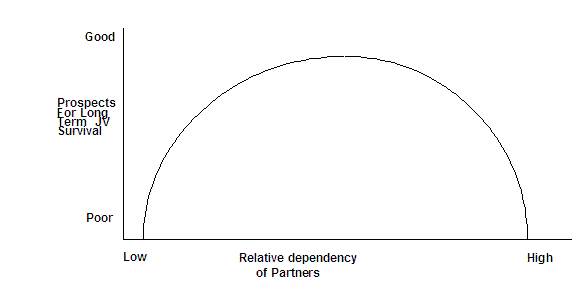
There should be a "middle level" of dependency between partners. If the level of dependency is too small, the JV is unlikely to survive difficult times. Yet, too much dependency, such as when small firms enter JVs with much larger partners, may prove unstable because of potential consequences of loss of a partner. JV termination might severely disable the small firm by causing customers, employees, and stock market to question the firm's viability. The resulting damage to its reputation could cause a precipitous decline in its stock value, harm morale, and limit the available strategic options. Painful lessons about relative dependency of partners were learned by several Indian firms which, in the late 80's and 90's formed JVs with Japanese, European and American firms as a means to acquiring new technology while they provided the market knowledge and marketing skills. Frequently, larger firms which provided the technology and capital for the JV would buyout their Indian partner and dissolve the JV. Example:- Godrej and P&G formed a JV which was dissolved when Godrej's brand was being neglected soon after P&G learnt the market skills to sell in India. Numerous options are available to help ensure that partners will continue to perceive themselves as mutually dependent. One method is to establish some means of "exchanging hostages". For instance, the JV agreement might stipulate that a unilateral decision to break up the JV will result in a substantial charge of some sort, ("alimony" payments) as well as covenants against engaging in competitive activities within a specified time period. The agreement might also guarantee cross purchases of specified volumes of products or services by partners. This option can reduce the impact of a breakup upon a more dependent firm by guaranteeing access to critical raw materials or sales revenues during the painful readjustment period. By employing techniques such as these, threats posed by dependency on a partner can be reduced substantially. Relative Company Size: The Elephant and the Ant complex JV's often have the best chance of long term success if both parties are comparable in sophistication and size, preferably large. If a small firm decides to enter into a JV with a similarly sized partner, the firms may magnify each other's weakness. This is less often the case between two large firms, which are likely to have similar values and control systems, similar tolerances for losses, and similar appetites for risk. Crisis are less common in large firms, particularly in regard to short-term cash flow. Thus, larger companies typically offer greater "staying power" being able to commit a greater volume of resources over a longer time horizon. Yet there are numerous exceptions of successful JVs between firms of different sizes. A smaller firm with unique capabilities may venture with a large corporation to exploit new opportunities which otherwise was impossible to exploit it alone. When size differences are significant, dubbed as "The elephant and the ant complex", managers must be aware of problems which could result. One common concern is the possible domination of one firm over the other. A relative problem is that partners' different operational environments and corporate cultures might appear to be incompatible. For instance a large fortune 20 company might have a bureaucratic environment with a relatively slow decision making process and a voracious appetite for information gathering and analysis, which contrasts sharply with a startup with a quick response orientation. A JV between the two can potentially run into problems if smaller firm feels paralyzed by the seemingly glacial pace at which the larger firm operates. The larger firm could perceive that it bears most or all of the risk. A JV between companies of widely different sizes often necessitates creation of special environment in order to foster successful venture development. For instance, effects of partner size difference might be reduced by giving the JV virtually a free hand in product development or other activities, minimizing administrative red tape, and permitting quicker response time. This emphasis on autonomy is particularly appropriate for ventures which confront rapidly changing environments, where slow response would be akin to a kiss of death. Willingness of a partner to allow this autonomy might be a critical consideration in the partner selection decision. The relevant measure of partner's size is not absolute corporate size, but relative size of the respective business units. Therefore managers should seek partners of similar size at the business or division level. Another option for minimizing effects of size difference is for a small firm to identify a large firm which has the financial muscle and appetite for a successful JV. This requires a greater diligence in identifying and contacting partners, however since these are attributes which tend to found in certain individuals or business units rather than in an organization as a whole. Yet, their presence helps to ensure the larger partner will be sufficiently aggressive to maintain respect from customers and competitors. As will there is greater likelihood that both partners will have similar perception of time as a vital component on the JV's success. Avoid Financial Dependency When contemplating a JV, be sure the prospective partner can generate sufficient financial resources to maintain the venture's efforts. Managers frequently note their avoidance of potential "anchors" -- partners likely to slow venture growth and development due to inability or unwillingness to provide their share of the funding. It must be noted that partners will always have differences of opinion regarding expansion. A small company may have fewer financial resources available for shouldering its portion if an expansion or to pay a higher financing rate than does the larger partner. This can not only cause operating problems, but might also result in bruised egos, which can further intensify the difficulty. Although not always possible to identify, several symptoms might indicate potential "anchors." Partner's financial balance sheets is usually a good indicator. A partner's resource constrains can constitute a significant hurdle to establish a successful JV. If precautions are observed, a partner with meager financial resources need not prevent a JV failure. JV agreements may include penalties if either partner attempt to sidestep its financial obligations. The agreement may dictate a buyout of the other partner in such cases along with covenants stipulating that the firm cannot engage in similar activities for a specified time period. These mechanisms can reduce undesirable effects of an "anchor" upon JV activities. Strategic Complimentarity: A Prerequisite for Long Term Success Although a major concern, relative size tends not to be as important as achieving a fit between partners' strategic goals for the JV. Form the onset of discussions, each partner must try to understand what other participants desire from the JV. Having different objectives in forming the JV, including the timing and level of returns on their investments, frequently produces conflicts of interests among partners. As partners' objectives diverge, there is increasing risk of dissatisfaction and associated problems. The risk may be heightened when the JV's environment is characterized by a high level of uncertainty, since, under the circumstances, changes on a JV's operations are most likely. Unexpected events can cause problems because of the difficulty on formulating a mutually acceptable response to change. A power game can result and the JV can collapse id the partners cannot reach agreement on an appropriate course of action. Divergence of corporate goals of the parent organizations, however can lead to a JV's downfall even if the performance of JV is satisfactory. For example Dow-Badische was formed in 1958 as a 50/50 JV between BASF and Dow Chemicals and was profitable over much of its life. Nevertheless, despite $300 million in annual sales, the JV was dissolved. BASF wanted to expand the venture, but, since the JV's activities did not fit the firm's strategic focus, Dow was reluctant to contribute additional funds. This gap between corporate goals prompted BASF to buy out Dow's share in 1978 and transform the JV into a wholly owned subsidiary. Although determining a prospective partner's objectives is often difficult task, it is essential. Failure to do so increases the prospects for later problems. The analysis needs to address not only the firm's current situation and goals, but also scenarios of its likely future position. JVs frequently encounter changes in their operating environments and it is essential to anticipate how a partner is likely to be affected by, and respond to, these changes. JVs tend to work only as long as each partner believes it is receiving benefits of is likely to benefit in the relatively near future. Operating Policies: Compatibility and fit Another consideration during partner selection is similarity of partner's operating policies. There are several instances of JV being dissolved because of inconsistencies between partners' accounting systems, employee benefits policies, debt-to-equity ratios, cultural biases etc. Differences in operating policies in an international JV are often due to cultural biases. Often times one partner wants the JV to follow its methods even of the JV is located in another country. Often times, US firms want their JVs to adapt American policies even if the JV is located outside US. Such cultural imposition leads to friction and eventual collapse of the JV. To overcome this, operating policies must be agreed upon before forming the venture. Communication Barriers International Joint Ventures often suffer from cultural biases and communication barriers. JVs tend to be fragile, communication problems tend to make operations even more difficult, more so when differences between national and ethnic cultures, including language, as well as corporate cultures exists. Because of cultural or language differences, subtle nuances might be more difficult to communicate, leading to greater expenditures of time in negotiations, delaying decisions and business transactions. For example, Director of operations sent a fax to his factory manager in Lima, Peru which said "Please send a head count of the people in your factory and in your office, broken down by sex. Information needed urgently." The Local factory manager, a Peruvian, replied as follows: "Here is your head count. We have 30 in the factory, 15 in the office, 5 in hospital on sick leave, none broken down by sex." The Peruvian manager added "If you must know, our problem here is with alcohol." The above example shows that even with a common language, communication can be difficult at times. Cultural barriers should be considered when evaluating prospective partners, especially when forming International Joint Ventures. Cross cultural training must be provided for managers and employees to avoid cultural communication blunders and barriers. Compatible management teams Management team at the helm of the JV plays a major role in its success. Personal rapport between principal decision makers is often important as it helps nurture the level of understanding necessary for a successful JV. Managerial compatibility can enhance the partners' ability to achieve consensus on critical policy decisions and to overcome roadblocks encountered during the JV formation and operation. In many cultures, establishing a personal rapport is the essential first thing in business before agreeing on anything. JV with firms in Mexico, Brazil, other Latin American countries, Japan, China, and Asia establishment of close personal rapport is customarily prerequisite to concluding business negotiations. It may seem unfortunate for a western manager that JVs are so heavily dependent on personal relationships, when attrition among key managers can hinder establishment and maintenance of close relations among partners' managers. To reduce prospects for such difficulties, firms should look for continuity among the critical personnel within a partner's management team. Trust and Commitment between partners Forming and operating a JV over a long term requires more than cordial relations between partner's management teams. The partner's perceived trustworthiness and commitment are also pivotal considerations, especially if the proposed JV involves firm's core technologies or other proprietorial capabilities which are the essence of the firm's competitive advantage. It must be remembered that today's partners could be tomorrow's competitors and managers have to react with some initial distrust regarding potential partners' motives. As one CEO noted, "You've got to be sure you're working with earnest and ethical people who aren't trying to undermine your company. Usually, a partner will have access to your trade secrets. He might attempt to complete a few projects, learn what you do, then exclude you from future deals." Exposing its technological core to a partner without adequate legal protection (Patents, copyrights etc.) from technological theft can threaten a firm's competitiveness. Western firms try to solve this potential problem by seeking majority control of the JV, and have lawyers structure the JV agreement to address every conceivable contingency. While these strategies might work when dealing with western firms, Asians firms view this as evidence of mistrust, thus threatening the venture from the start. Asian managers experienced in JV emphasize the building of mutual understanding and trust, which make the formal written agreement more a symbol of commitment to cooperate than an actual working document. Managers in JV must know that partners' will start looking into the legal agreement only when there is a sign of trouble and indicates the start of relationships breaking down. Also, irrespective of the written agreement, enforcing all the terms in that agreement via court of law may turnout to be very expensive and in some nations impossible. A partner may be able to muster a virtual army of lawyers making it very expensive for the other partner to take a grievance to court. Therefore, each partner needs to be comfortable that the other will honor the spirit, not just the letter, of the agreement. A JV relationship is delicate at best and complicated at worst. Without fundamental trust and commitment by each party, there is little hope for a successful working relationship. Closing Thoughts The preceding discussion presents a rather long list of criteria, but experienced managers probably can add others. In International JV, cultural differences and communication barriers have to be given extra attention. The criteria discussed above are very much relevant to International Joint Ventures and provides a foundation for identifying and evaluating the potential long term compatibility of prospective JV partners.
|